

Uji Genmaicha 100g
Genmaicha generally has a rather casual image: an inexpensive tea, something you can pick up at any supermarket, a tea made by processing bancha, and so on. Yet after running a tea shop for many years, one thing we noticed is that genmaicha has a surprisingly large following. It goes especially well with meals. And the sense of comfort people get from a cup of genmaicha may well reflect the deep relationship between the Japanese and rice. So HOJO decided to make an exceptionally delicious genmaicha of a kind you cannot normally find.
Developing a genmaicha with real body
The green tea used in typical genmaicha is usually bancha (tea harvested at the end of spring), and as a result it has almost no body. This is the main reason genmaicha comes across as light. Our aim, then, was to raise the body of the tea and thereby increase the satisfaction in each cup and the lingering aroma.
Made with Uji Sencha Mt. Jubu
The tea we used is "Uji Sencha Mt. Jubu," one of the most popular teas in HOJO's Japanese tea lineup. It is a native-seed (zairai) tea grown by natural farming at around 500m elevation on Mt. Jubu. It is characterized by strong body and the soft, rounded fullness peculiar to aracha (unrefined tea). We blended this full-bodied tea with roasted brown rice.
Traditional method, with the rice kept modest
With genmaicha, the usual way to lower costs is to mix in a larger proportion of rice, since rice costs less than green tea. HOJO set the blend ratio with aroma as the priority. As a result, the rice is blended in a smaller quantity than the green tea. Some genmaicha contains popcorn-like puffed rice, but this is added purely for appearance. Old-fashioned, traditional genmaicha is made with roasted brown rice alone. The reason this tea is priced lower than Uji Sencha Mt. Jubu is simply that rice costs less than tea leaves.
What follows is the description of Uji Sencha Mt. Jubu.
For an intensely deep finish and a sweet lingering aftertaste, we insisted on natural farming without fertilizer
Mt. Jubu is a 682m mountain located between the towns of Ujitawara and Wazuka. In ancient times this area lay at the bottom of Lake Biwa, so the whole district is rich in clay-based red soil.
In sourcing this tea, beyond the ideal environment of Mt. Jubu, we chose leaves from natural farming. Natural farming means giving no fertilizer or pesticides and letting the plants grow slowly, sturdy and wild, just like the mountain vegetables that grow on the hillsides.
In modern agriculture, fertilizer is considered indispensable for tea production. But tea saturated with fertilizer keeps growing excessively and accumulates large amounts of amino acids, while the polyphenols and minerals, the bioregulatory substances that are the essence of flavor and quality, become very thin, and the tea tastes bland. Because most Japanese tea on the market is so weak in flavor from an excess of amino acids, it is fired heavily to bring out a roasted aroma and give the tea some character. But a truly good tea is one that impresses you even when you simply eat the raw leaf. The "tea rich in theanine" that books cite as if it were synonymous with good tea means, in other words, tea saturated with nitrogen fertilizer, and by my definition it is the opposite of delicious. Words alone are not very persuasive, but if you actually compare raw leaves in the tea garden, the difference is obvious at a glance. When we considered this year's new products, before any discussion of how to process the tea, we were uncompromising in selecting the raw material. By obtaining good raw material, we achieved a tea that is fully delicious even with almost none of the firing that is standard practice in the Japanese tea industry.
1. "Aracha" with the fresh aroma of tea just made
Tea that has just come out of processing after picking is called aracha.
Normally, the aracha then has foreign matter, dust, and stems removed and is fired to become the final product (shiage-cha, or finished tea).
As for this firing step, if the raw material itself is of high quality, there is no need to fire it at all. Tea from high-quality raw material has a deep flavor and tastes of tea itself, so the more it is fired, the more its character fades.
By contrast, tea grown under the full influence of modern agriculture, with excessive nitrogen fertilizer, has so little polyphenol and mineral content that it has almost no flavor or sweetness. With tea like this, unless it is fired to give it a toasty aroma, it has no character at all. I believe the culture of heavy firing arose in the first place as a way to give some character to tea that is low in minerals and thin in taste.
With naturally farmed tea, the material itself is so good that it tastes wonderful even as unfired aracha. In fact, most tea farmers prefer aracha. They understand very well that aracha is delicious, and they seem to draw a line: good-looking finished tea for gifts, aracha for the family.
We are presenting two teas here. Both are the same tea, but the finishing differs slightly.
Uji Sencha Mt. Jubu
This is complete aracha; we removed foreign matter and dust and simply reduced the moisture before packaging. Not fired at all, this tea straight from processing is packed with an oxygen absorber so we can deliver the aroma of tea just made.
Uji Sencha Mt. Jubu Seikō Finish
This is complete aracha, with foreign matter and dust removed, then lightly fired in the Kyoto style. The fire aroma is barely perceptible, but compared with the aracha the fragrance is slightly tighter and more defined.
The two teas above are equally fine and hard to choose between; pick whichever suits the occasion.
2. We deliberately left the stems in, to preserve the tea's natural aroma.
In Japanese tea, the stems are yellow and therefore stand out.
In modern tea processing it is taken for granted that stems are always removed. Removing them yields beautiful green leaves, so in the appearance-driven Japanese tea industry, stem removal is the most basic of basics.
However, HOJO deliberately does not remove the stems. Through numerous experiments we realized that the presence of stems is extremely important. Stems are rich in minerals and have a very sweet aroma. Anyone who has tried a stem tea like karigane will know: stem tea is very sweet!
Still, we are talking about only around 10 stems per serving (3-5g). Can that small amount really change how the tea tastes?
To judge the effect of the stems, we compared tea from which the stems had been removed by hand (with tweezers) against tea with no stems removed.
The difference in aroma surprised even us. Everyone who tasted them, without exception, found the tea with stems more delicious, a startling result. The tea without stems became sharper in aroma, and the soft, sweet floral fragrance was dramatically weakened.
As an aside, in the old days it was said that a tea stem standing upright in your cup was a sign of good luck.
But tea today contains no stems to stand up. In other words, luck has nothing to do with it; there is simply no way for a stem to stand.
People in the past knew how good the stems tasted and were in the habit of drinking tea with stems in it.
In today's appearance-first world, the stems are removed even at the cost of aroma and flavor.
3. Grown at 600m, an exceptionally high elevation for Uji tea.
The tea garden sits high enough that snow settles in winter. Since this area was once the bed of Lake Biwa, good red soil has accumulated at the higher elevations, producing iron-rich tea with a deep finish in the throat.
At the foot of the mountain, by contrast, the terrain was carved out by river erosion and contains a lot of sand, so the tea tends to be thinner in taste.
At high elevation, the tea receives stronger sunlight in the daytime and its cells photosynthesize actively. At night, on the other hand, the temperature drops very low, so the tea stops growing and instead stores up plenty of polyphenols and minerals. Highland vegetables are richly flavored and delicious, aren't they? Tea is the same: tea grown high up has a concentrated taste and a deep finish.
4. We wanted a tea with a sweet, lingering aftertaste, so we source from a completely naturally farmed garden.
The moment you swallow this tea, you will be struck by a sensation entirely different from ordinary tea.
The tea slides smoothly down as if drawn into your throat, seeming to sink into your chest, and afterward a wonderfully pleasant sweetness spreads from the base of the tongue to the back of the throat. This is exactly the sensation characteristic of top-grade teas that win prizes at competitions in China. Overseas, a tea like this would command a ferociously high price, but because Japan's quality standards have developed in isolation, we were able to obtain it at a very realistic price.
Put simply, the definition of a good tea is one that tastes "concentrated." Concentrated means having body, a taste you can feel fully deep in the throat.
Brew cheap tea strong with lots of leaves and the astringency and bitterness will increase, but it will not become "concentrated." Uji Sencha Mt. Jubu has concentration in this sense. Even brewed with a tiny amount of leaf, the water itself tastes richer, giving a deep sense of satisfaction. It is the same principle as high-grade kombu, which need only be passed through water. Naturally, drop a single leaf of this tea into miso soup and you get a soup with the deep flavor of shijimi clam miso soup. No clam aroma, of course. Good-quality tea reveals its deliciousness even if you drink it holding your nose. Delicious tea has a soft, deep taste in itself, so it tastes good even without aroma.
Try dropping just one leaf into orange juice, beer, yogurt, Coca-Cola, or coffee.
Just try it, even if you think it sounds absurd! You will experience a transformation in taste beyond anything common sense would suggest.
This curious ability comes from the minerals, especially iron ions, that the very fine cells of the leaf release in abundance.
This tea has none of the amino-acid aroma so typical of recent Japanese tea; its fragrance is so clean and refreshing you might almost take it for an oolong. It is a perfect tea for oolong lovers as well.
5. In search of the golden tea garden
There is a tale you occasionally hear from old people in tea-producing regions.
"Long ago, I once saw a golden tea garden..." I have heard them say that the tea from that golden garden was extraordinarily delicious, and that they have never forgotten the taste. I spend two months a year in tea-producing regions of China and visit the domestic regions frequently. Naturally, I have seen golden tea gardens many times. It is very rare in Japan, but when natural farming, good red soil, and the ideal environment coincide, a garden of yellow tea leaves is born.
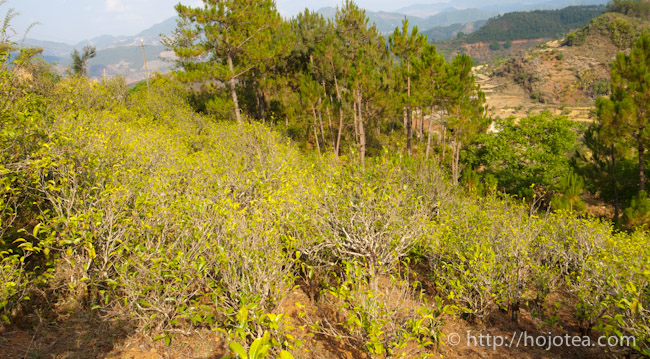
The photo above shows tea trees grown by completely natural farming by an ethnic minority community in Yunnan Province, China. A magnificent sight, truly living up to the words "golden tea garden."
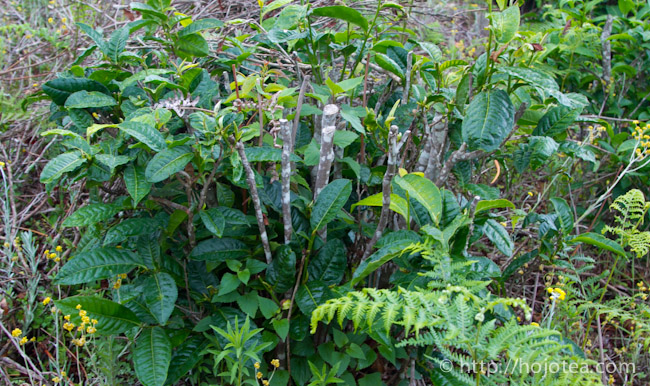
Wild plants growing in nature are routinely short of nitrogen. There simply is not that much nitrogen in the natural world, and so wild plants grow slowly, over a long time, becoming healthy plants rich in minerals and in polyphenols, their biological defense substances. The photo below shows wild trees in summer. Wild plants in a sunny spot are yellow-green all over!

In modern tea farming, nitrogen fertilizers such as nitrates are used heavily. Once nitrogen fertilizer goes in, the tea concentrates on growing. The leaves turn deep green and glisten as if they had been waxed.
In a sense it is like a person who eats nothing but meat dishes and is on the verge of metabolic syndrome. By contrast, tea leaves grown almost exactly like wild plants are small and yellow, and the tea trees take on a whitish cast.
If you have the chance, go out into nature and observe the colors of the plants. Plants growing in the wild are yellow-green.
Plants growing in a fertilized field, on the other hand, are deep green.
 |
 |
|
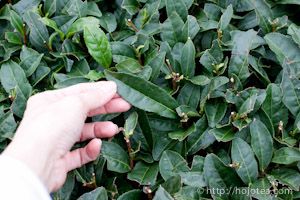
Tea grown with nitrogen fertilizer
The leaves are very large, pleated, and dark green. |
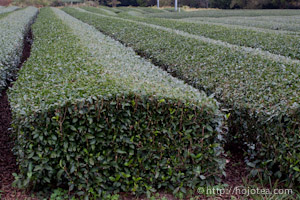
A typical tea garden
Growing tea this way increases the following year's yield. The leaves are deep green throughout, in stark contrast to the photo of wild plants above. |
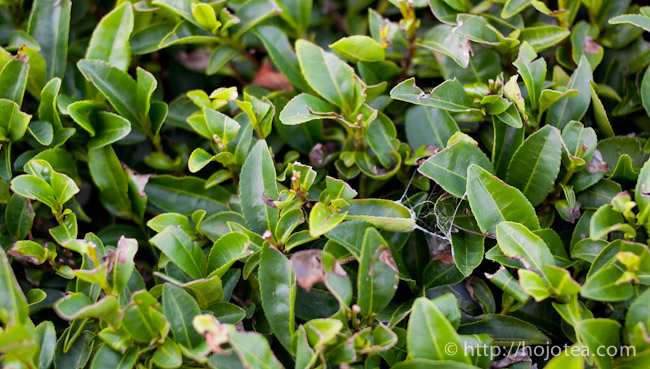
Naturally farmed tea: the bushes are leveled in autumn, but only the very tips are trimmed. The leaves are all small, yellowish, and springy. Put a mature leaf like the one in the photo in your mouth and there is almost no astringency, only a sweetness felt in the throat.
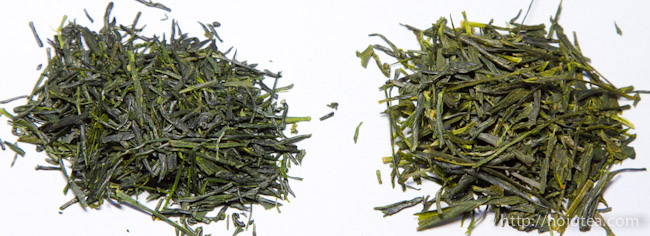
Look at the two photos of tea leaves above. Wouldn't you normally assume the tea on the left is the better quality? Tea grown without any nitrogen fertilizer has yellow leaves, and the liquor itself is yellow-green. At first glance it looks like oxidized tea, but it is this yellow from the moment it is made. And how sweet this tea is: it is exactly the sweetness of eating wild tara-no-me (angelica tree buds).
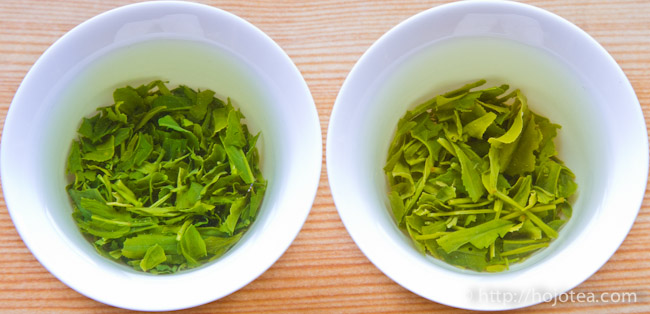
On the left is tea generally regarded as good; on the right is the naturally farmed tea HOJO chooses. Its hallmark is the same yellow color as wild plants.
The blind spot of organic farming
The idea that organic means healthy and organic means delicious is everywhere these days.
Organic farming is certainly reassuring where pesticides are concerned, but that has no bearing whatsoever on "delicious" or "good for you."
If you truly want to produce delicious vegetables, fruit, or tea, the key is to let the plant grow slowly and build leaves with high cell density, so that they are rich in polyphenols and minerals and develop a deep, full-bodied sweetness.
I have drunk many organic teas, and most were so little different from ordinary tea that I would not have known they were organic unless told.
This has a great deal to do with the fertilizer used and how the tea is grown. Even with organic fertilizer, if you apply a nitrogen fertilizer such as compost, the effect on the plant is ultimately the same as applying a chemical fertilizer such as nitrate.
Given nitrogen, plants grow vigorously, because nitrogen flips the growth switch.
But a vigorously growing plant is getting bigger because its cells themselves are growing larger.
Leaves in the growth phase do not produce polyphenols, and their mineral content is correspondingly low. Presumably they are too busy synthesizing cell walls for their own growth to have time to make polyphenols.
Leaves made of large cells break easily and produce a lot of dust.
My family runs an apple orchard, and when nitrogen fertilizer is applied, the apple leaves turn deep green, the leaves swell in size, and the apples grow bigger too. But one bite of the apple says it all: there is no concentration of flavor, it is watery and not delicious.
Organic or not, I believe what matters is growing tea slowly, over a long time, in a way that comes as close as possible to how wild plants grow. When tea has grown slowly in a harsh environment, you can taste that hardship as quality.
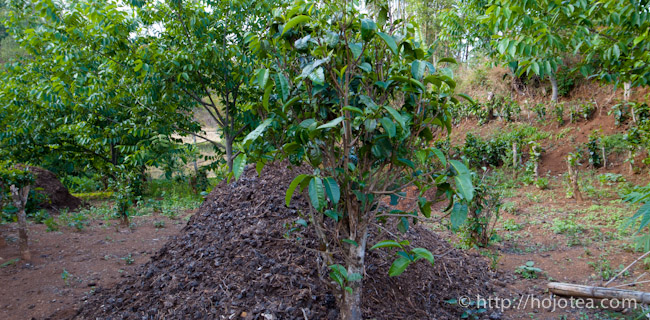
A tea tree beside a pile of animal manure. It bears huge, deep green leaves that hardly look like tea. Tea picked from a tree like this is thin in taste, with almost no depth in the throat.
Deep pruning
The deeper a tea bush is pruned, the more vigorously it sends out leaves the following year.
"Vigorously," in the end, means that the cells making up the leaf grow larger, and the tea becomes thin in minerals.
Japanese tea or otherwise, heavily pruned tea is suited to mass production; tea grown for quality is generally left almost unpruned and allowed to grow slowly.
The two practices above are absolutely routine in famous tea-producing areas like Shizuoka and Kagoshima.
Applying nitrogen and pruning deeply accelerates growth, enlarges the leaves, and increases yield.
Isn't it normal to expect that high quality means small yield and rarity?
High yield and high quality at the same time is too good a story to be true.
To repeat: whether highland vegetables, delicious apples, or premium melons, when you pursue flavor you let the plant grow slowly. Yield falls, but the cells that make up the vegetable or fruit become densely packed, producing a richly flavored food.
This is not limited to vegetables; the same can be said when you compare farmed fish that grow quickly with wild fish that grow slowly over a long time.
Pruned tea bushes vigorously send out young shoots, mass-producing large green leaves.
A tea that makes you sleepier the more you drink
With Uji Sencha Mt. Jubu, sleeplessness is not a problem. Quite the opposite: it is the ideal tea for anyone seeking deep sleep.
When you drink mineral-rich tea, that is, what the overseas tea market calls "high-grade tea," your body grows pleasantly warm and you actually become sleepy.
It is common knowledge that tea contains caffeine and that drinking too much keeps you awake. But as quality rises, the mineral content increases, and the resulting improvement in circulation makes you sleepy instead.
Uji Sencha Mt. Jubu is so rich in minerals that it can bring on a mild "tea drunkenness," relaxing you from within the way a fine brandy, whisky, or wine does.
This is not a matter of mind over matter: keep drinking and your face flushes and a soft, mellow feeling comes over you. Japanese law does not permit us to state health effects, so we cannot go into detail, but foods that improve circulation contribute to relaxation as well as to regularity and sound sleep. Please drink it and experience it for yourself.
Choose options