

Anxi Rou Gui Oolong 80g
Anxi Rou Gui is a tea made in Anxi County, Quanzhou, Fujian Province, China. For anyone who loves Chinese tea, the word "Anxi" immediately brings "Tieguanyin" to mind. Anxi is the famous home of Tieguanyin, and I have traveled there many times to source it. On one of those visits I discovered that a great many Rou Gui tea bushes were being cultivated in Daping Village in Anxi County, and since the quality of the tea was outstanding, I began buying it. The grower I worked with at the time later stopped making Anxi Rou Gui, however, and I kept searching for a tea of the same quality. A few years ago I found a high-quality tea, but had concerns about pesticides. So I asked the grower to change their garden management to meet Japanese standards, and after running tests for roughly 400 pesticides confirmed that the tea met Japanese criteria, I was able to purchase it again for the first time in years.
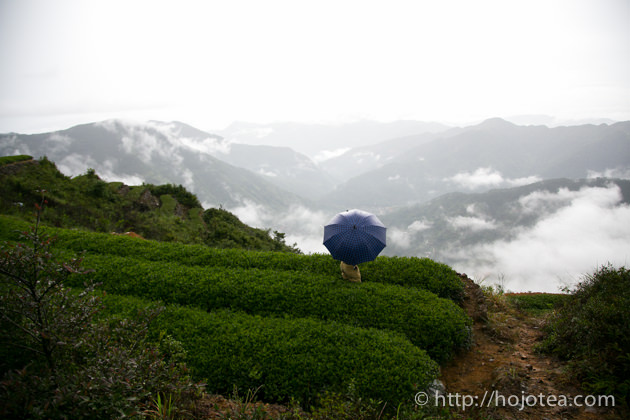
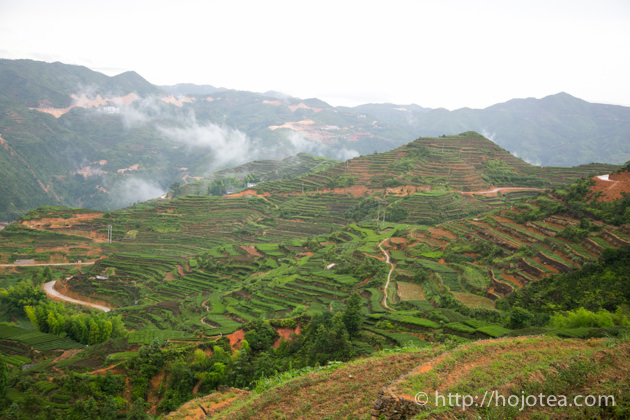
Called Rou Gui for its faint note of cinnamon
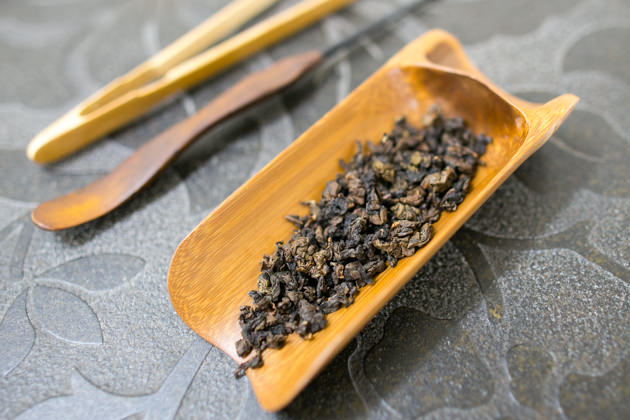
Rou Gui may be an unfamiliar word, but it is the name of a genus of plants in the laurel family, Cinnamomum, which is the common source of spices such as cinnamon, cassia, and Japanese nikki. The "Rou Gui" in Anxi Rou Gui is the name of a tea cultivar, so called because of its characteristic cinnamon-like aroma. The Anxi Rou Gui HOJO offers has been roasted somewhat firmly, and is notable for a soft cinnamon-like fragrance together with a sweet, chestnut-like aroma.
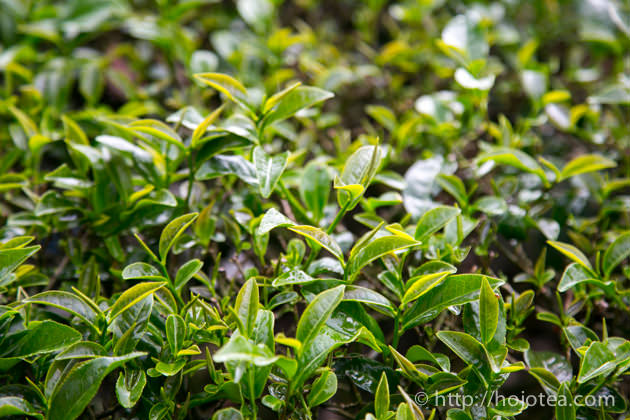
A slow-growing cultivar with a strong finish
Compared with other cultivars (in Anxi, these include Mao Xie, Tieguanyin, Huang Jin Gui, and Ben Shan), Rou Gui is characteristically late to bud. In my experience, growth speed is directly proportional to the aftertaste (finish and body). Mao Xie, for example, known for growing very fast, is a tea with a light finish (a weak aftertaste). Because of this cultivar trait, Rou Gui has a strong aftertaste and real substance in the cup.
How to Brew
Water
As the most readily available water, we recommend tap water. If you use tap water, boil it for 3 to 5 minutes to drive off the chlorine used for disinfection. Note, however, that even boiling cannot remove chlorine completely. Wherever possible, use a water filter with an activated-carbon cartridge to remove the chlorine. Otherwise the chlorine reacts with the aromatic compounds in the tea and you cannot enjoy its true fragrance. Chlorine is added to kill microorganisms, and it kills not only harmful ones but also the beneficial bacteria living in our gut. Various harmful effects at the cellular level have also been reported, and it can be a cause of allergies.
Distilled water and reverse-osmosis water contain no minerals at all, so the tea tends to taste flat. Use mineral-containing water such as tap water whenever you can.
Also, never remove the scale that builds up inside your kettle. Descaling with citric acid or the like means you will no longer get the flavor you are used to.
Once you have settled on a type of water, keep using the same type and do not switch. If the type of water changes, large amounts of minerals leach out of the scale, and after a while the tea will taste dramatically worse. Sticking with the same water is the secret to brewing good tea.
Amount of leaf
As a rule, use 1g of leaf per 40ml of water. For a teapot holding 200ml of water, that is 200 ÷ 40 = 5g. Likewise, use 8g of leaf for 300ml.
Temperature control is the life of Oolong
When brewing Oolong, the most important thing is controlling the temperature of the water.
It is not simply a matter of using hot water.
Even if you start with hot water, if it cools during brewing, the result is little different from brewing with lukewarm water.
The following two points are therefore essential.
Raise the temperature of the teapot
Pour boiling water into the teapot.
Let it stand for 10 seconds. This warms the vessel.
According to our experiments, the temperature drops by 20°C simply by pouring boiling water into a teapot.
In other words, although you think you are warming it with boiling water, it is really only at 80°C.
To brew Oolong even better, especially a fine Oolong, we recommend repeating this step twice. Pouring boiling water twice raises the teapot's temperature to around 95°C.
Raise the temperature of the leaves
Even after warming the teapot, if you brew immediately the leaves will lower the temperature of the water. You may think, "Surely a few tea leaves can't do that?", but tea leaves have a very large surface area and exchange heat efficiently; in our experiments the temperature fell by 20°C. So even after warming the teapot as in step 1, the temperature drops another 20°C.
Therefore, pour boiling water over the leaves once more. Pour briskly, quickly, and from as low a position as possible. If you pour in a slow trickle, the water cools along the way. Pouring from a height likewise lowers the temperature. Once poured, let the leaves sit in the water for about 7 to 10 seconds, then pour it off quickly. If you dawdle here, the flavor of the tea is lost. On the other hand, if it is too short, the leaves will not warm up.
Steps 1 and 2 are extremely important; mastering these two alone will change the taste of your Oolong dramatically. Conversely, if you skip them, you think you are brewing at 100°C when in fact you are brewing at 60°C, and the flavor ends up lacking definition.
The brewing times are as follows.
Rinse: 7-8 seconds
1st infusion: 20-30 seconds
2nd infusion onward: 10 seconds
After the times above, be sure to pour out all of the tea.
If water is left sitting in the teapot, the leaves keep extracting in the hot water, the 2nd and later infusions become far too strong, and the leaves oxidize.
Furthermore, once you have poured off the water, always remove the lid and let the leaves cool. This step is very important yet surprisingly little known. Cooling prevents oxidation and keeps the leaves fresh.
How to store the leaves
We recommend storing at room temperature.
Tea is sensitive to humidity, and the moment it absorbs even a little moisture, deterioration begins.
Please note that moisture can be absorbed unintentionally in situations such as the following.
- The tea is kept nearby while brewing and exposed to steam
- Moisture is clinging to a spoon or other utensil
- The pack is opened on a humid day or in a humid place
- The pack is opened immediately after being taken out of the refrigerator, causing condensation
- The pack is taken out of the refrigerator and left unopened to return to room temperature, but the seal is imperfect and condensation forms
In practice, the biggest causes of deterioration appear to be 4 and 5.
When stored in the refrigerator, the inside of the bag is cold, and even if it is tightly sealed with tape, outside air very often finds its way in and causes condensation. Once the leaves have suffered condensation, the aroma changes dramatically within 2 to 3 days.
As far as possible, store at room temperature, sealed in a properly dry room, and keep away from humidity. Ideally, consume within a few months of opening.
Unopened, vacuum-packed products can be stored for a year or more. If you wish to age the tea further, keep it unopened (still vacuum-packed) at room temperature. If you prefer to preserve the quality exactly as it was at purchase, store it in the refrigerator. If stored in the refrigerator, always allow a full 24 hours for it to return to room temperature before opening. Half a day may seem sufficient, but tea leaves have an enormous surface area and are, without exaggeration, a natural insulator. To the touch they seem to have reached room temperature, but the inside is still cold, and 24 hours are needed for the temperature to fully return to ambient. Once taken out of the refrigerator and opened, store at room temperature. From autumn through spring the ambient temperature is low, so tea keeps well at room temperature for several months or more.
Choose options