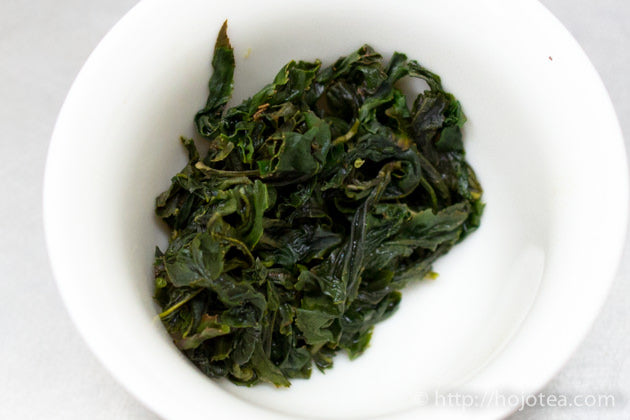
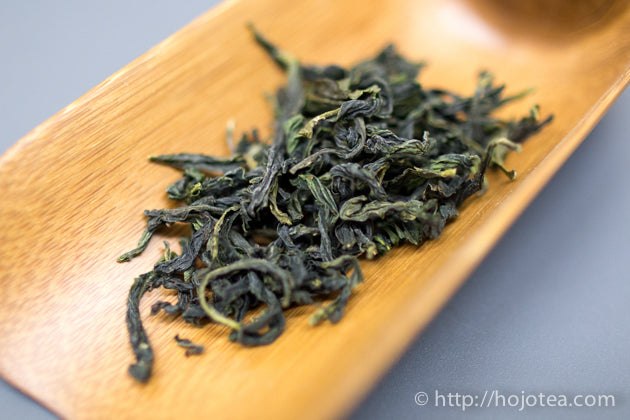
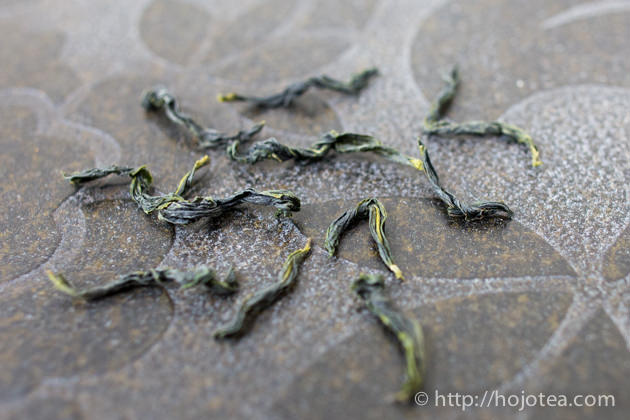
Wenshan Baozhong (Pouchong) 50g
Wenshan Baozhong is one of the teas that represent Taiwan. Its leaves are loosely rolled and very lightly oxidized, giving it a sweet, floral aroma. Many experts describe oolong as the most difficult tea to produce. This is because the degree of oxidation (fermentation) in oolong spans a wide range, from 10% to 80%, and controlling it is extremely difficult. Among oolongs, Wenshan Baozhong is one of the most lightly oxidized. For this reason, people trying it for the first time often mistake it for green tea. Wenshan Baozhong is characterized by a very strong floral aroma with a faint hint of green tea, and a sweet, refreshing taste. HOJO selects the spring harvest.


The seaweed-scented Wenshan Baozhong so common in recent years
Wenshan Baozhong is known for its trademark floral aroma. In recent years, however, many Wenshan Baozhong teas smell of green laver seaweed (aonori). Indeed, even when sourcing in the producing areas of Taiwan, most Wenshan Baozhong has a somewhat grassy, seaweed-like aroma. Many producers insist that this is what Wenshan Baozhong smells like, but as I remember it, most Wenshan Baozhong in the past truly smelled of flowers. As for why this change has occurred, I believe it is due to insufficient cooling, such as packing the tea while it is still hot after drying. Tea should always be cooled with a flow of air after heating. Hot leaves give off steam, which condenses on the leaf surface and causes the leaves to oxidize. When Wenshan Baozhong oxidizes, it smells exactly like green laver. These days seaweed-scented Wenshan Baozhong is extremely common, and I find very few teas whose aroma satisfies me. HOJO therefore bakes the tea in-house at low temperature to bring back the floral aroma that is Wenshan Baozhong's true character, and cools it immediately so that no condensation forms. Please enjoy a Wenshan Baozhong with the floral fragrance of old.

The history of Wenshan Baozhong
Wenshan Baozhong has a history of more than 100 years. The Wenshan district of Taiwan is also said to be the first area where oolong tea cultivars were planted. The name "baozhong" was first used in Anxi and Fuzhou in Fujian Province, and it derives from the way the tea was packaged. Around 1820, tea in Anxi was made by imitating the oolong-making methods of the Wuyi Mountains. The oolong made in Anxi at that time was sent to Fuzhou, where it was scented with flowers and sold as flavored oolong. Because this tea was wrapped in paper and sold in rectangular box-shaped packages, it was called baozhong tea. In Chinese, "baozhong" carries the meaning of "type of package." In 1873, oolong began to be produced in Taiwan's Wenshan district. The world economy was poor at the time, so the tea market was also sluggish, and since Taiwanese tea was expensive, Taiwan's trading merchants would not buy Taiwanese oolong, leaving large stocks unsold. To break this impasse, Taiwanese producers sent the unsold oolong to Fujian for scenting with flowers, and the tea was sold in Southeast Asia as flavored tea. Like the baozhong of Anxi, Taiwan's flavored oolong was wrapped in paper, and so it too came to be called baozhong tea. In 1881, tea masters were invited from Fujian to Taiwan, and flavored tea was produced within Taiwan and likewise sold in Southeast Asia. From 1885 onward, further research efforts were made to improve the quality and processing of baozhong tea. As a result, light-oxidation techniques were developed, and producers succeeded in drawing out a natural, sweet floral aroma. Today the tea is no longer wrapped in paper bags, but following the name of that era it is still called baozhong (Wenshan Baozhong).

Producing area and cultivar
The main producing area of Wenshan Baozhong is around Pinglin in the Wenshan district of New Taipei City, Taiwan. The area is relatively close to Taipei, at an altitude of about 600-800 m. The main cultivar is Qingxin Oolong, which is characterized by a deep aroma. The cultivar grown is Qingxin Oolong.Processing in detail
Wenshan Baozhong is the most lightly oxidized of Taiwan's oolongs and is made with gentle rolling. Because of this, many people assume it is relatively easy to produce, but in fact the opposite is true. Because the oxidation level is low, it must be controlled very precisely, and that requires uniform leaf shape, which means careful management from the picking stage onward.1. Picking
The picking season for Wenshan Baozhong is around early April. Typically one bud with two to three leaves is picked by hand. If the leaves are damaged during picking or transport, oxidation begins unintentionally and the floral aroma unique to Wenshan Baozhong cannot be brought out. The leaves must therefore be handled with great care.2. Outdoor withering
The leaves are spread thinly on sheets and sun-withered for 10-20 minutes on sunny days or 30-40 minutes on cloudy days. During this time the leaf temperature must be kept at 30-35°C; above 40°C the leaves deteriorate from the heat. The purpose of this step is to reduce the moisture in the leaves so that oxidation proceeds more easily in the subsequent steps.3. Indoor withering
The ideal environment for the enzymatic reaction is a room temperature of about 23-25°C with a relative humidity of 70-80%. After sun withering outdoors, the leaves are spread on bamboo mats and gently tossed by hand. The friction of this tossing causes fine bruising at the leaf edges, bringing the polyphenols in the leaf into contact with enzymes and starting oxidation. After tossing, the leaves are left to rest on bamboo sheets to promote oxidation. It looks simple, but tossing the leaves uniformly and controlling the level of oxidation precisely demands very high skill. If the tossing is too strong, the leaf edges turn red, the floral aroma weakens and astringency appears. If the tossing is too weak, the leaves keep losing moisture, oxidation is insufficient and a grassy aroma stands out. The tossing must be very gentle yet effective, and requires an experienced hand.4. Kill-green (shaqing)
Once the tea has oxidized sufficiently, it is heated in a stainless-steel drum at 140-160°C. This step evaporates excess moisture from the leaves, deactivates the enzymes with heat and also softens the leaves. As long as the leaves do not scorch, the higher the temperature of this heat treatment, the more floral, clean and transparent the aroma of the finished tea. If the temperature is too low or the heating time insufficient, residual enzymes remain active, the tea becomes cloudy, oxidation goes too far, the aroma weakens and an unpleasant astringency appears on the tongue. Conversely, if the leaves are overheated, they lose their moisture, the leaf temperature exceeds 100°C, and the result is scorching and an increase in tea dust. At the same time the heat leaves the tea weak in aroma.5. Rolling
Rolling is done under light pressure. It makes the leaves compact while lightly bruising the cells so that the tea extracts more readily when brewed.6. Drying
After rolling, the leaves are dried to a moisture content of around 5%. Drying may be done at 100-105°C for 25-30 minutes, or in two stages, first at 105-115°C for 10 minutes and then at 85-95°C for 40-60 minutes. The parameters vary with the quantity being processed.
How to Brew
Water
We recommend tap water, as it is readily available. If you use tap water, boil it for 3 to 5 minutes to remove the chlorine used for disinfection. Even boiling, however, cannot remove chlorine completely. Wherever possible, use a water purifier with an activated-carbon filter to remove the chlorine. Otherwise the aroma compounds in the tea react with the chlorine and you cannot enjoy its true fragrance. Chlorine is added to kill microorganisms, but it kills not only harmful ones but also the beneficial bacteria living in our gut. Various harmful effects at the cellular level have also been reported, and it can be a cause of allergies.
Distilled water and reverse-osmosis water contain no minerals at all, so the tea tends to taste flat. Use mineral-containing water such as tap water wherever possible.
Also, never remove the limescale that builds up inside your kettle. Cleaning it with citric acid or the like will change the taste of your tea from what it used to be.
Once you have settled on a type of water, keep using the same type and do not switch. If the type of water changes, large amounts of minerals leach out of the scale, and after a while the tea will taste dramatically worse. Sticking to the same water is the secret to brewing delicious tea.
Amount of leaf
Use 3 g of leaf per 200 ml of water. At this ratio, you can brew about 1 liter of tea.
Temperature control is the life of oolong tea
When brewing oolong, the most important thing is controlling the water temperature.
It is not simply a matter of using hot water.
Even if you start with hot water, if it cools down during brewing the result is little different from brewing with lukewarm water.
The following two points are therefore essential.
Raise the temperature of the teaware
Pour boiling water into the teapot.
Leave it to stand for 10 seconds. This warms the teaware.
According to our experiments, simply pouring boiling water into teaware drops its temperature by 20°C.
In other words, although you think you are warming it with hot water, it is actually only at 80°C.
If you want to brew oolong at its best, especially a premium oolong, we recommend repeating this step twice. Pouring hot water twice raises the temperature of the teapot to around 95°C.
Raise the temperature of the leaves
Even after warming the teaware, if you brew immediately the leaves will lower the temperature of the water. You may think "surely not from a few tea leaves?", but tea leaves have a very large surface area and a high rate of heat exchange, and in our experiments the temperature drops by 20°C. That is, even after warming the teaware in step 1, the temperature falls by another 20°C.
So pour boiling water over the leaves once more. Pour quickly and vigorously, from as low a position as possible. Pouring slowly in a trickle lets the temperature drop along the way, and pouring from a height does the same. After pouring, let the leaves sit in the water for 7-10 seconds, then pour it out quickly. If you dawdle at this point, the flavor of the tea is lost. On the other hand, if it is too short, the leaves do not warm up.
Steps 1 and 2 are extremely important; mastering just these two will dramatically change the taste of your oolong. If you skip them, you may think you are brewing at 100°C when in fact you are brewing at 60°C, and the flavor will lack definition. When passing boiling water through the tea, 5 to 10 seconds is the guide. Go a little longer in winter and shorter in summer.
Steeping times are as follows.
1st infusion: 10 seconds
2nd infusion: a few seconds
3rd infusion: a few seconds
4th infusion: a few seconds
5th infusion: a few seconds
After steeping for the times above, always pour out all of the tea.
If hot water is left in the pot, the leaves continue to extract, the second and later infusions become far too strong, and the leaves oxidize.
Furthermore, once you have poured out the water, always remove the lid to let the leaves cool. This step is extremely important, yet surprisingly little known. Cooling prevents oxidation and keeps the leaves fresh.
Choose options