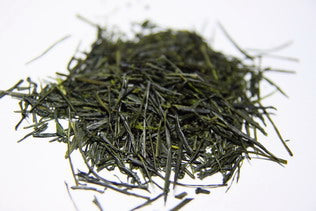
Honyama Hebizuka Sencha 100g
We often hear older people say that tea used to taste better than it does today.
It is tempting to dismiss this as nostalgia for one's youth, but visit any tea-growing region and you hear the same thing from several elderly people.
What is different between then and now?
First, Hebizuka Sencha is made by a truly remarkable method.
The leaves are allowed to grow slightly larger than for ordinary Sencha, and are not picked until then.
Letting them grow a little bigger deliberately increases the polyphenol content of the leaf.
This is the same thinking as in plucking for Oolong.
In a sense, leaves picked while still too young tend to be weak in flavor because they lack organic compounds.
The leaves, harvested only after their polyphenols have been deliberately raised, are then withered, even though this is a green tea.
Withering is a process practically synonymous with the making of Oolong, White Tea, and Black Tea.
Wilting the leaves for 24 hours in a well-ventilated, shaded place advances ripening by the leaf's own enzymes and draws out a sweet, floral aroma all at once.
This step alone is impressive, but in addition, because Hebizuka is at such a high elevation, the first flush itself comes late, in mid-May, and for that reason the tea is picked only once a year, and every leaf is picked by hand.
What do these characteristics have to do with tea tasting better in the old days?
Go to any tea garden today and you will see, as a matter of course, a small rail cart linking the garden to the foot of the mountain. Gardens are also criss-crossed with access roads, so even gardens deep in the mountains can be reached easily by car. Thanks to this infrastructure, harvested leaves are sent straight to the factory and processed on schedule. As a result, the leaves go into the processing plant immediately, in the fresh state they were in right after harvest.
What was it like in the past?
In the old days there was no way to send leaves harvested in a mountaintop garden straight down to the valley, and we can surmise that it was common to spread them on straw mats in the garden and leave them for a day. Because processing proceeded at a leisurely pace, withering was not done intentionally, but we can infer that withering took place as a result.
The climate at high elevation is characterized by strong daytime sun and extremely low nighttime temperatures. The organic compounds stored up during the day through photosynthesis would normally be consumed at night, but because of the sudden cold they are not. The low night temperatures thus slow the growth of the leaves, and organic constituents accumulate within them. Withering these leaves further heightens the aroma that Japanese tea usually lacks, resulting in what can only be called a masterpiece: a tea balanced not only in taste but in aroma and taste together.


1. History and Culture
The Abe River is one of Japan's swiftest and clearest rivers, and its basin is dotted with steep slopes. Mist forms frequently here, and there are fewer hours of sunshine than on the plains, so the conditions for making fine tea are all present. According to the "Chasetsu Shusei," there are records of wild tea growing in the Abe River basin in the Kamakura period, suggesting that the basin was well suited to growing tea from the outset.
As for the origin of Honyama tea, the "Tofukuji Chronicle" records "the Kokushi's planting of tea at Ashikubo in Suruga (present-day Ashikubo)." Local tradition holds that the Zen monk Shoichi Kokushi of the Kamakura period (a native of Tochizawa on the Warashina River, a tributary of the Abe) visited Chorakuji Temple in Kozuke Province in 1244, the second year of Kangen, then returned to his home village of Tochizawa and sowed tea seeds he had brought back from Song China in the village of Ashikubo, across the mountain. Eisai, called the father of Japanese tea, completed his "Kissa Yojoki" in 1211, so Honyama tea can be said to have begun at the very dawn of Japanese tea.
From then on, Suruga Province appears in various writings as a tea-producing region. And it was none other than Tokugawa Ieyasu who raised the standing of Honyama tea. To preserve the quality of the tea used at his tea gatherings, Ieyasu is said to have built a tea storehouse at Dainichi Pass in the upper Abe River and kept a large number of tea jars there. Records survive of Honyama tea subsequently being presented to Edo Castle as official tea.
The name "Honyama tea" was coined by Kotaro Tsukiji, a native of Kiyosawa Village on the Warashina River (present-day Kiyosawa Aimata). In the Meiji era, as tea exports flourished and tea came to be produced all over Japan, he named the traditional tea of his home region "Honyama tea" (the tea of the original source) to distinguish it from other regions.
Today, Shizuoka Prefecture boasts the largest tea production in Japan, and Chamachi in Shizuoka City, on the banks of the Abe River, is a hub where tea from all over the country is gathered. Honyama tea, produced right on its doorstep, is constantly sorted with a critical eye and delivers tea of high quality.
Hebizuka, which sits at an especially high elevation within Honyama and produces exceptionally fine raw leaf, has around ten households in total. Only a few families make Sencha, however, and since tea-making is done household by household, this product is a tea that only Mr. Nakamura can produce.
2. Growing Region
Heading north from Shizuoka City toward Umegashima, with the Southern Alps ahead of you, you meet the Abe and Warashina Rivers. The mountainous area stretching from these districts up to the foothills of the Southern Alps is collectively called Honyama. In general, then, Honyama tea means mountain tea grown in northern Shizuoka Prefecture near the foot of the Southern Alps. Within this area, Hebizuka lies even deeper in the mountains, more than an hour by car from the center of Shizuoka City. As its name suggests, the district called Hebizuka sits on high ground, and its tea gardens lie at an elevation of about 800m, about as close as one can get to the upper limit for growing tea in Japan.
Because of the high elevation, winter arrives early and spring comes about a month later than in other areas, so in effect winter lasts about two months longer than elsewhere.
The Japanese tea market has a somewhat extreme side: the earlier the shipment, the higher the relative price tends to be.
In other words, tea harvested around mid-April, when the season begins, is traded as premium tea, no questions asked.
The important point, however, is that the lower the elevation of the garden, the earlier spring arrives.
An early spring means a short winter, and that is not good for the quality of the tea.
Where a short winter shows is in the strength of the aftertaste felt at the back of the throat when you drink: it differs greatly between a first flush harvested late at high elevation and one harvested early on low ground.
In the case of Hebizuka tea, because the gardens are so extremely high, the first-flush harvest does not begin until mid-May, a full month later than typical Shizuoka tea, and if sold on the market it would inevitably fetch an extremely low price, quite at odds with its quality.
To resolve this dilemma, the grower, Mr. Nakamura, raises the quality of his tea by his own methods (described under several headings) and sells directly to tea companies, bringing the exceptionally niche quality of Hebizuka Sencha to the world.
In fact, "Hebizuka" has one more distinctive feature.
True to its name, Hebizuka, "the snake's tomb," is a rocky area, and the tea gardens are strewn with boulders.
The rock that makes up this area is not granitic; like Yixing, Sado, and Iga, it consists mainly of purple-clay (zisha, purple and red) rock, and its color tells you that iron is its principal mineral component.
Hebizuka's extremely iron-rich geology, with limited nutrients, slows the growth of the tea while promoting mineral uptake, and forms the matrix that gives birth to a tea of exceptional quality.

3. Cultivar and Harvest
Honyama Hebizuka Sencha is made from the Yabukita cultivar. Only the first flush is harvested, in mid-May; there is no second flush.
The leaves are picked after the sun has risen, to avoid morning dew.
If morning dew gets mixed in, only the dew-wet portions turn to hot water during steaming, which excessively destroys the cell structure of the leaf, and a fine Sencha cannot be made. High-quality Sencha is therefore made from leaves harvested on a clear day.
For Honyama Hebizuka Sencha, plucking is deliberately delayed until the leaves are somewhat larger than the usual harvest standard for Sencha. This is for the withering process unique to Honyama Hebizuka Sencha that follows: as the leaf grows it produces more polyphenols, and the aim is for these to yield a floral flavor through withering.
4. Processing
1 – Receiving the raw leaf
As this is essentially a family garden, picking is done by Mr. Nakamura's wife with help from neighbors and acquaintances. The harvested leaves are carried to the family home, which doubles as the factory, and the work proceeds by Mr. Nakamura's own hand.
2 – Withering
The leaves are spread on bamboo trays and left for 24 hours in a cool, dark, well-ventilated place free of humidity. This is the withering process that defines Hebizuka tea. Withering gradually promotes enzymatic reactions in the leaf, creating a sweet aroma in the same way that fruit ripens after picking.

3 – Steaming
To preserve the fresh aroma, steaming is completed in a very short 20 to 30 seconds.
Applying high-temperature saturated steam evenly for a short time leaves the leaves with a dry, light feel, without being wetted by condensation. This is a crucial point in making delicious tea.
4 – Cooling
The leaves, heated by steaming, are cooled while the moisture they contain is driven off at the same time. Removing the moist heat promptly prevents secondary heat damage.
5 – Primary rolling (sojū)
Agitating the leaves in hot air dries them efficiently while shaping them through rolling.
6 – Rolling (jūnen)
The only step that uses no heat. The leaves are moved in a circular motion under pressure to distribute their moisture evenly. Because rolling generates frictional heat, the leaves are periodically loosened to release it.
7 – Secondary rolling (chūjū)
Using a rotary dryer, the leaves are dried while being lightly rolled, evening out the moisture as they are twisted finer.
8 – Final rolling (seijū)
Straight back-and-forth movements combined with circular lateral movements create the needle-like "twist" characteristic of Sencha. It is important that each leaf has a black sheen and is hard and tightly rolled.
9 – Drying
The leaves still contain moisture after final rolling, so they are dried to bring the moisture content down to around 5%. Tea that has completed drying in this way is called "aracha" (rough tea).
Because aracha has not yet undergone the finishing "hiire" (firing), it has a stronger raw-leaf aroma and bitterness than finished tea.
10 – Firing (hiire)
For Honyama Hebizuka Sencha, HOJO deliberately fires at low heat in order to preserve the fresh, floral aroma. As a result there is almost none of the roasted note so common in recent Sencha, and you can savor the fresh aroma created by the tea material itself.
Firing has the following two purposes.
- 1. To dry the aracha to a moisture level low enough to withstand storage.
- 2. To heighten the aroma of the tea through heating and improve its flavor.
Tea companies normally buy aracha as raw material and fire it by their own proprietary methods to create their own aroma and taste. By blending several of these individually fired teas, the company's original "finished tea" is completed.
In the case of HOJO's Honyama tea, Honyama Hebizuka Sencha, no blending is done at all, in order to preserve the garden's own traditional taste and aroma.
5. How to Brew
HOJO's guide to brewing delicious Sencha
The taste of Sencha is composed of a balance of bitterness, astringency, and umami (sweetness). Each of these tastes comes from a different component, and the balance between them changes easily with the way the tea is brewed, often producing a completely different taste. We therefore suggest first getting to know the tea's true flavor with a standard method, then adjusting the brewing to your own preference and enjoying the range of tastes.
Water
Tap water contains chlorine, so please do not use it without a water filter. Chlorine is not only bad for the body; it reacts with the tea's aromatic compounds and prevents you from enjoying the true aroma. If you use bottled water, soft water is more suitable than hard water. With hard water the taste becomes bland and the liquor can turn cloudy white.
Amount of leaf
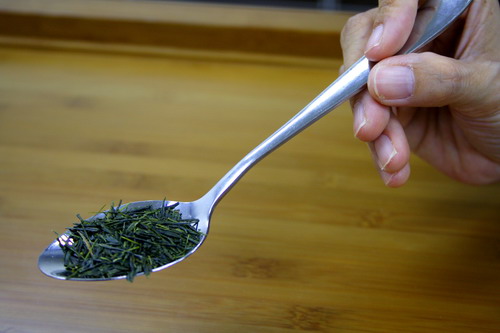
One tablespoon (5g)
As a rule, use 1g of leaf per 50ml of water. For a teapot holding 200ml of water, that is 200 ÷ 50 = 4g. Likewise, use 6g of leaf for 300ml.
Water temperature and steeping time
The basic rule for steeping time is: the hotter the water, the shorter the steep; the cooler the water, the longer. If the water is in the 60-80°C range, 1 minute is the appropriate steeping time. Honyama Hebizuka Sencha is a highly aromatic tea, so use a slightly higher temperature. Ideally, steep for just under 1 minute at 70-80°C.
After pouring the 1st infusion, always remove the lid. If the lid is left on, the residual heat cooks the leaves and they oxidize rapidly from the 2nd infusion onward. Oxidized leaves turn yellowish and lose both taste and aroma. Pouring out every drop so no water remains in the pot and leaving the lid off cools the leaves as quickly as possible. Leaving water in the pot ruins the taste of the 2nd and later infusions, so even if it is a bother, pour out completely every time.
The hardest part of brewing Sencha is the 2nd infusion. Misjudge the timing of the 2nd infusion and the number of times you can enjoy the tea drops sharply. Keep the steeping time for the 2nd infusion to within a few seconds. Some customers worry that a few seconds will not extract any flavor, but the leaves, already saturated with water, release flavor instantly on the 2nd infusion.
For the 3rd infusion onward, use 10 seconds, and for the 4th to 6th add 10 seconds each time. That is, the 4th infusion is steeped for 20 seconds and the 5th for 30 seconds.
Pouring
To even out the taste, pour a little into each cup in turn, in several rounds. This is called "mawashi-tsugi" (pouring in rotation). Also, pour to the very last drop so that no water is left in the teapot. This serves both to pour out the umami-rich tea to the end and to make the 2nd infusion delicious. And once you have finished pouring, open the lid of the teapot to prevent the tea from steaming.
Teaware suited to Honyama Hebizuka Sencha
Choosing your teaware is as important as choosing your water. In general, the material known as stoneware, fired at high temperatures around 1180°C, is suitable. Representative examples are Banko ware, Sado Mumyoi ware, Tokoname ware, and Bizen ware. Customers who prize a rounded throat feel and richness of taste are recommended reduction-fired teaware; the purple-clay Banko kyusu is the classic example. If you want both aroma and throat feel, use red clay (shudei). Sado Mumyoi and Tokoname are famous for red clay.
Choose options