

Fu Brick Tea (Fu Zhuan) 200g
A dark-tea fermentation unlike Pu-erh
Fu Brick Tea belongs to the category of dark tea (hei cha): a post-fermented tea made with the help of microbial fermentation. When people think of microbially fermented tea, Ripe Pu-erh (Shou) is the famous example, but the fermentation of Fu Brick Tea differs in one major respect. Ripe Pu-erh is fermented as loose leaf, whereas Fu Brick Tea is fermented after being compressed into a block. Different microorganisms are involved, and the result is the aroma and taste unique to Fu Brick Tea.The aroma and taste of Fu Brick Tea
The aroma of Fu Brick Tea depends heavily on mold fermentation, giving it a distinctive woody character. To draw comparisons: umeboshi pits, hay, wood, herbs, cheese, and raw mushrooms such as porcini. Reading this, it may sound like a strange aroma, but when actually served to customers it is very well received, and it is the kind of fragrance that many people enjoy. In my own shop it is also a tea with a very high repeat rate. (Just as it is hard to describe the smell of cheese to someone who has never eaten it, the aroma of Fu Brick Tea is highly distinctive and difficult to put into words.) As for the taste, because it comes from gardens with restrained fertilizer use, the finish is surprisingly long, with solid body, and combined with its unique aroma it is a tea with real substance.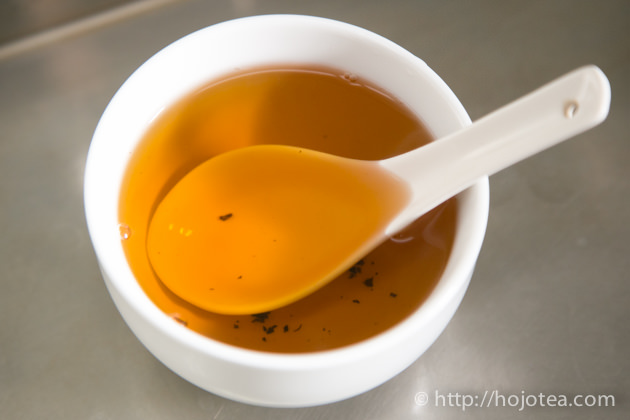
With age, Fu Brick Tea develops dried-fruit aromas
Like Pu-erh, Fu Brick Tea changes in aroma as it ages. It ages faster than Pu-erh: the longer it is stored, the darker the leaf and the liquor become, while dried-fruit aromas grow stronger and the dense sweetness felt in the mouth intensifies. In China, Fu Brick Tea that has been stored for several years trades at a higher price than new tea. In my experience, aging without oxygen forms the ideal aroma, but even stored after opening it matures within a reasonably acceptable range.Fu Brick Tea and its much-discussed fat-burning properties
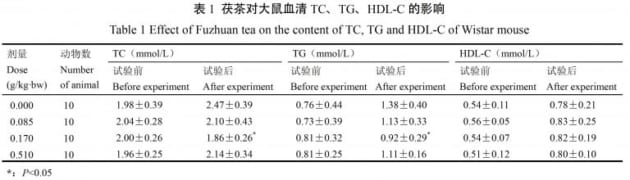
Fu Brick Tea has attracted attention for its fat-reducing effects, and numerous studies have been carried out, chiefly by Chinese researchers. According to Zhou et al. BMC Complementary and Alternative Medicine 2014, 14:263, mice given Fu Brick Tea showed a marked reduction in liver fat and triglycerides, and the effect increased further with a higher intake of the tea. Xiao Wenjun et al., Journal of Tea Science 2007, 27(3): 211-214 ran experiments on both mice and humans. According to that paper, as intake of Fu Brick Tea increased, cholesterol and triglycerides fell while good cholesterol (HDL-C) rose. The results are so neat and so exactly as one would hope that they invite a degree of skepticism, but for those of us who worry about fat, they are surely a very interesting finding. Table 1 below shows the mouse data and Table 3 the human data for total cholesterol (TC), triglycerides (TG), and good cholesterol (HDL-C) after drinking Fu Brick Tea. In Table 1, as the dose (intake of Fu Brick Tea) increases, cholesterol and triglycerides decrease and good cholesterol increases. Table 3 is the human experiment, and comparing Before Drinking with After Drinking shows the same trend observed in the mice.

An essential part of daily life for Mongolians
Fu Brick Tea is made in China, but it is drunk mainly in the Mongolian regions, Tibet, and the Uyghur Autonomous Region. These are harsh environments of desert and cold, where vegetation is limited and the inhabitants live chiefly on meat, dairy, and bread, so vegetables are naturally in short supply. For them, Fu Brick Tea serves to supplement minerals and vitamins; more than a tea, it is a source of nutrition essential to daily life. In Mongolia and elsewhere it is also drunk with butter.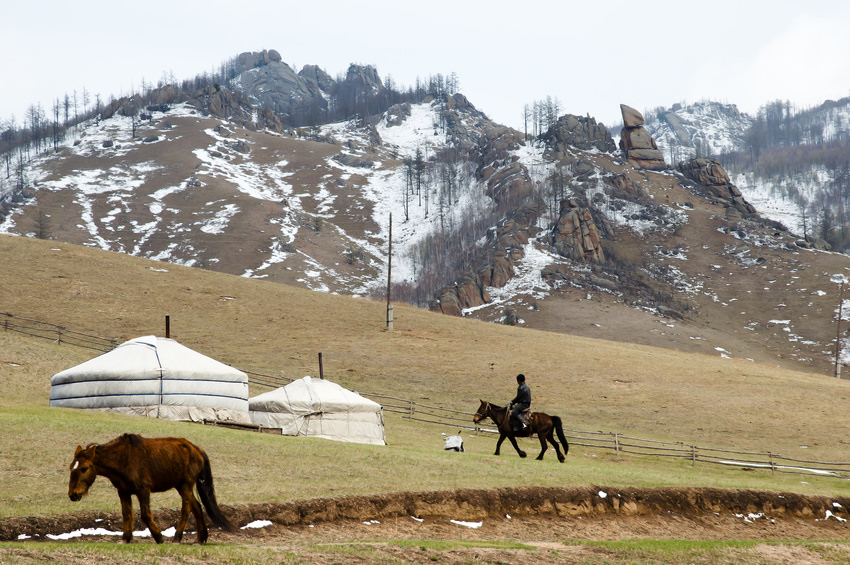
The history of Fu Brick Tea
The tea trade between China and the Mongolian, Tibetan, and Uyghur peoples of its northwest has a long history; tea was already being traded in the Tang dynasty. China exported tea and in return acquired horses from Mongolia and other regions. This trade of tea for horses was called the Tea-Horse Market, and from the Song dynasty onward the government established a dedicated trade bureau; the tea was called official tea or government tea, and the trade was conducted as national policy. The tea exported to the Mongolian regions at that time was a type of green tea, equivalent to what is today called hei mao cha (dark raw tea). The tea was tightly packed and transported over several months loaded on donkeys and horses. It is said that exposure to wind, rain, and high temperatures along the way caused unintended microbial fermentation. Unexpectedly, however, the aroma produced by this fermentation was welcomed by the people, and it is said that from around the 1300s, in the Ming dynasty, the present method of making Fu Brick Tea, with deliberate microbial fermentation, was developed in Shaanxi Province. Fu Brick Tea and teas of a similar style subsequently came to be made not only in Shaanxi but also in Hunan and even Sichuan.
How Fu Brick Tea is made
The actual production of Fu Brick Tea is divided into two stages.Producing hei mao cha
Hei mao cha sounds rather technical, but simply put it is the mao cha, that is, the rough tea, used for making dark tea. Rough tea refers to tea that has not yet been finished.- One bud with 3 to 5 leaves is used.
- Kill-green by pan-firing
- Rolling (kneading the tea)
- Piling (12-24 hours)
- Second rolling
- Baking
Fa Hua (flowering)
The hei mao cha is compressed into rectangular or square blocks and stored in a high-humidity environment. This stage encourages the growth of molds originating from the leaf and the environment. When fermentation goes well, golden specks called "golden flowers" (jin hua) can be observed inside the tea. Golden flowers are the spores produced by the koji mold Eurotium cristatum, and they are indispensable to any discussion of Fu Brick Tea. The more golden flowers, the better the production process is considered to have gone. The golden flowers themselves do not have aroma or taste; rather, their presence indicates that mold has proliferated and secondary metabolism has taken place. That said, more golden flowers do not mean higher quality. The quality of the tea is determined by the quality of the leaf used (harvest timing, elevation, plucking standard, cultivation method, and so on). Golden flowers are an indicator of whether the fermentation was well controlled.
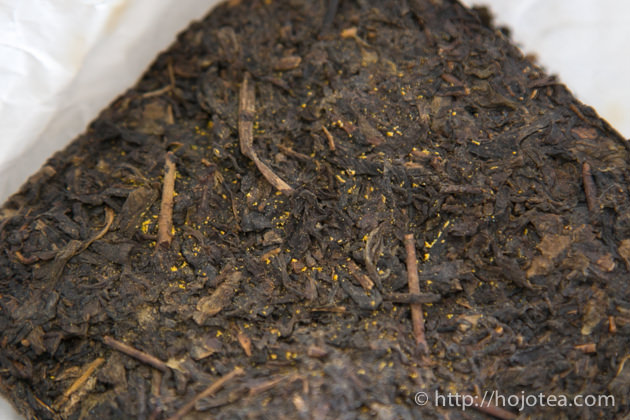
The yellow specks are the koji mold spores known as "golden flowers" 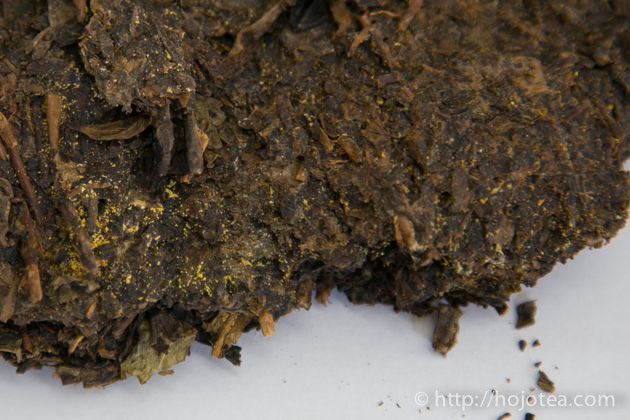
Prices vary greatly by grade
Fu Brick Tea comes in a wide range of grades. As a general rule, the larger the compressed block, the lower the grade. A lower grade means the tea was picked in summer rather than spring. The plucking standard also differs by grade. In the lower grades, large leaves that have grown out over the summer are used as raw material, giving a strongly astringent, coarse taste. Whether from Hunan or Shaanxi, the highest grade comes as a 200g block. HOJO purchases the 200g block, regarded as the finest quality. This tea uses spring leaf of roughly one bud with 3 to 5 leaves. Below this grade come 357g and 400g blocks, and the 1kg and 2kg blocks are everyday, general-purpose tea. In fact, 200g Fu Brick Tea is rarely consumed in Mongolia; most of it is sought by tea enthusiasts in China and abroad. 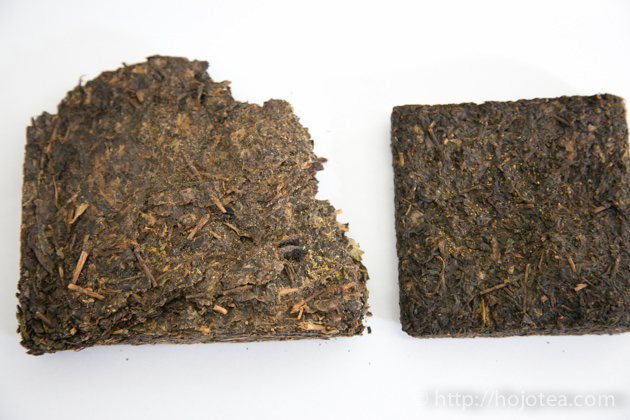
In the photo above, the left is a 400g block and the right a 200g block. Starting with the stem content, you can see that the one on the left is coarser overall. The spring tea used for the 200g block has smaller leaves throughout and, because its components are more concentrated, a darker color. The 1kg and 2kg blocks use even larger leaves picked in summer. 
Selected to meet pesticide standards
HOJO purchases the 200g block regarded as the highest quality, and goes further by selecting tea from gardens that can clear Japanese pesticide standards. We have it tested by SGS for 360 pesticides and confirm that it meets Japanese standards before purchasing. HOJO has sold Fu Brick Tea in Malaysia for the past 10 years, and until now sourced tea from Hunan. In recent years, however, the quality and price of Hunan Fu Brick Tea have been unstable, so we now work with producers in both Shaanxi and Hunan, checking quality, price, and pesticide results. The product currently on sale is from Shaanxi Province.
How to Brew
Water
As the most readily available water, we recommend tap water. If you use tap water, boil it for 3 to 5 minutes to drive off the chlorine used for disinfection. Note, however, that even boiling cannot remove chlorine completely. Wherever possible, use a water filter with an activated-carbon cartridge to remove the chlorine. Otherwise the chlorine reacts with the aromatic compounds in the tea and you cannot enjoy its true fragrance. Chlorine is added to kill microorganisms, and it kills not only harmful ones but also the beneficial bacteria living in our gut. Various harmful effects at the cellular level have also been reported, and it can be a cause of allergies.
Distilled water and reverse-osmosis water contain no minerals at all, so the tea tends to taste flat. Use mineral-containing water such as tap water whenever you can.
Also, never remove the scale that builds up inside your kettle. Descaling with citric acid or the like means you will no longer get the flavor you are used to.
Once you have settled on a type of water, keep using the same type and do not switch. If the type of water changes, the interaction with the minerals in the scale makes the tea taste dramatically worse. Sticking with the same water is the secret to brewing good tea.
Amount of leaf
Use 1g of leaf per 50ml.
In other words, for a 200ml teapot, 200ml ÷ 50 = 4g of leaf is needed.
Raise the temperature of the teapot
Pour boiling water into the teapot.
Let it stand for 10 seconds. This warms the vessel.
Raise the temperature of the leaves
Even after warming the teapot, if you brew immediately the leaves will lower the temperature of the water. You may think, "Surely a few tea leaves can't do that?", but tea leaves have a very large surface area and exchange heat efficiently; in our experiments the temperature fell by 20°C. So pour boiling water over the leaves once more. Pour quickly and from as low a position as possible. If you pour in a slow trickle, the water cools along the way. Pouring from a height likewise lowers the temperature. Once poured, let the leaves sit in the water for about 10 seconds, then pour it off quickly. If you dawdle here, the flavor of the tea is lost.
Then repeat this once more for 5 seconds. In other words, the leaves are rinsed with hot water twice in total.
Steeping time
1st infusion: 10 to 20 seconds
2nd infusion onward: simply pass the water through
If the taste is too strong, do not hesitate to dilute it by adding hot water. Bitterness is a sign that it is "too strong." Dilute boldly until the bitterness is gone.
From the 2nd infusion onward, simply passing hot water through is enough; there is no need to steep. With this method you can brew around 8 to 10 infusions, which is very economical.
An important point when brewing: keep the 1st infusion at a level where you think, "Was that a little too weak?" If you extract the tea fully from the 1st infusion, the 2nd and later infusions will be extremely strong.
A simple method
The simple method is to preheat a 200 to 300ml teapot once with boiling water for 10 seconds, add the leaves, and steep for 3 minutes. For flavor the method above is superior, but when you do not need to be that serious, this way is convenient.How to store the leaves
We recommend storing at room temperature. Keep away from direct sunlight. After opening, seal the pack tightly so the tea is not exposed to the outside air. If you intend to age it, ideally keep it unopened. Oxygen is removed when the tea is individually packed, and under oxygen-free conditions the tea ages ideally.
Choose options