
Tieguanyin Lanyun Oolong 70g
Tieguanyin from Anxi, Fujian Province
Tieguanyin may well be the most widely known of all Chinese teas.
There are many theories about the origin of the name, but today "Tieguanyin" refers to a cultivar.
In other words, oolong tea made from the Tieguanyin cultivar is called Tieguanyin. Incidentally, it was Taiwan that inherited the Anxi method of making Tieguanyin.
Muzha Tieguanyin, still produced near Taipei, carries on the old Anxi way of making it.
The fundamental techniques behind Taiwan's high-mountain teas likewise have their roots in Anxi.
In fact, the history of Tieguanyin is relatively short; it seems to have existed in its present form for only a few hundred years.
Tea was grown in the Anxi region before that, but it appears to have been somewhat different from today's Tieguanyin.
Tieguanyin originally traces back to Wuyi rock tea, and like Wuyi oolong, charcoal roasting was the basis of the traditional method.
One reason Anxi Tieguanyin is of such high quality lies in its soil. Anxi is covered with yellowish-brown clay soil that is rich in red clay, much like the Uji tea region and Yixing, the home of Chinese teapots. Thanks to the abundant iron in the soil, the tea is mellow and rich in flavor.

The "Qing Xiang" Style with the Fragrance of Orchids
The current trend, however, favors the completely unroasted type.
Unroasted Tieguanyin is called the "qing xiang" (fresh fragrance) type, and it is green in appearance.
Smell the leaves and you will find them remarkably fruity. The aroma is generally described as orchid, though to me it is closer to peach.
The fragrance of Tieguanyin is truly powerful, and first-time drinkers are invariably struck by a kind of culture shock.
Quite a few people, it seems, first tasted qing xiang Tieguanyin on a trip to China, could never forget it, and fell in love with Chinese tea as a result.
 |
 |
|
|
Leaves of the Tieguanyin cultivar |
A Tieguanyin tea garden in Anxi |
Plucking Only After the Shoots Have Turned to Branches
In Anxi, tea buds emerge in March, which is half a month to a month earlier than in Japan.
In Japan, the harvest runs for about a month, from mid-April to mid-May.
Tieguanyin, however, is not picked in March, nor in April. Only in May, once the leaves have grown considerably into large, firm leaves, does the plucking finally begin.
By then the stems have turned from green to brown, the buds are gone, and the shoots have become more like "branches."
Young buds simply will not do for Tieguanyin's distinctive aroma; fully grown, large leaves are needed.
Only by deeply fermenting these polyphenol-rich mature leaves can the fragrance of Tieguanyin be produced.
Anxi Tieguanyin is also known for its exceptionally strong finish in the throat, and the use of mature leaves is one reason for this.
Compared with young buds, fully grown leaves contain more polyphenols, and a high polyphenol content also means a high mineral content.
It is the same principle by which fruit left on the tree to the very end has the richest flavor.
 |
 |
|
|
Harvested only after growing into large branches |
Leaves immediately after fermentation |
Green in Appearance, Yet Very Deeply Fermented
The brewed liquor is a pale yellow-green, and many people say that "today's Tieguanyin is no different from green tea."
But Tieguanyin is an entirely different tea from green tea. Judging it to be green tea because it looks green is jumping to conclusions.
Tieguanyin is in fact fermented very deeply. It may resemble green tea, but it is nothing of the kind.
It is fermented more heavily than Taiwanese oolong, and by the end of fermentation the edges of the leaves have turned reddish-brown.
A process unique to Tieguanyin is the removal of these browned edges during production. Depending on the method, there are exceptional cases in which they are not removed.
The edges are removed by hand or, more recently, by machine, which is why even high-grade Tieguanyin often has ragged leaves that no longer hold their original shape.
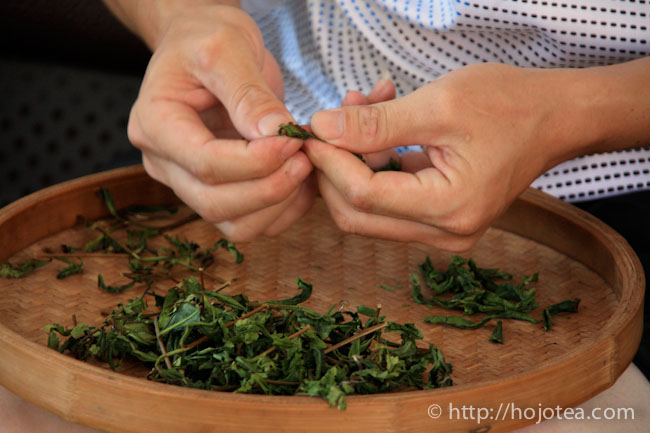
The photo above shows the leaf edges being removed by hand
Because of the late harvest, the finished Tieguanyin also has stems protruding from the leaves.
To achieve a cleaner aroma, the stems are removed one by one by hand in Anxi.
Visit Anxi in May or June and everywhere you go you will find people removing stems from Tieguanyin.
 |
 |
|
|
Even large factories remove the stems by hand |
Removing the stems by hand |
How Are Tieguanyin Grades Determined?
Tieguanyin is sometimes assigned grades such as "special grade" or "grade 1," but this is mainly a practice of large tea factories. Big factories produce in volume and employ multiple sales staff, so they need clear internal distinctions of tea quality.
In the general high-end tea market, on the other hand, the concept of grades does not exist. Each producer makes tea grown at different elevations and in different areas, and holds a variety of lots. No particular grade is assigned to these teas; which one you choose depends on your own judgment of value and your budget.
The pricing of Anxi tea is straightforward: prices are set according to the richness of body and aroma. In other words, the higher the quality, the softer the tea and the deeper the aroma.
Furthermore, among Tieguanyin teas, the qing xiang type is generally the most expensive. This is not the result of anyone's particular decision, but of popularity in the market.
As a rule, the best quality comes from first-flush tea harvested at high elevation and grown with almost no nitrogen-based fertilizer. The Tieguanyin Lanyun sold by HOJO offers a crystal-clear aroma, deep body, and great depth, with no unpleasant astringency.

 |
 |
 |
 |
 |
 |
 |
 |
 |
 |
 |
 |
 |
 |
 |
 |
 |
 |

How to Brew
◇ Water to Use
For convenience, we recommend tap water. If you use tap water, boil it for 3 to 5 minutes to drive off the chlorine used for disinfection. Even boiling, however, cannot remove chlorine completely. Wherever possible, use a water purifier with an activated carbon filter to remove the chlorine from the water. Otherwise the chlorine reacts with the tea's aroma compounds and you will not be able to enjoy its true fragrance. Chlorine is also added to kill microorganisms, and it kills not only harmful microbes but also the beneficial bacteria living in our gut. Various harms at the cellular level have been reported as well, and it can even cause allergies.
Distilled water and reverse-osmosis water contain no minerals at all, so the tea tends to taste flat. Please use mineral-containing water such as tap water whenever possible.
Also, never remove the limescale that builds up inside your kettle. Descaling with citric acid or the like will keep you from getting the tea flavor you are used to.
Once you have settled on a type of water, keep using that same type and do not switch. If the water changes, large amounts of minerals leach out of the scale, and after a while the tea will taste dramatically worse. Sticking to the same water is the secret to brewing delicious tea.
Choose options