

Tsuge Native-Seed Sencha 100g
Tsuge, said by some to have been the center of ancient Japan
Tsuge is a place name in the Yamato Highlands, in the northeastern part of Nara Prefecture. Tsuge was once Tsuge Village, but it was merged into Nara City in 2005. The name Tsuge survives today as a locality, and the growing area for Tsuge Native-Seed Sencha is the district of Tsuge Shiraishi-cho. 
Tsuge is a fascinating area in the context of ancient Japanese history.
The district is dotted with important cultural heritage closely tied to ancient Japan, including keyhole-shaped burial mounds such as the Sanryobo Kofun cluster and shrines such as Shiraishi Kunitsu Shrine, Ogami Shrine, and Tsuge Yamaguchi Shrine. Many of the shrines in Tsuge are deeply connected with the deity Okuninushi, and one theory holds that this area was the former Izumo Village.
In the Kojiki, Okuninushi cedes the land of Ashihara-no-Nakatsukuni (Japan) to Amaterasu (thought to represent immigrants from the continent); the center of Japan at that time, its capital, may well have been somewhere around Tsuge.
Mineral-rich soil
The tea garden for Tsuge Native-Seed Sencha lies on a mountain slope within walking distance of Kunitsu Shrine and Ogami Shrine.
Tsuge, where so many ancient sites remain, is land that has largely escaped erosion by rivers, and the ground around the tea garden is covered with clay-rich brown forest soil high in iron.
We suspect that one reason Tsuge Native-Seed Sencha shows such an extraordinarily deep finish is the abundant iron in this brown forest soil.
A garden without pesticides or fertilizer
Tsuge Native-Seed Sencha comes from a garden that has been managed by natural cultivation, with no fertilizer and no pesticides, for several decades or more.

The Tsuge Native-Seed Sencha garden and its grower
We evaluate the quality of each of the grower's several gardens individually and purchase only the tea from the single garden we like best.

When we ask what makes a tea delicious, we believe the answer is "a tea that grew up healthy."
If we take wild plants as the model of a healthy plant, then a healthy tea is one that grew in a state close to that of a plant in nature.
Wild plants depend solely on the ecosystem for their nitrogen and live on a limited supply of it. Tea grown with fertilizer (nitrogen fertilizer) has a higher nitrogen concentration in its cells. As a result, the tea bush synthesizes large amounts of chlorophyll, photosynthesizes vigorously, and tries to grow as fast as it can.
Tea grown with fertilizer grows quickly, its cells swell, and cell density drops. The yield goes up, but in exchange the aftertaste thins out and the flavor becomes flat, without depth.
Fertilized tea is, to use a human analogy, something close to a metabolic syndrome.
Some growers promote the fact that they use no chemical fertilizer, but in our view, whether chemical or organic, as long as it is nitrogen fertilizer the effect on the tea is the same. Carbon-based fertilizer made from grass and fallen leaves, on the other hand, keeps tea and vegetables in a natural state and poses no problem.
Grow without fertilizer and pesticides become unnecessary
Observe wild plants and you will see that, although no one sprays them with anything, they are not troubled by pests and go on living vigorously for years.
It is precisely because nitrogen fertilizer is applied that a plant (tea) attracts insects, and that is why pesticides become necessary.
Even a wild plant, if given fertilizer, will grow larger leaves of a very dark green and at the same time begin to suffer insect damage. Unfertilized tea, in addition to its low nitrogen concentration, contains more polyphenols, terpenes, and similar compounds. These bioactive substances contribute greatly to taste and aroma, forming a rich flavor and fruity, floral notes.


Because unfertilized tea grows slowly, it does not need vigorous photosynthesis. It therefore has less chlorophyll, and its overall yellow-green color is a distinguishing feature.

Seed-grown tea
Tsuge Native-Seed Sencha is made from seed-grown tea. Seed-grown means tea that was sown from seed; in Japan it is called zairai, or "native."
Strictly speaking, the term zairai (native species) is used for animals and plants indigenous to Japan, such as the Asian black bear, the Japanese serow, and the Yamato char. Since tea originally came from China, the label is not really appropriate. Nevertheless, the Japanese tea trade calls seed-grown tea zairai, so HOJO also uses the term for clarity.
Teas with cultivar names, such as Yabukita, Okumidori, and Benifuki, are planted from cuttings. Sowing seed produces hybrids through cross-pollination, so to propagate a specific cultivar, cuttings or grafting are essential.
Compared with cuttings, seed-grown tea has a completely different root structure. The photograph below makes the difference obvious at a glance. 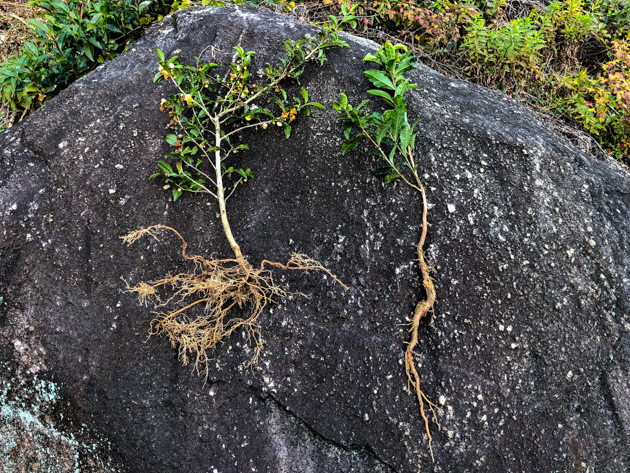
Left: a cutting (cultivar). Right: seed-grown. A tea bush grown from seed forms a taproot, a long root like a burdock. This lets it absorb minerals from the soil more readily, yielding a tea with a richer aftertaste.
The taste and aroma of Tsuge Native-Seed Sencha
The aroma of Tsuge Native-Seed Sencha is floral, though understated overall. Its greatest feature is, without question, the very long finish: a rich, deep aftertaste that seems to sink down into the body. In length of finish it is the greatest among all of HOJO's Japanese teas, and the quality of the raw leaf stands out. The processing is a little rough around the edges, but thanks to the quality of the material it is a tea with real substance.
Choose options