

Ma'anshan Ancient Tree White Tea 50g
Sourced from a Village Above 2000m
Ma'anshan is a mountain in the western part of Lincang, Yunnan, near the border with Myanmar. The name Ma'anshan refers both to the mountain and to a village. In the center of Ma'anshan village, however, fertilizer-based cultivation has spread as tea prices have soared. The village center sits at 1500 to 1600m, and the higher ground around the village reaches about 1700m. I, however, buy tea from a village where traditional natural cultivation is still preserved, deeper into the mountains beyond the Ma'anshan shown in the photos below. The area where I sourced this tea lies above 2000m, and the first flush there can be picked about ten days later than in other areas. Tea that grows slowly in the high mountains, with their sharp swings between day and night temperatures, is intensely sweet and deeply satisfying to drink. 
 The center of Ma'anshan
The Hallmark of Ma'anshan Tea: A Body That Fills the Whole Mouth
The defining characteristic of Ma'anshan tea is the sensation of the tea spreading to fill your entire mouth. In tasting terms this is called body: when you take the tea into your mouth, a strong sweetness is felt on both sides of the mouth, and a sweet aftertaste lingers after you swallow. Ma'anshan is blessed with fine soil, and every tea made around this village has an exceptionally strong body. Beyond body, a deep finish that seems to be drawn down into the back of the throat is another hallmark of Ma'anshan tea.
Made the Traditional Way
This tea was finished in a style similar to Bai Mudan (White Peony). The leaves were plucked as one bud and two leaves, or one bud and three leaves on the central shoots. During withering, we were not too concerned with color; instead, to let dehydration stress push fermentation further and bring out a strong sweetness, we withered the leaves for longer than is usual for Bai Mudan (more than two days). Rather than in a withering trough or a dedicated withering room, the leaves were spread in a single layer on bamboo trays in a shady, well-ventilated spot and withered under natural conditions. The result is a refreshing aroma with hints of muscat, citrus, and fresh spring greenery.

The photo shows the finishing step at our own facility, where a gentle hot-air treatment removes off-flavors and refines the aroma.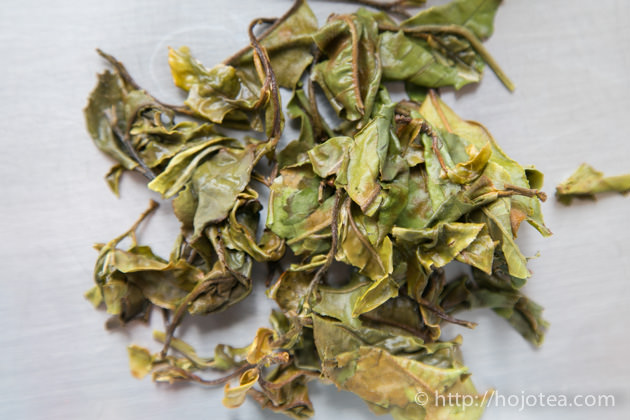
A White Tea That Transforms with Aging
White tea is delicious drunk right away, but aging it before drinking is another way to enjoy it. White tea made from naturally grown leaves, like Ma'anshan Ancient Tree White Tea, is especially rich in polyphenols and develops a pronounced sweet aroma when aged. Moreover, because these naturally grown teas have also been nibbled to some extent by leafhoppers, aging brings out an intensely sweet, honey-like, muscat-like fragrance. After several years or more of aging, Ma'anshan Ancient Tree White Tea turns into a tea with a sweet aroma reminiscent of ice wine. If you wish to age it actively, keep the bag unopened, in its oxygen-free state, in as warm a place as possible. The higher the average annual temperature, the faster the aging.
Cold-Brewed, It Is a Hit with Children
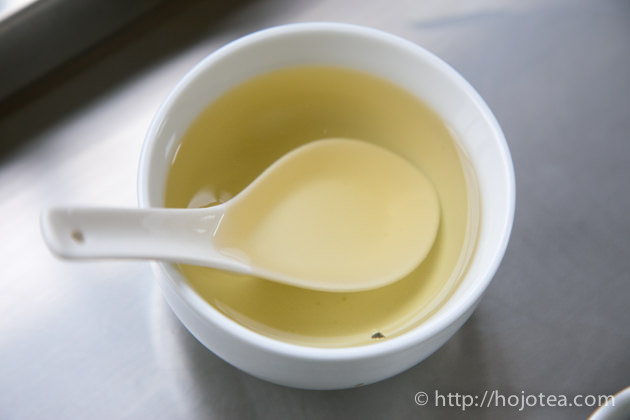
There is one more way to enjoy Ma'anshan Ancient Tree White Tea: cold brewing. I put 5g of leaves in 1 liter of water, place it in the refrigerator, and take it out a few hours later. If it seems weak at that point, leave it another hour or two; if it seems strong, dilute it with water to your preferred strength. To draw out more aroma, use boiled water that has been allowed to cool. Chilled white tea is wonderfully refreshing and delicious, and astonishingly popular with children. White tea is lightly fermented and keeps the leaf as close to its natural state as possible, and in my experience children love it. Children tend to prefer lightly fermented teas over black tea, oolong, or strongly flavored green tea; watching the children around me, they are extremely fond of white tea and raw pu-erh.
How to Brew
Water to Use
For convenience, we recommend tap water. If you use tap water, boil it for 3 to 5 minutes to drive off the chlorine used for disinfection. Even boiling, however, cannot remove chlorine completely. Wherever possible, use a water purifier with an activated carbon filter to remove the chlorine from the water. Otherwise the chlorine reacts with the tea's aroma compounds and you will not be able to enjoy its true fragrance. Chlorine is also added to kill microorganisms, and it kills not only harmful microbes but also the beneficial bacteria living in our gut. Various harms at the cellular level have been reported as well, and it can even cause allergies.
Distilled water and reverse-osmosis water contain no minerals at all, so the tea tends to taste flat. Please use mineral-containing water such as tap water whenever possible.
Also, never remove the limescale that builds up inside your kettle. Descaling with citric acid or the like will keep you from getting the tea flavor you are used to.
Once you have settled on a type of water, keep using that same type and do not switch. If the water changes, large amounts of minerals leach out of the scale, and after a while the tea will taste dramatically worse. Sticking to the same water is the secret to brewing delicious tea.
Brewing for the Best Flavor
Standard Method
Amount of leaves: 3-4g per 200ml
Water temperature: boiling water
Steeping time
1st infusion: about 30-40 seconds
2nd infusion onward: within 10 seconds
With this method you can brew six or more infusions in total.
Gongfu Method
To get the most out of this tea, do try brewing it gongfu style. The gongfu method developed in Chaozhou as a way to bring out the best in Phoenix Dancong oolong.
Amount of leaves: 5-7g per 100ml
Water temperature: 100℃
Rinse the leaves twice with boiling water. The purpose is to raise the temperature of the leaves. Complete each rinse quickly, within 1 to 2 seconds.
Keep the first infusion, and every infusion after it, to a few seconds. The first infusion will be on the light side, but from the second infusion onward the strength will be just right.
A Surprisingly Delicious Method
White tea can also be brewed with cold water. Use mineral water or water passed through a purifier. Pour 200ml of water over 3g of leaves and leave it for 20 to 30 minutes. The aroma and flavor extract gradually from the white tea, letting you enjoy its taste and fragrance in their natural state. Cold-water extraction yields less color than hot water, but take a sip and you will find a rich flavor.
How to Store Tea Leaves
We recommend storing at room temperature.
Tea is vulnerable to humidity, and the moment it absorbs even a little moisture, deterioration begins.
Please be aware that moisture can be absorbed unintentionally in situations such as the following.
- The tea is kept nearby while brewing and is touched by steam
- Moisture is clinging to the spoon or other utensils
- The package is opened on a humid day or in a humid place
- The package is opened immediately after being taken out of the refrigerator, causing condensation
- The package is taken out of the refrigerator and left unopened to return to room temperature, but the seal is imperfect and condensation forms
In practice, items 4 and 5 seem to be the biggest causes of deterioration.
When tea is stored in the refrigerator, the inside of the bag is cold, and even if it is tightly sealed with tape, outside air very often gets in and causes condensation. Once the leaves have suffered condensation, the aroma changes dramatically within two or three days.
As far as possible, store at room temperature, sealing the package in a thoroughly dry room to keep out humidity. Ideally, consume within a few months of opening.
Unopened, vacuum-packed products can be stored for a year or more. If you wish to age the tea further, keep it unopened (still vacuum-packed) at room temperature. If you prefer to maintain the quality exactly as it was when purchased, store it in the refrigerator. If stored in the refrigerator, always allow a full 24 hours for it to return to room temperature before opening. You might think half a day is enough, but tea leaves have a very large surface area and are, without exaggeration, a natural insulator. To the touch they may already seem to be at room temperature, but the interior is still cold, and a full 24 hours is needed to bring the temperature back up. Once the tea has been taken out of the refrigerator and opened, store it at room temperature. From autumn through spring, outdoor temperatures are low, so the tea will stay delicious for several months or more even at room temperature.
Choose options