
Imperial Dianhong Black Tea 100g
A Blend of Naturally Grown Yunnan Black Tea and Imperial-Grade Ripe Pu-erh
We created this original HOJO tea, unlike anything before it, by blending naturally grown black tea with ripe pu-erh.
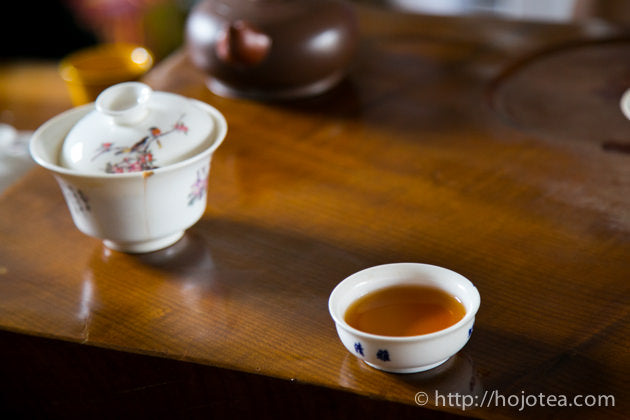
The sweet aroma of black tea meets the mellow, deep flavor of ripe pu-erh in a tea that is beautifully balanced in both fragrance and taste. It also makes a wonderful milk tea.
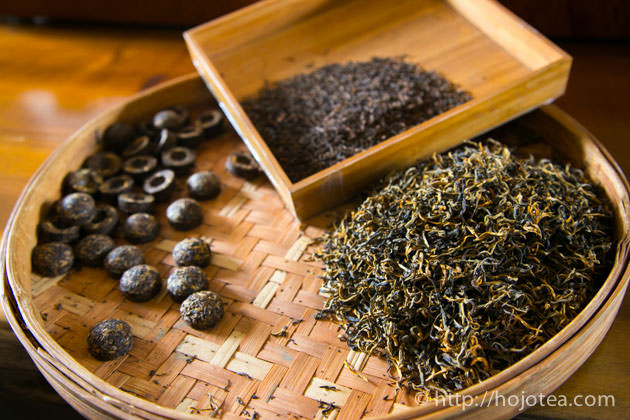
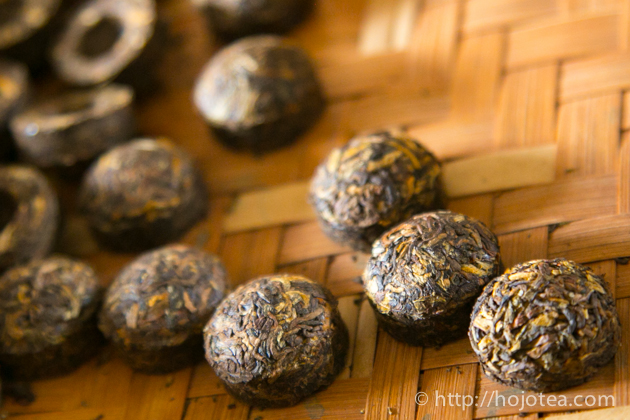
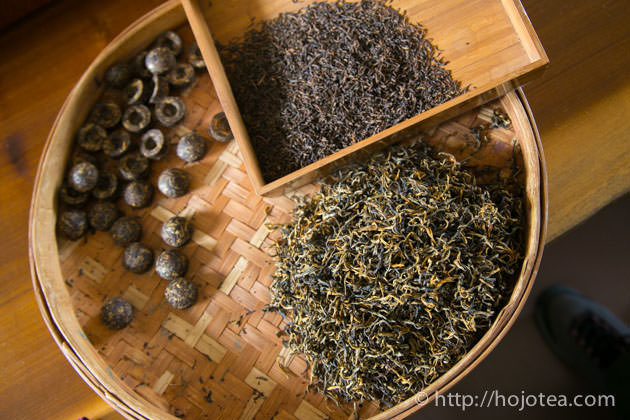
For ease of brewing, the tea is compressed into mini tuocha (roughly 5g each), so you can simply drop one into your teapot and brew a delicious cup with no fuss.
It is delightful to drink right away, but if you let it age for a while, you will discover a different aroma to enjoy.
High-quality ripe pu-erh never smells musty.
Some people dislike ripe pu-erh because it smells like "old furniture," "rotting wood," or "mold." But a musty smell is the mark of a very poor-quality ripe pu-erh, one whose fermentation process went wrong.
A good tea moves you when you drink it. At HOJO we taste a great many teas, again and again, so that we can bring you only the best quality.
Product Details

We created an entirely new tea by blending naturally grown black tea with ripe pu-erh. The result combines the sweet aroma of black tea with the mellow, deep flavor of ripe pu-erh, in a tea that is well balanced in both fragrance and taste.
A Collaboration of Imperial Pu-erh and Naturally Grown Black Tea
Blending black tea with ripe pu-erh turns out to be more delicious than you would imagine, and for years I had been enjoying the two blended together for my own pleasure.
Rather than keep that pleasure to myself, I recommended the blend to many friends and customers, but it never really caught on, for the following three reasons.
- You have to obtain two different teas
- You have to blend them yourself
- Compressed ripe pu-erh and loose-leaf black tea extract at different rates, so the flavor is never consistent
Compressed into Mini Tuocha for a Uniform Blend of the Two Teas
I wanted to solve all three of these problems and make a blend of Yunnan black tea and Imperial pu-erh that anyone could enjoy with ease.
However, if the two teas are blended as loose leaf, they cannot be mixed evenly: Imperial-grade ripe pu-erh has much smaller leaves than the larger-leafed black tea.
For this reason, I decided to compress the tea in its blended state rather than sell it as loose leaf.
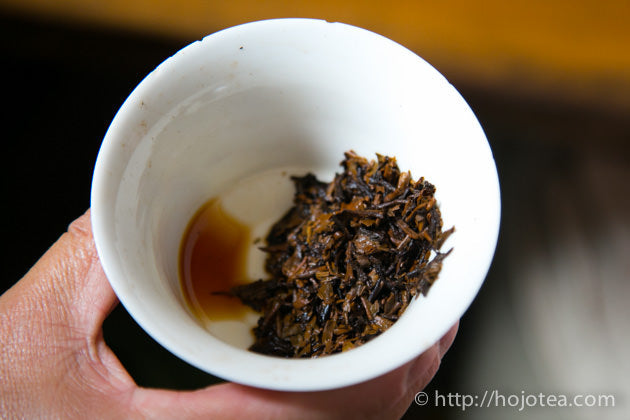
Compressing it into a 200g or 357g tea cake, though, raised concerns that the black tea leaves would break when the cake was pried apart, and that the mix would become uneven. So I chose to shape it into mini tuocha instead.
Each mini tuocha weighs about 5g, so you simply place one in your teapot and enjoy exactly the aroma and flavor I intended. It could not be more convenient.

The Black Tea Is Made from Premium One-Bud-One-Leaf Pluckings
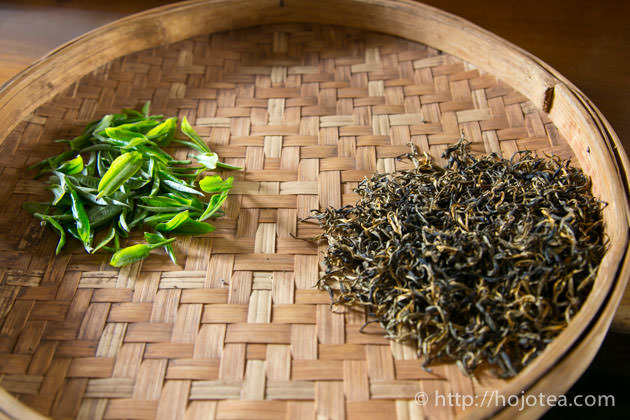
As for the raw materials, the black tea is made from one-bud-one-leaf pluckings harvested around March 20.
One bud and two leaves would give a tea with more robust flavor and aroma, but I deliberately selected one-bud-one-leaf pluckings for the black tea to achieve a smoother mouthfeel.
The black tea comes from a naturally farmed tea garden at an elevation of 2000m in Lincang, Yunnan. The tea is grown without pesticides or fertilizer, and not even the grass growing on the ground is removed.
It is a black tea of exceptional depth and medium body, and I think it is delicious enough to enjoy on its own as a black tea.
To secure black tea made from the very first pluckings of spring, I stayed in Yunnan from before the black tea season began, making certain to purchase early-picked tea.


The Ripe Pu-erh Is Imperial-Grade Golden Buds (Gong Ting Jin Hao)
For the ripe pu-erh, we used the Imperial Golden Buds (Gong Ting Jin Hao) sold by HOJO.
It too is made from naturally grown tea in Lincang. After two to three years of aging, this tea develops a sweet aroma reminiscent of dried jujube.
For that reason, I believe this black tea and pu-erh blend can be enjoyed not only right away, but also after a period of aging, when it will reveal a different aroma.

Why We Named It Imperial Dianhong (Gong Ting Dian Hong)
The finished tea turned out even more beautiful than expected, and we achieved exactly the flavor and aroma we were aiming for.
Because it blends Imperial Golden Buds, an Imperial-grade ripe pu-erh, with Yunnan black tea, we named it Gong Ting Dian Hong, or Imperial Dianhong.
Dianhong (Dian Hong in Chinese) is another name for Yunnan black tea. "Dian" is an old word for Yunnan Province, so Dianhong literally means "the red of Yunnan," that is, Yunnan black tea.


Delicious as Milk Tea, Too
Imperial Dianhong is lovely served straight, but it also pairs exceptionally well with milk.
We recommend brewing it strong with as little water as possible, then mixing it with plenty of milk.
The texture is as gentle as silk, and you will notice a natural sweetness even without adding sugar.
Sourcing Focused on Naturally Grown Tea

We have visited Yunnan every spring since 2010. Over many years on the ground, we have built numerous connections with famous tea-producing areas. What we value, however, is not the fame of the origin but a tea with a clear, transparent taste and a long finish. That is why we focus on remote mountain villages, selecting gardens of old, high-elevation trees grown without fertilizer, and sourcing through our own distribution routes. For details, please see the page below.
In Yunnan, thousands of producers make tea labeled with a famous origin while using leaves from elsewhere, and such teas flood every corner of the market, from airports to convenience stores and supermarkets.
What complicates matters is a curious reversal: the "copies" made from remote-area tea are often higher in quality than the genuine article. This is especially common with pu-erh from Lincang, and it is well known among the professionals who buy tea locally. For details, please see the page below.
Yunnan is home to long-established brands such as Dayi and Zhongcha. These brands owe their renown to the high esteem in which their pre-1990 teas are held.
So what makes those old teas special? Many people assume it is long aging, but in fact the leaves used at the time were high-quality tea grown naturally, without fertilizer.
That is why tea made today will not reach the same quality no matter how long it is aged. For details, please see the page below.
Choose options