

Dong Ding Oolong 100g
1. History and Culture
Dong Ding is the name of a mountain in Lugu, Nantou County, Taiwan. The trail up the mountain is said to be extremely slippery, and because climbers had to dig in with their toes ("dong jiao jian," or "frozen toes") to reach the summit, the mountain came to be called "Dong Ding."
About 150 years ago, the oolong cultivar brought from Wuyi in Fujian Province, China, is said to have been planted on Dong Ding Mountain. At first, "Dong Ding Oolong" referred to oolong tea produced in the vicinity of Dong Ding Mountain, but as its reputation grew, tea grown in other regions came to be sold under the same name. In recent years, tea grown in the lowlands is given a heavier roast for a toasty aroma and even exported overseas as Dong Ding Oolong.
2. Growing Region
The leaves are grown on Dong Ding Mountain in Nantou County, Taiwan. As the fame of Dong Ding Oolong spread, ordinary high-mountain tea not from Dong Ding Mountain began to be roasted and sold under the name Dong Ding Oolong. In fact, most of the Dong Ding Oolong on the market is said not to come from Dong Ding Mountain. At the same time, even within Taiwan, "Dong Ding Oolong" is increasingly treated as a type of tea rather than an origin, and genuine Dong Ding Oolong from Dong Ding Mountain is now a rare thing.
 |
 |
|
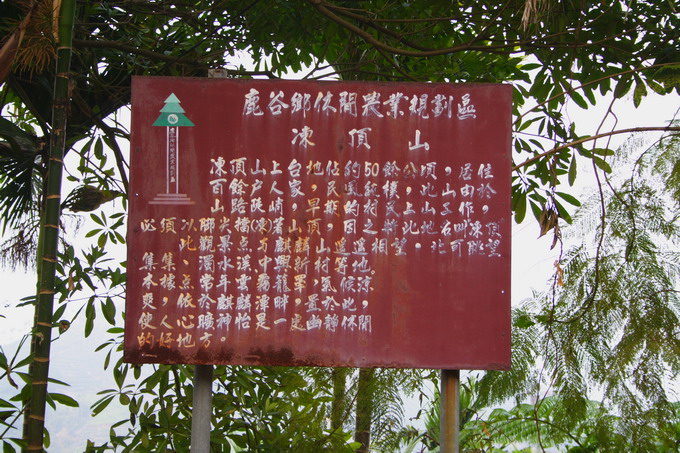
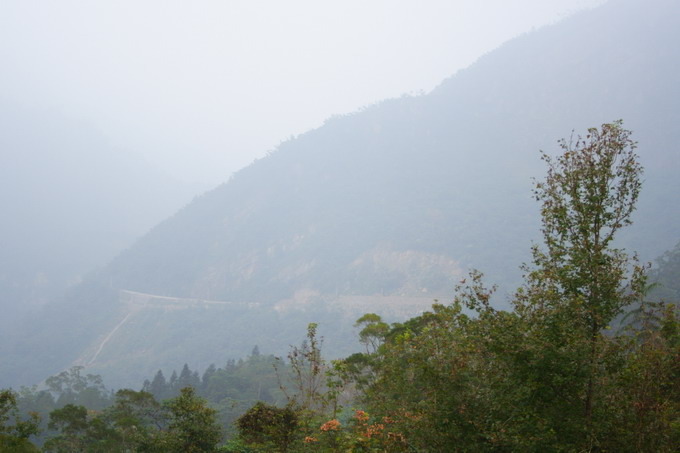
| [Dong Ding Mountain] Mostly shrouded in mist in the afternoon |
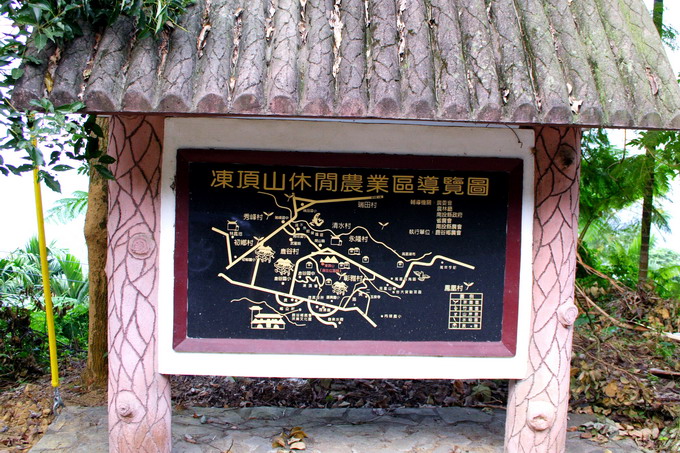
At HOJO, however, we insist on authentic Dong Ding Oolong and sought out tea from Dong Ding Mountain itself. Dong Ding Mountain is one of Taiwan's foremost sources of fine tea, and the secret to its distinctive, delicious tea lies in its location. Dong Ding is by no means a high mountain; its elevation is only around 1000m. In terms of sunlight, soil quality, and general environment, conditions on Dong Ding Mountain are not particularly comfortable for tea. Yet mysteriously, tea grown in this harsh environment produces a powerful aroma and a sweet taste. One sip of our Dong Ding Oolong and you will understand.
 |
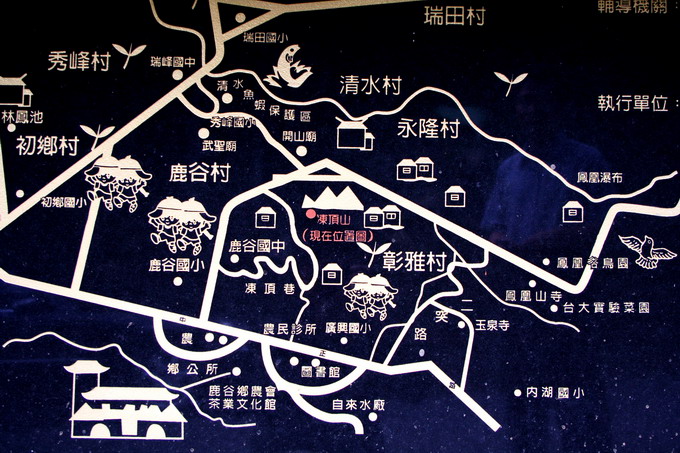 |
The sweet aroma and the mellow, refined drinking experience reminiscent of a fine Japanese tea are qualities you get only from tea grown on Dong Ding Mountain in Lugu Township. The raw leaves are purchased from a pesticide-free tea garden.

3. Cultivar and Harvest
|
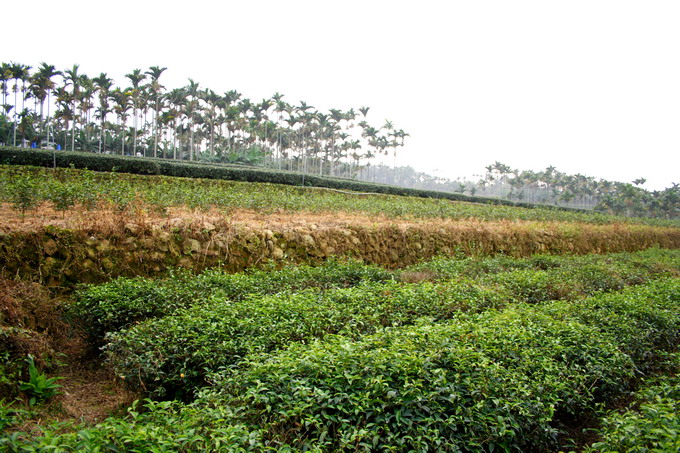
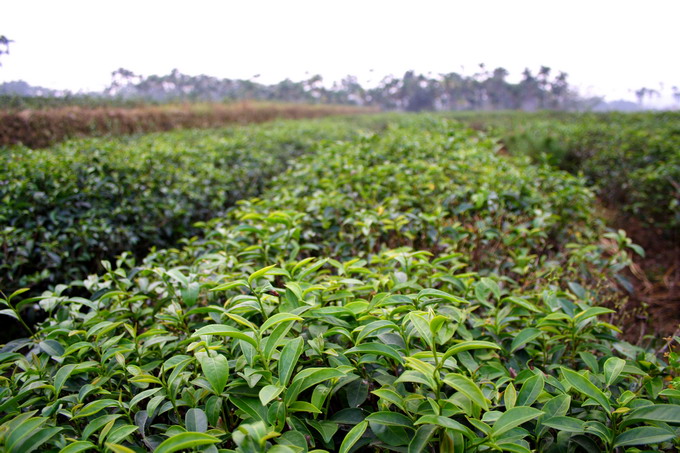
HOJO's Dong Ding Oolong is made from the cultivar known as Qing Xin Oolong. Tea made from this cultivar is clean and refreshing to drink, yet carries an elegant fragrance. |
 |
|
|
As the photo shows, the leaves are yellowish-green rather than lush green, and the plants cannot be said to be growing vigorously. Yet it is precisely these slow-growing leaves that yield delicious tea. |
||
 |
 |
|
| A garden of the Qing Xin Oolong cultivar | Leaves of the Qing Xin Oolong cultivar, from which Dong Ding Oolong is made |
All plucking is done by hand. Three to four leaves, including the bud, are picked by hand. Harvests take place in spring, summer, autumn, and winter, but the finest leaves come from the spring and winter pluckings. The winter harvest takes place in November and December. HOJO's Dong Ding Oolong is made only from spring- or winter-plucked tea, whose leaves are fresh and tender.
4. Processing
Sun Withering
After harvest, the leaves are spread on the ground under the sun to wither. This is called sun withering. Normally it is done on a lightly overcast day to keep the leaves from being damaged by the sun. When the weather is fine and the sunlight strong, a cover is stretched several meters above the ground to soften the light.
Sun withering evaporates moisture from the leaves and gently sets fermentation in motion. The leaves gradually soften and begin, little by little, to give off a fresh aroma.
Indoor Withering and Fermentation
The way oolong is fermented differs greatly from black tea. Once sun withering is complete, the leaves are carried indoors and scattered on sheets. For moist, sappy leaves, the layer is kept thin to speed up evaporation.
Next, the leaves are spread on bamboo trays. Spreading them on the trays encourages fermentation, and the leaves are repeatedly lifted and "dropped onto a tilted tray," then "left to rest and ferment."
The leaves are then tumbled in a bamboo drum. As they are lifted and dropped, lifted and dropped, the edges are gradually bruised and enzymatic fermentation proceeds.
When fermentation has progressed sufficiently, a sweet, floral aroma rises from the leaves. Leaves processed by a skilled craftsman turn red only at the edges. This shows that only the perimeter of the leaf was bruised and partially fermented, and it clearly distinguishes them from low-quality leaves that have reddened unevenly.
Once fermentation is complete, the leaves are heated to deactivate the enzymes and stop fermentation. If fermentation is not halted at the right moment, it continues and the flavor drifts toward that of black tea.
The number of tumblings and the resting times are decided based on the moisture content, aroma, and color of the leaves. This delicate timing is judged by the experience of the craftsmen, and it has an enormous influence on the quality of the oolong. The workers act on the instructions of a "master," and the master's skill largely determines the aroma of the oolong. To obtain excellent quality consistently, you must work with an excellent master.
Rolling
At this stage the leaves already have the flavor of oolong tea. But apart from the edges, the leaf cells are still intact, so if brewed as they are, the flavor and aroma would not extract sufficiently. On the other hand, if the leaves were rolled under high pressure as in black tea production, (1) unwanted off-flavors would leach into the tea, and (2) the components would be overexposed to air, causing non-enzymatic oxidation (oxidation without enzymatic fermentation) that alters the taste and aroma.
To resolve this dilemma, oolong production uses a technique called "bao rou." As the characters suggest, bao rou means wrapping and then rolling.
While still warm and soft, the leaves are placed in a cloth bag. Ten to twenty kilograms of leaves are wrapped at a time and formed into a ball the size of a basketball. Today the end of the bag is twisted tightly by machine. This powerful twisting compresses the bag and puts the leaves under strong pressure.
Next, the ball of leaves is placed in a disc-shaped machine. It has an upper and lower disc, and the ball of tea is sandwiched between the two plates. The upper disc is fixed and does not move; only the lower disc rotates. The ball of leaves is rolled as it turns. After a period of rolling, the leaves are gently heated once more. Because the leaves harden and crack when they cool, they are heated periodically to keep them soft.
Gradually the leaves tighten and are formed into balls. The higher the grade, the more tightly rolled the leaves and the heavier they feel. Good-quality leaves also have a glossy surface from the hardened extract that has emerged from the leaf.
This sequence of steps is repeated many times. The number of repetitions, the manner of rolling, and the application of heat vary with the condition of the leaves. For example, leaves harvested from a garden somewhat short of nutrients and water have relatively low moisture. If these leaves were rolled in the same way, the low moisture would cause them to crack, or the heat would cause discoloration.
Taking into account the condition of the leaves, the day's weather, and many other factors, and adjusting the conditions of each step accordingly, is essential, and this is the mark of a capable "master."
Once rolling is complete, the leaves are dried in a dryer until their moisture content falls below 5%, and the tea is finished.
6. How to Brew
Water to Use
For convenience, we recommend tap water. If you use tap water, boil it for 3 to 5 minutes to drive off the chlorine used for disinfection. Even boiling, however, cannot remove chlorine completely. Wherever possible, use a water purifier with an activated carbon filter to remove the chlorine from the water. Otherwise the chlorine reacts with the tea's aroma compounds and you will not be able to enjoy its true fragrance. Chlorine is also added to kill microorganisms, and it kills not only harmful microbes but also the beneficial bacteria living in our gut. Various harms at the cellular level have been reported as well, and it can even cause allergies.
Distilled water and reverse-osmosis water contain no minerals at all, so the tea tends to taste flat. Please use mineral-containing water such as tap water whenever possible.
Also, never remove the limescale that builds up inside your kettle. Descaling with citric acid or the like will keep you from getting the tea flavor you are used to.
Once you have settled on a type of water, keep using that same type and do not switch. If the water changes, large amounts of minerals leach out of the scale, and after a while the tea will taste dramatically worse. Sticking to the same water is the secret to brewing delicious tea.
Amount of Leaves
As a rule, use 1g of leaves per 40ml of water. So for a teapot holding 200ml, 200 ÷ 40 = 5g. Likewise, use 8g for 300ml.
Temperature Control Is the Life of Oolong
When brewing oolong, nothing matters more than controlling the water temperature.
It is not simply a matter of using hot water.
Even if you start with hot water, if it cools during the brewing process, the result is little different from brewing with lukewarm water.
The following two points are therefore essential.
Raise the Temperature of the Leaves
Even after warming the teaware, if you brew immediately, the leaves themselves lower the water temperature. You may think "surely a few tea leaves can't do that," but leaves have an enormous surface area and exchange heat very efficiently; in our experiments the temperature drops by 20℃. In other words, even after warming the teaware as in step No. 1, the temperature falls another 20℃.
So pour boiling water over the leaves once more. Pour briskly and quickly, from as low a position as possible. If you pour slowly in a thin trickle, the water cools along the way. Pouring from a height likewise lowers the temperature. Once the water is in, let the leaves steep for 7 to 10 seconds, then pour it off quickly. If you dawdle here, the tea's precious flavor is lost. But if the time is too short, the leaves will not warm up.
Steps 1 and 2 are extremely important; master just these two and the flavor of your oolong will change dramatically. Skip them, and while you may think you are brewing at 100℃, you are actually brewing at 60℃, and the taste will lack sharpness.
The steeping times are as follows.
1st infusion: 55 seconds
2nd infusion: 45 seconds
3rd infusion: 55 seconds
4th infusion: 65 seconds
5th infusion: 75 seconds
6th infusion: 85 seconds
After steeping for the times above, be sure to pour out all of the tea.
If water is left sitting in the teapot, the leaves continue to extract in the hot water, making the second and later infusions far too strong, and the leaves oxidize.
Furthermore, once you have poured off the tea, always remove the lid and let the leaves cool. This step is extremely important yet surprisingly little known. Cooling prevents oxidation and keeps the leaves fresh.
Choose options