
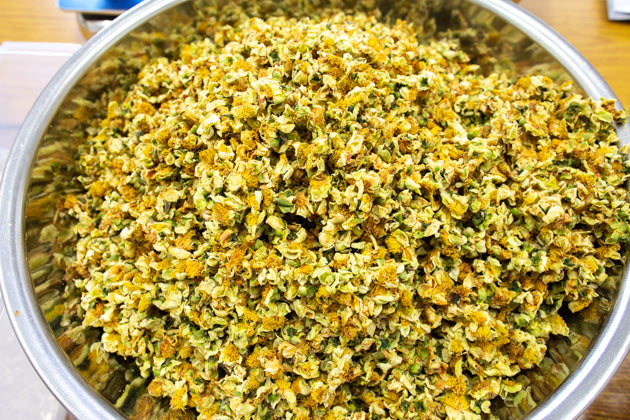
Old tea tree flower 50g
This is a flower tea made from tea flowers harvested from old trees without pesticides or fertilizers. This flower tea is made by drying the flowers of tea trees that are hundreds of years old in tea plantations at an altitude of 2000-2200m in the west of Lincang.
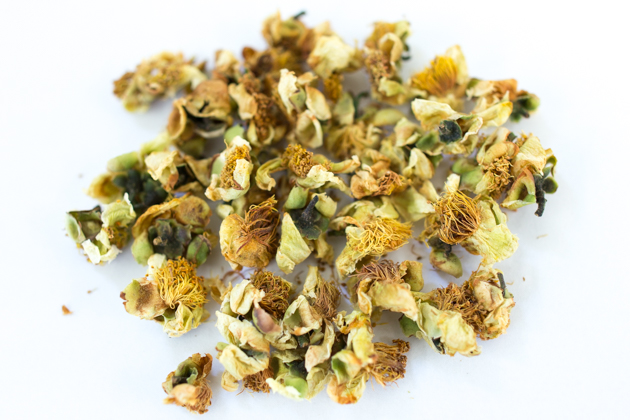
Tea flowers are hard to obtain even if you want them
If you go to a typical tea plantation in Japan or Taiwan, you will see that the tea flowers are sparse, despite the large size of the tea fields. In fact, the number of tea flowers is inversely proportional to the amount of fertilizer applied. Interestingly, tea plants grown with fertilizer will have fewer flowers, while tea plants left in their natural state without fertilizer will produce many tea flowers.
If a tea plant is given fertilizer, it is like a person, enjoying a rich life, so perhaps it decides that it doesn't need to have offspring?

Not all tea flowers are the same
Even though they are all called tea flowers, the quality of their taste is not the same for each tea plant. Just like tea leaves, there are noticeable differences in the quality of the flowers. In particular, the taste and intensity of the fragrance can vary greatly depending on the altitude, the age of the tree, and whether or not fertilizer is used. Tea trees grown at high altitudes and old trees, as well as those grown without fertilizer, grow slowly, so the tea flowers have a rich taste and aroma, a very strong aftertaste, and a long lingering finish, allowing you to enjoy a strong flavor. 
These are tea flowers, harvested from a tea plantation that produces Tangjia Ancient Tree Raw Pu-erh tea.
Old tree tea flowers are flowers from old trees that are about 200-300 years old. Because they are large trees as big as a two-story house, it is necessary to climb the tree to harvest them. 

Sweet peach-like scent
Although it is made from tea flowers, when you first drink it, it smells like a barley drink that is popular in Malaysia, but as soon as you swallow it, the aroma changes in your mouth to something reminiscent of rich peaches and pears (recollect). Because it has a very fruity and sweet aroma, it was well received by the female staff at HOJO.
Blending is fun
Tea flower tea is delicious when drunk alone, but it is interesting to blend it with other teas. Tea flower comes from the tea plant, so it goes well with all kinds of teas, and blending it expands the world of taste and aroma. It goes well with green tea, white tea, black tea, oolong tea, etc. 
Low caffeine, 1/20th that of tea leaves
Tea flowers are recommended for people who want to limit caffeine intake. Mr. Sakamoto of the Kagoshima Prefectural Agricultural Experiment Station has analyzed the caffeine content of tea flowers. According to his literature, tea leaves contain 2-5% caffeine, while flowers contain only 0.1%.
https://www.jstage.jst.go.jp/article/cha1953/1956/8/1956_8_84/_pdf/-char/en
Since the amount is extremely small, just a few tenths of that contained in tea leaves, it is recommended for those who require ultra-low caffeine tea, such as pregnant women and nursing mothers.
Cold-brewed tea is also recommended
Preferences may vary, but Koju Chaka is a delicious tea even when brewed in water. If you brew it in water during the hot season, you can easily drink it straight from the refrigerator. When brewing in water, use "cooled water" that has been cooled after boiling. As a guideline, use 5g for 2L of water. Leave it in the refrigerator for half a day to overnight to complete the brew.
How to drink deliciously
Water used
We recommend tap water, as it is water that is readily available. If you use tap water, boil it for 3 to 5 minutes to remove the chlorine used for disinfection. However, even boiling cannot completely remove the chlorine. If possible, use a water purifier with an activated carbon filter to remove the chlorine in the water. Otherwise, the tea's aromatic components and chlorine will react with each other, and you will not be able to enjoy the original aroma. Chlorine is also added to kill microorganisms. It not only kills microorganisms that are harmful to health, but also kills the good bacteria that live in our intestines. Various harms have also been reported at the cellular level, and it can cause allergies.
Distilled water or reverse osmosis water tends to give the tea a flat taste because it does not contain any minerals. Please use tap water or other mineral water whenever possible.
Please do not remove any limescale (scale) from the kettle. Washing with citric acid, for example, will result in the tea losing its original flavor.
Once you have decided on the type of water you will be using, please continue to use the same type of water without changing the type of water in the future. If the type of water is changed, a large amount of minerals will be dissolved from the scale, and after a while the taste of the tea will dramatically deteriorate. The secret to making delicious tea is to continue using the same water.
Amount of flowers
As a guideline, 5g will make 1.5 liters. Please adjust the amount according to the number of people. 3g will make 1 liter.
How to brew
Use boiling water, run the flowers through it once, preheat for about 10 seconds, then discard the water. This is not a cleaning procedure, but a step to raise the temperature of the flowers. The higher the temperature at which the tea is brewed, the more refined the flavor will be. Use boiling water when brewing the tea. For the first brew, steep for about 30 seconds as a guide, although this depends on the size of the teapot. If you are using a large teapot, steep for a little longer. From the second brew onwards, simply running the water through the tea is enough to bring out the flavor and aroma. You can brew multiple brews, so enjoy the tea until the flavor and aroma are gone.
Choose options