


Da Cha Tou Ripe Pu-erh Nuggets 50g
The first tea to sell out at the source
Cha tou are lumps of tea, anywhere from fingertip-sized to the size of a silkworm cocoon, that form naturally when the leaves clump together midway through the fermentation of ripe pu-erh. Among ripe pu-erh, cha tou are prized for their especially fine aroma and their smooth, rich, concentrated taste, which makes them hugely popular within China as well. Da cha tou (large cha tou) are often kept by the producers as part of their own collections, or bought up a year in advance by close customers on pre-order, so they are hard to obtain even if you travel to the producing region, let alone find on the tea market. Cha tou made from naturally farmed tea in particular are targeted by many tea merchants, so competition with other buyers is common, and it is not unusual for tea you had reserved to be snapped up by someone else. HOJO was able to secure these cha tou by placing our reservation a year ahead.
Large, medium, and small cha tou
Because cha tou form naturally during fermentation, freshly produced cha tou vary widely in shape and size. The producer grades these lumps of differing sizes into large, medium, small, and extra small. Da cha tou are the largest grade of all. Even so, since they are naturally formed lumps, "large" does not mean they are uniform in size. 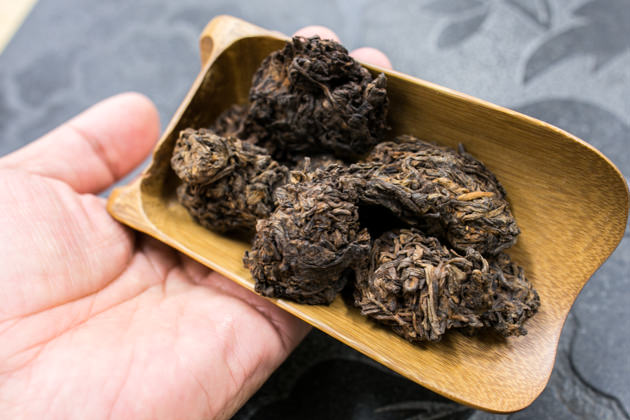
Cha tou are natural lumps that form only from spring-picked tea
The fermentation of ripe pu-erh involves a succession of microorganisms: aerobic bacteria, anaerobic bacteria, molds, and yeasts. Cha tou form when the leaves clump together naturally during microbial fermentation, through the interaction between the tea's own compounds and polysaccharides produced by microorganisms, chiefly actinomycetes. Cha tou form only when the raw material is the first spring picking, which is rich in compounds; they essentially do not form from summer-picked tea. Autumn-picked tea yields a few, but only in tiny quantities. With autumn tea, fermenting several tons of leaves produces at most 20 to 30 kilograms of cha tou, and those are loose, crumbly lumps whose taste and aroma are clearly inferior to spring cha tou, with a very coarse flavor. Spring tea is so rich in compounds that its cha tou grow very hard and large. However, since ripe pu-erh made from spring tea is itself very scarce, cha tou are extremely rare on the pu-erh market. 
An oxygen-free interior creates the signature aroma
Cha tou are not just unusual in shape; their taste and aroma are distinctive at a level anyone can recognize. Compared with ripe pu-erh from the very same batch, the aroma is far fruitier, the taste richer and sweeter, and the texture smooth and velvety on the palate. The reason cha tou have such a distinctive flavor lies in how they form. A cha tou formed midway through fermentation is only half-fermented inside, and its interior becomes an oxygen-free environment. At that point the lump still holds a moderate amount of moisture, and it continues to mature for about a month in the heat generated by fermentation. Maturing in the absence of oxygen is what gives the tea its intensely fruity aroma. Large cha tou in particular contain a greater volume of oxygen-deprived leaf, which is why their aromatic character and quality stand out even among cha tou. 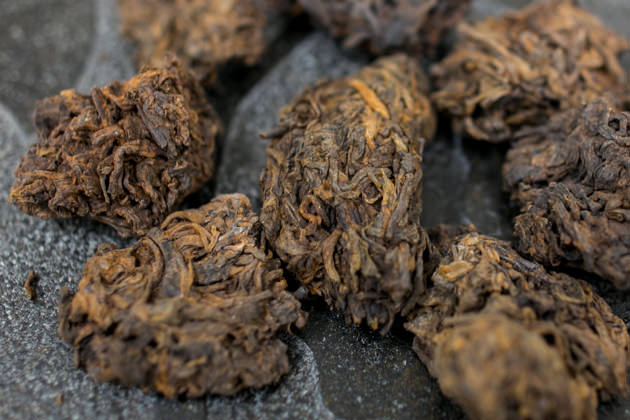
The white powder on the surface is actinomycetes, essential to ripe pu-erh fermentation
You may sometimes notice a white, powdery substance on the surface of cha tou. At first glance it looks like mold, but it is not mold; it is actinomycetes. Mold is filamentous, not powdery. Ripe pu-erh is made by microbial fermentation, and when that fermentation is well controlled, actinomycetes multiply abundantly, so they can be seen on the surface of the finished tea. When tea is pressed into cakes, the steaming dissolves the actinomycetes and they are no longer visible, but cha tou are sold in their raw, freshly produced state, so it is not unusual to see them. Actinomycetes are an important microorganism in the fermentation of ripe pu-erh and are not harmful to the body, so please rest assured. Below is a photo of ripe pu-erh partway through fermentation. The lumps are cha tou. The white patches visible here and there are the actinomycetes that are indispensable to good ripe pu-erh fermentation. 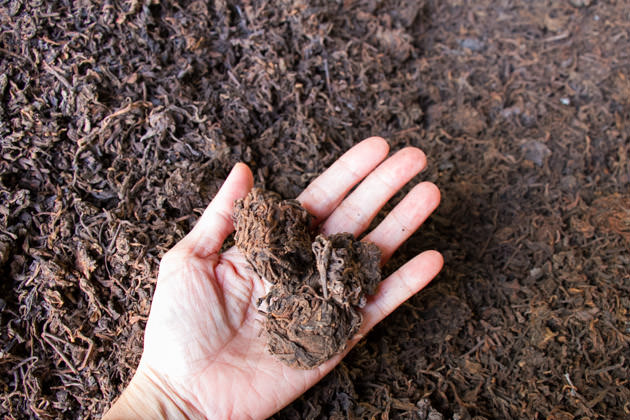
The white areas are the actinomycetes essential to ripe pu-erh fermentation 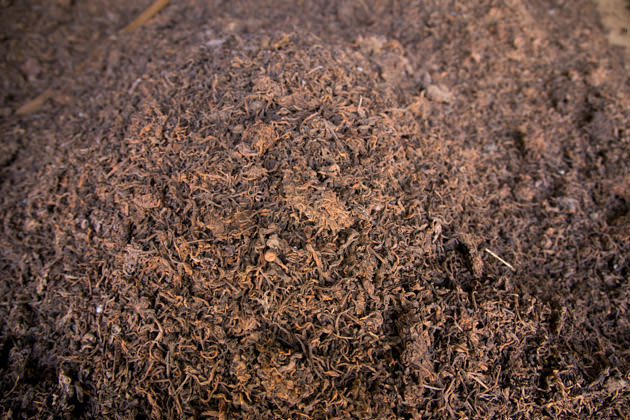
Tea from a naturally farmed garden at 2,000m
This product is made from spring tea (2019 harvest) from a naturally farmed tea garden at around 2,000m elevation in southwestern Lincang. Natural farming uses no fertilizer at all, so the tea grows slowly, over a long period. As a result it is rich in minerals and polyphenols, with a concentrated, deeply flavorful taste and aroma.
Da cha tou smell of dried fruit
Da cha tou are produced through ideal fermentation and carry a sweet aroma like dried fruit: dried apricot, prune, fine raisins, brandy. There is none of the musty, stale, or earthy smell often associated with ripe pu-erh. Cha tou mature faster in storage than ordinary ripe pu-erh. With aging, the fruit aroma grows stronger and the tea becomes richer. 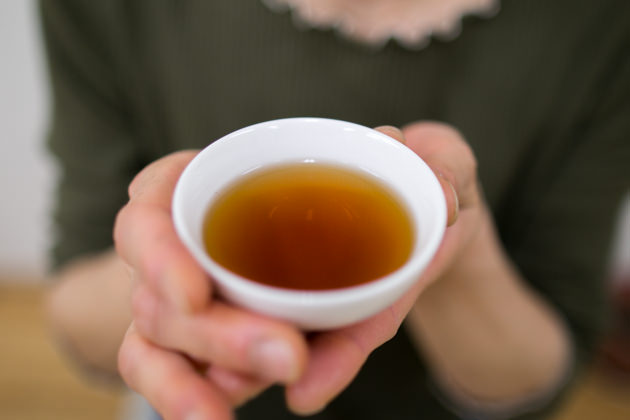
A perfect match for milk, black tea, and shochu
With their sweet dried-fruit aroma and silky-smooth texture, da cha tou pair beautifully with milk. Brew da cha tou on the strong side and add milk, and you get a smooth milk tea with a rich, lingering aftertaste. Adding spices to make a chai is also an interesting idea. Da cha tou are also excellent for blending with black tea. The two go together remarkably well: the middle notes of the black tea sit on top of the deep dried-fruit aroma of the da cha tou, adding complexity to the fragrance. As for which black tea to blend with, my personal preference is for Yunnan black teas. Yunnan Ancient Tree Black Tea Xing Mi Xiang, Ancient Tree Dianhong, and Yunnan Gongfu Black Tea are all good choices. A blend of black tea and da cha tou is delicious straight, of course, but it is also fun with milk. Da cha tou also go very well with shochu, so do give it a try. Personally, I find it pairs well with kokuto (brown sugar) shochu. Da cha tou are delicious on their own, but combined with black tea or milk and mixed with shochu, they become downright addictive.
Storing da cha tou
As for storage, unopened da cha tou will keep for decades without any problem. Even after opening, their quality is very stable; to put it bluntly, you could leave them for a year or two and notice no significant deterioration. The one thing to avoid is light, especially sunlight, which causes rapid deterioration, so please store them away from light.
How to Brew
Water
For convenience, we recommend tap water. If you use tap water, boil it for 3 to 5 minutes to remove the chlorine used for disinfection. Even boiling, however, cannot remove chlorine completely. Wherever possible, use a water filter with an activated carbon cartridge to remove the chlorine. Otherwise the chlorine reacts with the tea's aromatic compounds and you will not be able to enjoy its true fragrance. Chlorine is added to kill microorganisms, and it kills not only the harmful ones but also the beneficial bacteria living in our gut. Various harmful effects at the cellular level have also been reported, and it can be a cause of allergies.
Distilled water and reverse-osmosis water contain no minerals at all, so the tea tends to taste flat. Please use mineral-containing water such as tap water wherever possible.
Also, never remove the limescale that builds up inside your kettle. Cleaning it with citric acid or the like will mean you can no longer get the taste of tea you are used to.
Once you have settled on a type of water, keep using that same type and do not switch. If the water changes, large amounts of minerals leach out of the scale, and after a while the tea will taste dramatically worse. Sticking with the same water is the secret to brewing delicious tea.
Amount of leaf
As a guide, 5g of tea will make about 2 liters.
So decide how much leaf to use based on how much tea you ultimately want to drink.
For example, if you plan to drink about 1 liter, 2.5 to 3 grams is appropriate.
Heat the teaware
Pour boiling water into the teapot.
Let it stand for 10 seconds. This warms the teaware.
In our experiments, simply pouring boiling water into a teapot drops the temperature by 20°C.
In other words, although you think you are warming it with hot water, the water is actually only at 80°C.
If you want to brew oolong at its best, especially high-grade oolong, we recommend repeating this step twice. Pouring in hot water twice raises the temperature of the teapot to around 95°C.
Heat the tea leaves
Even after warming the teaware, if you brew immediately the leaves will lower the water temperature. You may think "surely a few tea leaves can't do that?", but tea leaves have a very large surface area and exchange heat efficiently; in our experiments the temperature drops by 20°C. So even though you warmed the pot, the temperature falls by another 20°C.
Therefore, pour boiling water over the leaves once more. Pour quickly, from as low a position as possible. If you pour in a slow trickle, the water cools along the way. Pouring from a height also lowers the temperature. Once the water is in, leave the leaves in it for 1 to 3 seconds and then pour it off quickly. If you dawdle here, the flavor of the tea will be lost. But if it is too short, the leaves will not be warmed.
Then repeat this step once more. In other words, rinse the leaves with hot water twice in total. With pu-erh, the leaves are compressed, so water cannot penetrate inside them. That is why we recommend rinsing twice.
The steeping times are as follows.
1st infusion: 1 minute
2nd infusion onward: just pass the water through
Cha tou are hard, tightly compacted lumps that take time to open up, so steep them for longer. In fact, for the first infusion you could even pour in the water and leave it to sit for a while. If it comes out too strong, like coffee, add hot water to dilute it.
With pu-erh, from the second infusion on you only need to pass the water through; there is no need to steep. This way you can brew 6 or more infusions, which makes it very economical.
Store any tea you cannot finish in the refrigerator. Pu-erh does not deteriorate in quality when refrigerated. It is also fine to put partly brewed leaves straight into the refrigerator as they are. With green tea or oolong, partly brewed leaves deteriorate quickly if stored. Fully fermented pu-erh, by contrast, can be interrupted midway, kept in the refrigerator, and continued a day later.
Choose options