
Uji Sencha Mt. Jubu 100g
Mt. Jubu
Uji tea. Wazuka, the town where Mt. Jubu stands, has been known since ancient times as a source of fine Uji tea, alongside Ujitawara, Minamiyamashiro, Kasagi, Tsukigase and Asamiya.
Land that was once the bed of Lake Biwa was uplifted, and erosion by the Nabari River then carved the river terraces that are characteristic of Tsukigase.
Perhaps because of that lakebed origin, these areas have an exceptionally fine-grained, high-quality red clay. Rich in iron, this red soil produces tea with a dense aftertaste and a long finish. Red clay is not found everywhere along the Nabari River, however; it survives only in tea gardens near the un-eroded summits of the mountains.
Conversely, land formed by river erosion contains a lot of sand and yields a tea with a light, thin finish.
 |
 |
|
|
Around Mt. Jubu This area is covered with iron-rich clay red soil. |
The home of Uji tea The distinctive landscape of mountains and valleys creates a wide gap between day and night temperatures, nurturing fine tea. |
The diagram below illustrates why the red clay layer exists only at higher elevations. River erosion washed soil down from the mountains, leaving the red clay layer in only a few places.

The Mt. Jubu tea gardens sit at an altitude high enough for snow to settle in winter. Because this area was once the bed of Lake Biwa, fine red clay has accumulated at the higher elevations, producing an iron-rich tea with a deep, satisfying finish.
At the foot of the mountain, by contrast, the terrain was carved out by river erosion, so the soil is sandy and the tea tastes thinner.
At high altitude the leaves receive stronger sunlight by day and their cells photosynthesize vigorously. At night, however, temperatures drop sharply, so the plant stops growing and instead stores up polyphenols and minerals.Highland vegetables are known for their rich, concentrated flavor. Tea is the same: tea grown high up tastes richer and has a deeper finish.
Grown naturally without fertilizer, for a deep finish and a sweet, lingering aftertaste
Mt. Jubu is a 682 m peak between Ujitawara and Wazuka. Because this land once lay at the bottom of Lake Biwa, the whole area is rich in clay red soil.
When sourcing this tea, we looked beyond the ideal environment of Mt. Jubu and chose leaves from natural cultivation. Natural cultivation means growing the plants without fertilizer or pesticides, slowly and over a long time, so that they become sturdy and wild, like the mountain vegetables growing on the hillsides.
In modern agriculture, fertilizer is considered essential for tea production. But tea saturated with fertilizer keeps growing excessively; it accumulates large amounts of amino acids, while the polyphenols and minerals that regulate the plant and give tea its flavor and quality become very thin, leaving a bland tea. Most Japanese tea on the market tastes very thin because of this excess of amino acids, so it is fired heavily to draw out aroma and give the tea some character. Yet truly good tea impresses you even when you simply chew the raw leaf. The "theanine-rich tea" that books cite as the hallmark of quality is, put another way, tea steeped in nitrogen fertilizer, and by my definition it is the opposite of delicious. Words alone are not convincing, but if you compare fresh leaves in the garden the difference is obvious at once. When we considered this year's new products, before any discussion of processing we were uncompromising in selecting the raw material. With good raw leaf in hand, we achieved a thoroughly delicious tea with almost none of the firing that the Japanese tea industry regards as standard.
First of all, the moment you swallow this tea, you will be surprised by a sensation completely unlike ordinary tea.
The tea slides smoothly down the throat as if drawn in, seeming to settle in the chest, and afterwards a wonderfully pleasant sweetness spreads from the base of the tongue to the back of the throat.
Put simply, the definition of good tea is that it tastes "rich." Rich means it has body, a flavor you can feel firmly at the back of the throat.
Brewing cheap tea strong with a lot of leaves increases the astringency and bitterness, but it does not make the tea "rich." Uji Sencha Mt. Jubu is rich in this sense. Even brewed with a tiny amount of leaf, the water itself becomes richer in taste, giving a deep sense of satisfaction. It is the same as saying that fine kombu only needs to be passed through water. Naturally, a single leaf of this tea dropped into miso soup gives the soup a depth like miso soup made with freshwater clams, though without the clam aroma, of course. You can tell the quality of a good tea even if you drink it with your nose pinched. Delicious tea has a soft, deep taste of its own, so it tastes good even without aroma.
Try putting a single leaf into orange juice, beer, yogurt, Coca-Cola or coffee.
Just try it, even if you think it sounds absurd! You will experience a change in flavor beyond anything common sense would suggest.
This curious ability comes from the fine minerals released by the leaf cells, iron ions in particular.
This tea has none of the amino-acid aroma so common in recent Japanese teas; its fragrance is so clean and refreshing you might mistake it for an oolong. It is a perfect tea for oolong lovers too.
Made from precious native-seed tea plants
Uji Sencha Mt. Jubu is made from what is called zairai, or native-seed tea. Zairai is often taken to mean a species native or indigenous to Japan, but strictly speaking it refers to tea that retains the characteristics of the old tea plants brought over from China. Being close to wild tea, native-seed plants root more vigorously than cultivars such as Yabukita, and at the same age their roots are longer. As a result they generally absorb minerals more efficiently than cultivars and produce tea with more depth of taste and aroma. (Depth of taste here does not mean bitterness or astringency, but richness of flavor, in other words the depth of the aftertaste.) In China, too, most high-quality teas are made from seed-grown plants; even the famous Longjing is made from seed-grown tea at its top grades.
"Aracha," with the fresh aroma of tea just made
Tea that has just finished processing after picking is called aracha, or crude tea.
Normally, the aracha is then cleaned of foreign matter, dust and stems, and fired to become the final product, or finished tea.
As for this firing, if the raw material itself is of high quality, there is no need to fire it at all. Tea made from high-quality leaf has a deep flavor and tastes of the tea itself, so the more it is fired, the more its character is lost.
On the other hand, tea grown conventionally on plentiful nitrogen fertilizer is low in polyphenols and minerals and has almost no natural sweetness of its own. Such tea has little character unless heat is applied to develop a toasty aroma. I believe the very culture of heavy firing was a measure to give some character to tea that is low in minerals and thin in taste.
With naturally grown tea, the leaf itself is so good that it tastes wonderful even as unfired aracha. In fact, most farmers prefer aracha. They know very well that aracha tastes better, and seem to keep the good-looking finished tea for gifts and the aracha for the family.
Stems deliberately left in, to preserve the tea's natural aroma
In Japanese tea, the stems are yellow and therefore stand out.
In modern tea processing, stems are always removed. Removing them gives a beautiful green leaf, so in the appearance-driven Japanese tea industry stem removal is the most basic of basics.
However, HOJO deliberately does not remove the stems. Through many experiments we realized that the stems are extremely important. Stems are rich in minerals and have a very sweet aroma. Anyone who has tried a stem tea such as kariganecha will know how sweet stem tea is!
Still, there are only about ten stems in a single serving (3-5 g). Can so few stems really change the taste?
To find out, we compared a tea from which the stems had been pulled by hand with tweezers against a tea with the stems left in.
The difference in aroma surprised even us. Everyone who tasted them preferred the tea with stems, an astonishing result. The tea without stems had a sharper aroma, and its soft, sweet floral fragrance was dramatically weaker.
As an aside, in the old days a tea stem floating upright in the cup was said to bring good luck.
But today's tea contains no stems to stand upright. Good luck or not, it simply cannot happen.
People in the past knew how good the stems tasted and habitually drank their tea with the stems in.
Today appearance comes first, and the stems are removed even at the cost of aroma and flavor.
In search of the golden tea garden
There is a story you occasionally hear from old people in tea-growing regions.
"Long ago, I once saw a golden tea garden..." I have heard people say that the tea picked from that golden garden was extraordinarily good, and that they have never forgotten the taste. I spend two months a year in the tea regions of China and visit the Japanese regions frequently. Naturally, I have seen golden tea gardens many times. It is very rare in Japan, but when natural farming, fine red clay and the ideal environment come together, a garden of yellow tea leaves is born.
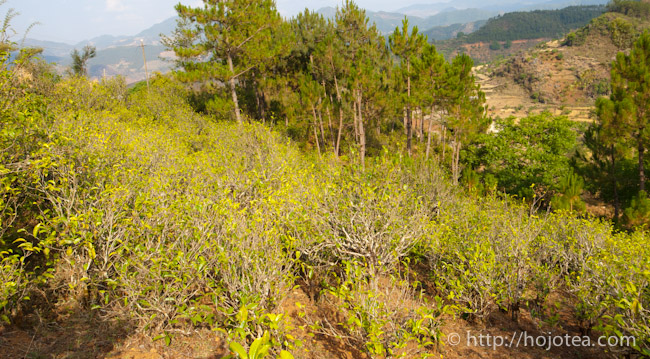
The photograph above shows tea trees grown entirely naturally by an ethnic minority in Yunnan, China. It was a magnificent sight, exactly what the words "golden tea garden" describe.
Wild plants growing in nature are chronically short of nitrogen. There is not that much nitrogen in the natural world, which is why wild plants grow slowly over a long time and become healthy plants rich in minerals and in polyphenols, the plant's own defensive compounds. The photograph below shows wild trees in summer. Plants growing in a sunny spot are yellow-green all over!

In modern tea farming, nitrogen fertilizers such as nitrates are used heavily. Once nitrogen fertilizer is applied, the tea plant concentrates on its own growth. The leaves turn deep green and shine as if they had been waxed.
In a sense, it is like a person who eats nothing but meat and is becoming overweight. By contrast, tea grown almost as it would grow in nature has small, yellow leaves, and the bushes take on a whitish look.
If you have the chance, go outdoors and look at the color of the plants. Plants growing naturally are yellow-green.
Plants growing in a fertilized field, on the other hand, are dark green.
 |
 |
|
|
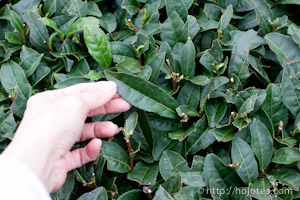
Tea grown with nitrogen fertilizer The leaves are very large, pleated and dark green. |
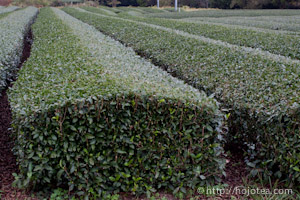
A typical tea garden Growing tea this way increases the following year's yield. The leaves are dark green throughout, in contrast to the photograph of wild plants above. |
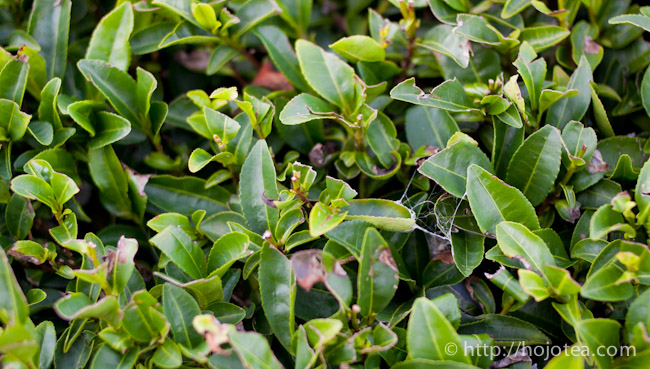
Naturally grown tea: the bushes are evened out in autumn, but only the very tips are trimmed. Every leaf is small, tinged with yellow and resilient. Even a mature leaf like those in the photograph has almost no astringency when chewed, and you feel sweetness in the throat.
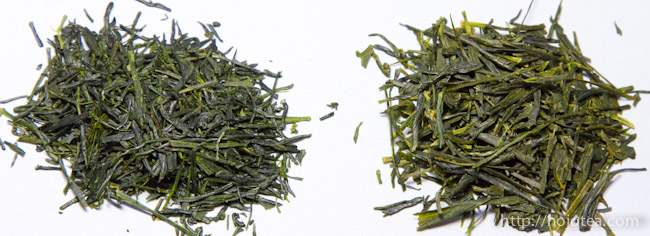
Look at the two leaf photographs above. Wouldn't you normally assume the tea on the left is the better quality? Tea grown without any nitrogen fertilizer has yellow leaves, and the liquor itself is yellow-green. At first glance it looks like oxidized tea, but it is this yellow from the moment it is made. And how sweet it is: exactly the sweetness of wild angelica-tree buds (tara no me).
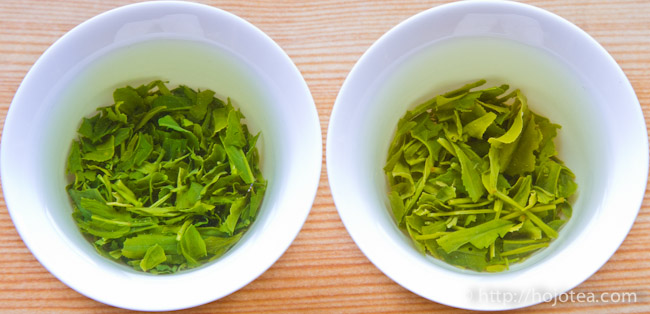
On the left is tea generally regarded as good; on the right is the naturally grown tea HOJO selects. Its hallmark is the same yellow color as plants growing in the wild.
The blind spot of organic farming
The idea that organic means healthy and organic means delicious is everywhere these days.
Organic farming is certainly reassuring where pesticides are concerned, but that has nothing whatsoever to do with "delicious" or "good for you."
To make truly delicious vegetables, fruit or tea, the plant must be allowed to grow slowly so that it forms leaves of high cell density, rich in polyphenols and minerals, with a deep flavor and a full, sweet body.
I have drunk many organic teas, and most were so little different from ordinary tea that I would not have known they were organic unless told.
This has a great deal to do with the fertilizer used and how the tea is grown. Even with organic fertilizer, if the plant is given a nitrogen fertilizer such as compost, the effect on the plant is ultimately the same as a chemical fertilizer like nitrate.
Given nitrogen, the plant grows vigorously, because nitrogen switches growth on.
A vigorously growing plant gets bigger because its individual cells grow larger.
Leaves in the growth phase do not produce polyphenols, and so the tea is low in minerals too. Presumably the plant is too busy synthesizing cell walls for its own growth to have time to make polyphenols.
Leaves made of large cells break easily and produce a lot of dust.
My family grows apples. With nitrogen fertilizer the leaves turn deep green, the leaves grow larger and so do the apples. But one bite makes it obvious: the flavor has no depth, and the apple is watery and unappealing.
Organic or not, I believe what matters is growing tea slowly, over time, in a way that is as close as possible to wild mountain plants. In tea that has grown slowly in a harsh environment, you can taste the hardship it endured as quality.
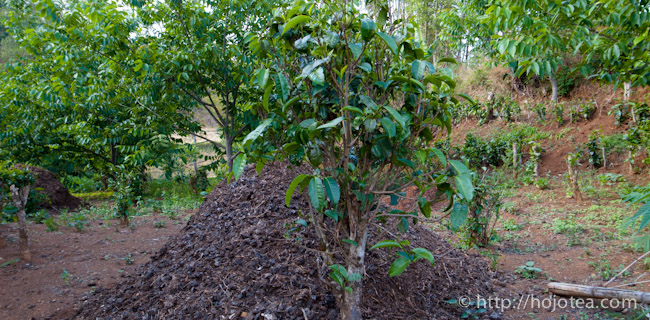
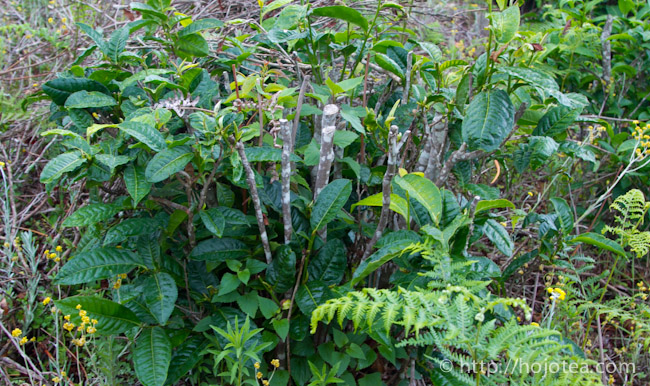
A tea bush beside a pile of animal manure. It bears huge, dark green leaves that hardly look like tea. Tea picked from a bush like this is thin in taste, with almost no finish.
Deep pruning
The deeper a tea bush is pruned, the more vigorously it sends out leaves the following year.
"Vigorously" ultimately means that the cells making up the leaf become larger, giving a tea low in minerals.
Not only in Japan, heavily pruned tea is for mass production, while tea grown for quality is generally pruned very little and left to grow slowly over time.
The two practices above are perfectly routine in famous producing regions such as Shizuoka and Kagoshima.
Applying nitrogen and pruning deeply speeds up growth, enlarges the leaves and increases yield.
Isn't it normal for high quality to mean low yield and rarity?
High yield and high quality at the same time is simply too good to be true.
To repeat: whether highland vegetables, delicious apples or premium melons, whenever flavor is the goal the plant is grown slowly over time. Yield falls, but the cells that make up the vegetable or fruit become densely packed, and the result is food with a rich, concentrated taste.
This is not limited to vegetables. The same applies when you compare fast-growing farmed fish with wild fish that grow slowly over time.
Pruned tea bushes send out young shoots vigorously and produce large quantities of big green leaves.
A tea that makes you sleepier the more you drink
With Uji Sencha Mt. Jubu, sleeplessness is not a concern. Quite the opposite: it is an ideal tea for anyone seeking deep sleep.
When you drink a mineral-rich tea, what the overseas tea market calls "premium tea," your body grows pleasantly warm and you actually become sleepy.
It is common knowledge that tea contains caffeine and that drinking too much keeps you awake. But as quality rises, the mineral content increases and circulation improves, which makes you sleepy instead.
Because Uji Sencha Mt. Jubu is so rich in minerals, it can even bring on a mild "tea drunkenness," relaxing you from within just like a fine brandy, whisky or wine.
This is not a matter of mindset: keep drinking and your face flushes and you begin to feel soft and mellow. Japanese law does not permit us to state health effects, so we cannot go into detail, but foods that improve circulation contribute to relaxation, regularity and sound sleep. Try it for yourself and see.

How to Brew
Water
We recommend tap water, as it is readily available. If you use tap water, boil it for 3 to 5 minutes to remove the chlorine used for disinfection. Even boiling, however, cannot remove chlorine completely. Wherever possible, use a water purifier with an activated-carbon filter to remove the chlorine. Otherwise the aroma compounds in the tea react with the chlorine and you cannot enjoy its true fragrance. Chlorine is added to kill microorganisms, but it kills not only harmful ones but also the beneficial bacteria living in our gut. Various harmful effects at the cellular level have also been reported, and it can be a cause of allergies.
Distilled water and reverse-osmosis water contain no minerals at all, so the tea tends to taste flat. Use mineral-containing water such as tap water wherever possible.
Also, never remove the limescale that builds up inside your kettle. Cleaning it with citric acid or the like will change the taste of your tea from what it used to be.
Once you have settled on a type of water, keep using the same type and do not switch. If the type of water changes, large amounts of minerals leach out of the scale, and after a while the tea will taste dramatically worse. Sticking to the same water is the secret to brewing delicious tea.
Amount of leaf
Adjust the amount of leaf to the number of people you are serving.
For 1 to 2 people, 2-3 g is appropriate; for 3 to 4 people, 4-5 g.
Amount of leaf

One teaspoon (3 g)
Water temperature
Japanese tea is commonly thought to be brewed at low temperatures, but naturally grown tea is rich in polyphenols, and to extract them efficiently you should brew with boiling water.
Steeping time
Because the water is hot, keep the steeping time as short as possible to prevent the leaves from deteriorating from the second infusion onward. As a guide, the first infusion should be within about 20-30 seconds.
For the second infusion, simply pass the hot water through. In other words, there is no need to wait even one second.
Brew the third to sixth infusions and beyond the same way as the second.
Pouring
To keep the flavor and color even, swirl the teapot gently before pouring and fill each cup a little at a time, going round several times. This is called mawashi-tsugi, or pouring in rotation. Also, pour out every last drop so that no water is left in the pot.
Furthermore, once you have poured out the water, always remove the lid to let the leaves cool.
Choose options