

Imperial (Gong Ting) Golden Buds Ripe Pu-erh 200g
This tea is characterized by a delicate flavor that seems to seep into the tongue, backed by deep, rich body. The taste is extremely concentrated, with no astringency or bitterness whatsoever. It brings on "tea drunkenness" easily, so we recommend drinking it when you want to relax completely.
If you are a pu-erh lover, you have probably heard the name Gong Ting (Imperial) pu-erh. Gong Ting pu-erh is one category of ripe pu-erh. Books and websites tend to present Gong Ting pu-erh as the highest grade of pu-erh, but that is not necessarily an accurate understanding.

Left: mao cha. Right: after grading.

Mao cha immediately after fermentation
Freshly processed ripe pu-erh leaf is called mao cha, and consists of one bud with two leaves, or one bud with three leaves. With ripe pu-erh, the mao cha is either compressed and sold as is, or it is sieved and graded by size and by part of the plant. Neither approach is better than the other, but grading naturally allows the buds, leaves, and stems to be separated, which can bring out characteristics that mao cha does not have. Among these grades, the one that collects only the tips, the buds, is called Gong Ting pu-erh. Because it consists mostly of buds, the tea before pressing is a deep golden color, and its appearance gives the impression of a high-grade tea. Given the small yield and high demand, Gong Ting pu-erh commands the highest price of all the graded parts. There are exceptions depending on the producer, however: sometimes the tea called "cha tou," the lumps that form naturally when leaves clump together, sells for the highest price of all.

Cha tou: lumps of tea leaves that form naturally during fermentation
Of course, even among Gong Ting pu-erh, quality varies enormously depending on the raw material used. Tea grown with heavy fertilizer, naturally farmed tea, and naturally farmed tea picked from old trees all differ in the strength of their body, and the soil of the tea garden also determines the tea's body. What matters is obtaining good raw material with excellent body and richness; such tea is, naturally, delicious even as mao cha. Gong Ting pu-erh made from good raw material is excellent precisely because its source is excellent, and it offers a taste that imprints itself deeply on your memory after a single cup.

The Gong Ting Golden Buds pu-erh we present here was harvested in a region close to the Myanmar border, about ten hours by car from Lincang. The tea trees are owned by an ethnic minority community, and the tea is grown by natural farming. In reality, the vast majority of ripe pu-erh is made from plantation tea grown with modern agricultural methods. Stop by any tea shop in a Chinese airport, in Yunnan or elsewhere, and you will find enormous quantities of pu-erh for sale, almost all of it plantation-grown ripe pu-erh. Plantation tea is not bad in itself, but plantations modify the soil and actively use pesticides and fertilizers, so quite apart from safety concerns, the tea ends up thin and lacking in body. Since ripe pu-erh is not a tea with a strong aroma to begin with, a lack of body robs it of much of the pleasure of drinking it. We are always searching for ripe pu-erh made from naturally farmed old trees. "Natural farming" sounds appealing, but what it really means is tea trees left to fend for themselves. Left in a harsh natural environment and grown without fertilizer, without human help, these trees adapt to all kinds of environmental stress and grow extremely slowly. As a result, the tea's cells are small, and the minerals, polyphenols, and other compounds in the leaf become highly concentrated. Tea made this way has strong body and a taste you will not forget after a single cup.
Golden tea

Have you heard of "golden tea"? It refers to tea gardens where the leaves shine golden like ripening rice. When tea is grown naturally, without fertilizer or pesticides, the plants become nitrogen-deficient and the leaves turn yellow like a banana skin. Such tea lives by its own strength without human assistance; the tea trees function as part of the ecosystem rather than being coddled by human hands. Look closely at a garden that has changed in this way and you will see abundant life. And yet, we are told, the tea trees rarely fall ill and are not eaten by insects, even without any spraying. Tea trees placed in a harsh environment send their roots deep and grow slowly. As a result, the cells that make up the leaf are very small and densely packed. Tea that has grown slowly over a long time is healthy and therefore rich in polyphenols and minerals, which gives it strong body, a sweet aftertaste, and a thick, velvety texture. When fertilizer is too abundant, plants devote themselves to growing and do not synthesize catechins and other polyphenols. In modern tea farming, using large amounts of nitrogen fertilizer is standard. Once nitrogen fertilizer goes in, the tea grows and grows, turns deep green, and the leaves glisten as if they had been waxed. In a sense it is like a person who eats nothing but meat dishes and is on the verge of metabolic syndrome. It looks beautiful, but such tea is light in taste and lacks body.
 |
 |
|
Tea grown with modern farming and fertilizer
The leaves are very large and deep green. |
Tea grown with modern farming and fertilizer
In gardens heavily fed with nitrogen fertilizer, the leaves are frighteningly large and break easily. |
|
 |
 |
|
Natural farming
At first glance it looks very scraggly, the kind of sight that makes you ask, "Wait, this is tea?" But once you taste this tea, it is a flavor you will never forget. |
Natural farming
The same variety of tea as in the photo above. The difference in cultivation makes the leaves dramatically smaller. |
Tea leaves that have grown by their own strength, much like wild plants, are very small and yellow, and the tea trees themselves take on a whitish cast. But look around you. Plants growing in the wild are yellow-green. Wild mountain vegetables, wild fish, wild mushrooms that have grown as part of the ecosystem are all delicious, are they not? In pursuit of the robust flavor that nature produces, HOJO goes looking for golden tea every year.
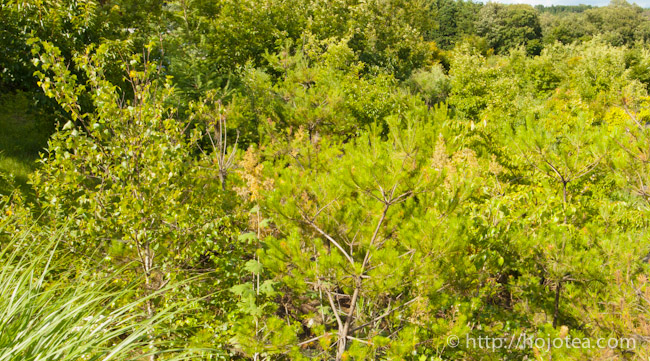
Wild plants growing in a sunny spot are yellow-green.
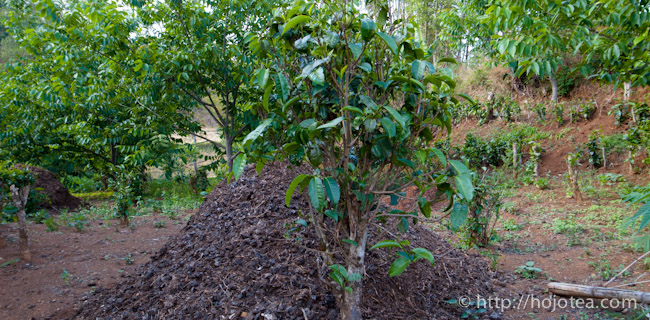
A tea tree beside a pile of animal manure. It bears huge, deep green leaves that hardly look like tea. Tea picked from a tree like this is thin in taste, with almost no depth in the throat.

In an ethnic minority village we came across tea trees that had turned yellow under natural farming. The tree at the back center is old, so it had been given excessive care, and as a result bore large, deep green leaves.
How to Brew
Water
For convenience, we recommend tap water. If you use tap water, boil it for 3 to 5 minutes to remove the chlorine used for disinfection. Even boiling, however, cannot remove chlorine completely. Wherever possible, use a water filter with an activated carbon cartridge to remove the chlorine. Otherwise the chlorine reacts with the tea's aromatic compounds and you will not be able to enjoy its true fragrance. Chlorine is added to kill microorganisms, and it kills not only the harmful ones but also the beneficial bacteria living in our gut. Various harmful effects at the cellular level have also been reported, and it can be a cause of allergies.
Distilled water and reverse-osmosis water contain no minerals at all, so the tea tends to taste flat. Please use mineral-containing water such as tap water wherever possible.
Also, never remove the limescale that builds up inside your kettle. Cleaning it with citric acid or the like will mean you can no longer get the taste of tea you are used to.
Once you have settled on a type of water, keep using that same type and do not switch. If the water changes, large amounts of minerals leach out of the scale, and after a while the tea will taste dramatically worse. Sticking with the same water is the secret to brewing delicious tea.
Brewing pu-erh
Amount of leaf
Use 1g of tea per 40ml of water.
In other words, for a 200ml teapot, 200ml ÷ 40 = 5g of tea.
Heat the teaware
Pour boiling water into the teapot.
Let it stand for 10 seconds. This warms the teaware.
In our experiments, simply pouring boiling water into a teapot drops the temperature by 20°C.
In other words, although you think you are warming it with hot water, the water is actually only at 80°C.
If you want to brew oolong at its best, especially high-grade oolong, we recommend repeating this step twice. Pouring in hot water twice raises the temperature of the teapot to around 95°C.
Heat the tea leaves
Even after warming the teaware, if you brew immediately the leaves will lower the water temperature. You may think "surely a few tea leaves can't do that?", but tea leaves have a very large surface area and exchange heat efficiently; in our experiments the temperature drops by 20°C. So even though you warmed the pot, the temperature falls by another 20°C.
Therefore, pour boiling water over the leaves once more. Pour quickly, from as low a position as possible. If you pour in a slow trickle, the water cools along the way. Pouring from a height also lowers the temperature. Once the water is in, leave the leaves in it for 1 to 3 seconds and then pour it off quickly. If you dawdle here, the flavor of the tea will be lost. But if it is too short, the leaves will not be warmed.
Then repeat this step once more. In other words, rinse the leaves with hot water twice in total. With pu-erh, the leaves are compressed, so water cannot penetrate inside them. That is why two rinses are needed.
The steeping times are as follows.
1st infusion: 10 to 20 seconds
2nd infusion onward: just pass the water through
With pu-erh, from the second infusion on you only need to pass the water through; there is no need to steep. This way you can brew around 8-10 infusions, which makes it very economical.
Store any tea you cannot finish in the refrigerator. Pu-erh does not deteriorate in quality when refrigerated. It is also fine to put partly brewed leaves straight into the refrigerator as they are. With green tea or oolong, partly brewed leaves deteriorate quickly if stored. Fully fermented pu-erh, by contrast, can be interrupted midway, kept in the refrigerator, and continued a day later.
Storing the tea
We recommend storing at room temperature.
Tea is sensitive to humidity; the moment it absorbs even a little moisture, it begins to deteriorate.
Please be aware that moisture can be absorbed unintentionally in situations such as the following.
- The tea is left near the kettle while brewing and is touched by steam
- Moisture on a spoon or scoop
- Opening the package on a humid day or in a humid place
- Opening the package immediately after taking it out of the refrigerator, causing condensation
- Taking it out of the refrigerator and leaving it unopened to return to room temperature, but the seal was imperfect and condensation formed
In practice, the most common causes of deterioration seem to be 4 and 5.
When tea is kept in the refrigerator, the inside of the bag is cold, and even if it is sealed tightly with tape, outside air quite often gets in and causes condensation. Once the leaves have been exposed to condensation, the aroma changes dramatically within 2-3 days.
As far as possible, store at room temperature, sealing the package in a properly dry room to keep humidity out. Ideally, consume within a few months of opening.
Unopened, vacuum-packed products can be stored for a year or more. If you wish to age the tea further, keep it unopened (still vacuum-packed) at room temperature. If you prefer to preserve the quality exactly as it was when purchased, store it in the refrigerator. If you do refrigerate it, always allow 24 hours for it to return to room temperature before opening. You might think half a day is enough, but tea leaves have a very large surface area and are, without exaggeration, a natural insulator. To the touch it may feel as though it has already reached room temperature, but the inside is still cold, and it takes a full 24 hours to warm through. Once it has come out of the refrigerator and been opened, store it at room temperature. From autumn through spring the ambient temperature is low, so it will keep well at room temperature for several months or more.
There are containers on the market that can create a vacuum. They are not common, but they are ideal for storing tea, so it is worth seeking out one of these special containers.
Choose options