
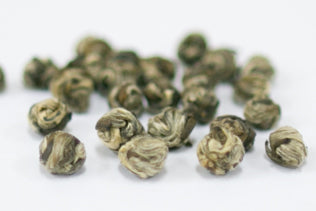
Jasmine Dragon Special Grade
By blending tea buds from Yunnan with those from Fuding, Fujian, we have created the ideal flavor.
The tea leaves from Yunnan Province are sourced from naturally grown tea gardens, giving the tea a robust flavour and a rich, lingering aftertaste.
Fujian tea leaves are characterized by their smooth and gentle taste, so by blending small amounts, the strong aftertaste of the Yunnan tea leaves and the smooth drinking experience of the Fujian tea leaves create a pleasant harmony.
The fragrance is made with fresh jasmine flowers harvested during the rainless autumn season, allowing you to enjoy the very fresh scent of jasmine.
Since it is difficult to obtain tea of this level on a consistent basis, we have decided to sell it as Special Grade. Sales will end once the current stock is sold out.
We have completely reconsidered the quality of the raw tea leaves and produced a jasmine tea of a quality that ordinary jasmine pearls simply cannot match.
The tea leaves are selected for picking in March, during the very cold season, so the nutrients stored during the winter are concentrated in the new buds.
The refreshing scent of green tea reminiscent of spring and the scent of jasmine flowers combine to create a very elegant and rich aroma. Those who try it for the first time will be especially surprised by the depth of flavor.
The aroma lingers on your throat for a long time, allowing you to enjoy the deliciousness of the tea from your mouth to your throat.
This is the first tea in the HOJO lineup that we would like you to try, and is also a great introduction to Chinese tea.
This is a custom-made jasmine tea made without compromise, from the raw green tea, jasmine flowers, to the production method.
Do you know what determines the quality of jasmine tea? It is often thought that the quality is determined by the scent of jasmine, but this is not the case.
Of course, the scent of jasmine flowers is important, but what's even more important is the quality of the tea leaves used to make jasmine tea. It's no exaggeration to say that 80% of the quality of jasmine tea is determined by the quality of the tea leaves.
Some customers mistakenly think that jasmine tea is "jasmine flower tea" or "tea made from jasmine leaves," but proper jasmine tea refers to tea whose tea leaves have been infused with the scent of jasmine flowers.
Therefore, the quality of the tea leaves used will have a significant impact on the final quality of the jasmine tea. The highest quality jasmine tea is made only from tea buds picked in the spring.
Even though they are called spring picks, they can be picked in March, April, or May, and the earlier they are picked, the higher the quality and the price.
By the way, you can tell when tea leaves were picked by looking at the ratio of white to black parts of the tea leaves. Tea picked early has more white parts, and even the darker parts are more silvery in color.
We select tea leaves picked in March. Because it is picked during the very cold season, the nutrients stored during the winter are concentrated in the new leaves.
The refreshing scent of green tea reminiscent of spring and the scent of jasmine flowers combine to create a very elegant and rich aroma. What is particularly worth emphasizing is the depth of flavor.
The aroma lingers on your throat for a long time, allowing you to enjoy the deliciousness of the tea from your mouth to your throat.
We completely reexamined the quality of the raw tea leaves and succeeded in creating a quality that ordinary Jasmine Pearls simply could not match.
Five characteristics of Jasmine Tea
The following five characteristics are characteristic of Jasmine Tea:
- Made using the first spring tea, it has a mellow, sweet taste with no bitterness.
- The tea has a beautiful yellow color and its quality does not deteriorate even if it is left for a while.
- It can be brewed for 5-6 times without any problems, making it economical.
- Easy to fill even long glasses or mugs
- The water brewing is very delicious
This is the first tea in the HOJO lineup that we would like you to try, and is also a great introduction to Chinese tea. First, let me tell you about the appeal of this tea.

Delicious food that gives overseas Chinese a culture shock
Do you know what kind of people the overseas Chinese living in Southeast Asia are?
They are successful business people, that is, people who live a wealthy life. Of course, they eat Chinese food regularly and frequently drink high-quality jasmine tea.
We have a directly managed store in the Gardens Mall in Mid Valley, one of the largest shopping malls in Malaysia. At first, they were skeptical about this Chinese tea sold by a Japanese brand, but after trying it, they gave it high praise.
"Smells like real flowers"
"Not too strong, not too weak"
"The scent of jasmine doesn't linger in your mouth."
"It has a sweet aftertaste and is delicious."
"No matter how many times you brew it, the refreshing scent of jasmine will last."
To their surprise, this was their first experience with jasmine tea like this, and they wondered what kind of jasmine tea they had been drinking until now.
We also received similar feedback in various monitor tests in Japan.
"The aroma wafts through your nose and leaves a sweet green tea taste, so you can drink it with a meal."
"It doesn't smell like jasmine tea, it smells like jasmine."
"A pleasant fragrance without any unpleasantness"
"A fragrant aroma, a comfort that calms the nerves"
"I was surprised at how good the scent was."
HOJO's Jasmine Tea "Jasmine Dragon Pearl" has an elegant and natural scent that makes you feel as if jasmine is really there, and this scent continues even after brewing for 5 or 6 times.
Economical benefits unique to high-quality tea
The aroma lasts even after the fifth brewing with one serving of tea leaves (3g). The price is 2,800 yen/100g, which means the price per 3g is about 85 yen.
In other words, the price per cup is about 17 yen. For this price, you can enjoy jasmine tea of a quality far superior to that of the finest Chinese restaurants in the comfort of your own home.
Brewing is easy if you use a glass
You don't need any special tea utensils to drink jasmine tea. Anyone can easily enjoy jasmine tea by using a long glass. Below is a picture of the tea leaves of jasmine tea opening up after hot water is poured into the long glass.

Add a teaspoon of tea leaves. There is no need to be greedy and add too much.

Allow the boiled water to cool slightly and then carefully pour 80-85°C water into the glass.

The tea leaves will begin to open immediately. It is said that the higher the quality, the faster the opening speed.

Although you may be tempted to shake the glass, it's best to stay gentle to obtain the delicate flavor.

After 3 minutes, the downy hairs on the tea leaves will fall off and float in the water. Gently shake the tea to keep the concentration constant.

Once you've finished drinking it, pour in more hot water. You can drink it 5-6 times.
The best thing about cold brew is the water brewing
HOJO's Jasmine Tea is made from green tea leaves made only from the tender buds harvested just after winter. This tea leaf, which is also used for white tea, is so delicious when brewed in water that it will amaze your family!
It's extremely easy to make!
- For 5g (example), prepare about 1000ml of water. Using cooled boiled water will improve the aroma and flavor.
- No need to use a teapot. Put tea leaves and water into a plastic or glass container such as a plastic bottle.
- Simply place the container in the refrigerator and leave it for a few hours.
- When the tea leaves have fully opened, it is ready to drink.
What if you make too much? Just put it on ice.

What makes our products different from those of other stores? - A detailed explanation of the differences in tea leaves
They say, "Oh! I know this tea!"
Many people seem to think that all round jasmine teas are the same type.
But did you know that these spherical jasmine tea "jasmine pearls" are produced by hundreds, even thousands, of different producers throughout China, Taiwan, and India? Each company produces the same shaped jasmine tea.
Even though the fruit has the same shape, there is a big difference in quality and the price. The purpose of making it round is to make it easier to mix with jasmine flowers.
However, the quality is greatly influenced by the blending method, the type of jasmine used, the type of tea leaves, the processing method of the leaves, and other factors. The most important factor influencing the quality is the quality of the green tea used.
Green tea harvesting begins in March, and is distributed on the market through April, May, June, and even autumn.
At HOJO, we not only use green tea picked in March, but we also place importance on a strong aftertaste by seeking out green tea that is made using methods that minimize the use of fertilizer.

Jasmine tea is sifted and visually selected in Japan before shipping.
History and Culture of Jasmine Pearls - Why Chinese Quality is the Best
Jasmine flowers are native to Iran. They were brought to China via the Silk Road during the Tang Dynasty, and it is said that it has been 1,700 years since they were introduced into China.
Initially, jasmine flowers were used only for decorative purposes. The use of jasmine flowers in tea began in Guangdong Province during the Southern Song Dynasty (1240).
During the Ming Dynasty, there was a dramatic innovation in the technology for absorbing the aroma of jasmine flowers into tea leaves, and specific processing methods, including the selection of ingredients, blending recipes, and drying methods, were established and compiled into manuals.
Large-scale industrial production began in Fuzhou during the Qing Dynasty. By 1900, jasmine tea production in Fuzhou reached 1,500 tons.
At its peak (1928-1938), total jasmine tea production is said to have reached 7,500 tons. At the end of the 19th century, foreign trading companies established offices in Fuzhou, and jasmine tea became an important trade item with foreign countries.

As its popularity grew, jasmine tea production spread from the South to the North and East (Zhejiang, Sichuan, Hunan, Guangxi, and Yunnan).
However, jasmine cannot grow in cold environments, so in cold regions, it is necessary to move jasmine indoors under heating.
These controls were so costly that northern tea producers were forced out of business. Besides China, the scent of jasmine attracted the attention of tea traders in Taiwan.
In 1873, tea leaves were exported from Taiwan to Fuzhou, where they were commissioned to be processed to give them a jasmine scent. In 1882, a Taiwanese trader brought back jasmine seeds and began cultivating them in Taiwan.
By 1939, Taiwan's jasmine tea production had reached 1,300 tons per year. However, due to Taiwan's unique climate, the fragrance of jasmine flowers was inferior to that of Chinese tea.
Since 1980, the government of Guangxi has made great efforts to expand jasmine tea production, and at the same time, Guangxi has been recognized by China's Ministry of Commerce as a producer of jasmine flowers.
As a result of these reforms, Guangxi's jasmine gardens are now the largest and known for producing high-quality jasmine.
The best jasmine tea is made by combining excellent tea leaves and flowers.

Jasmine flower

Jasmine flower
Jasmine is a plant that originally prefers a tropical climate and requires temperatures above 20 degrees Celsius. The jasmine-growing area in Guangxi has proven to be the most suitable climate for its growth.
The region has a subtropical monsoon climate, which allows jasmine to easily survive the winter and is free from freezing and frost.
When the flowers bloom, it is desirable for the air temperature to be above 25°C. The jasmine garden is located on the slope of a hill.
This location provides good drainage and plenty of sun for the jasmine, plus the soil is very fertile, which helps to produce large, highly fragrant flowers.
Due to this quality advantage, it is said that the same level of fragrance can be achieved with 70% of the amount of other flowers.
Tea leaves
Until around 2010, the tea leaves used to produce jasmine tea were mainly of the Fuding Da Bai variety produced in Fujian Province.
However, due to the boom in white tea in Fujian Province, the price of white tea has skyrocketed, and as a result, many green tea farmers who produce jasmine tea have switched to producing white tea.
Although some farmers still produce green tea for jasmine tea, the price has risen dramatically, which is why green tea from Yunnan Province has been attracting attention in recent years.
At HOJO, Jasmine Dragon Pearl is a green tea from Yunnan Province, and Jasmine Dragon Pearl Special is By blending tea buds from Yunnan Province with those from Fuding, Fujian Province, we create the ideal flavor.

Jasmine flower

Jasmine flower field
Jasmine flowers come in several varieties, but can be broadly divided into three groups.
- Single-Petal Jasmine
- Double-Petal Jasmine
- Multi-Petal Jasmine
①Single-Petal (Petal) Jasmine
Before 1963, this type of jasmine was mainly cultivated for jasmine tea processing. This type of jasmine flowers bloom earlier (6-7am) than Double-Petal jasmine (8-9am). The yield is very low, with only about half the yield of Double-Petal jasmine per unit area of farm. In addition, it is very susceptible to diseases and has low adaptability to the environment, so it is rarely cultivated in recent years.
②Double-Petal Jasmine
It is well suited to producing jasmine tea because of its very high production volume, strong adaptability to the environment, the fact that the flowers bloom all at once, and the strong fragrance that the flowers give off.
③Multi-Petal Jasmine
After plucking, the flowers bloom at 7 to 8 o'clock. However, the way the flowers bloom is not uniform, but rather gradually and randomly, so if used to process jasmine tea, the fragrance is weak and it is not suitable.
The flower harvesting period varies depending on the climate and growing conditions of each region, but generally there are four main seasons:
- Spring flowers: Generally produced from May to June, 15% of the annual production.
- Summer flowers: Generally, 30% of the annual production is produced in July.
- Fused flower: Produced in late summer, generally in August, accounting for 30% of the annual production.
- Autumn flowers: Generally produced from September to October, 25% of the annual production.


During spring, the production volume is low and the quality is poor due to the low environmental temperature and lack of nutrients stored in the plants. Flowers harvested in early spring and late autumn are small in size and yellowish in color.
The flowers are not suitable for processing into jasmine tea because they rarely bloom. The flowers best suited for processing into jasmine tea are those harvested in summer and late summer.
It enjoys high temperatures, plenty of sunshine and rain - factors favourable for producing more flowers, larger size and better quality.
The important point in picking flowers is whether the picked flowers will bloom at night. Therefore, when picking flowers, flowers suitable for processing into jasmine tea are carefully selected and picked. The criteria for picking flowers are as follows:
- The petals are full and white in colour, and there is a long stem.
- Flowers with green petals will not open, so they are not picked.
- Flowers that have already bloomed will not be picked as they have lost much of their fragrance.
Processing - Everything is made by hand by craftsmen
Jasmine Pearls are made by hand in an extremely complex process. The green tea is processed in early spring and then stored until the jasmine season (summer) arrives. During the aromatization process, the flowers are given extra care to ensure that the tea leaves absorb the best possible aroma.
Processing of tea leaves for jasmine tea
Why is high-quality jasmine tea granular? All high-quality jasmine tea is pearl-shaped.
Do you know why it is shaped like this? In fact, the tea leaves are processed into a spherical shape to ensure smooth mixing and dispersion with the jasmine flowers, giving them the same shape and size as jasmine buds.
The tea leaves and jasmine buds are both round spheres that can blend well with each other.
The manufacturing process of Jasmine Dragon Pearl involves the following steps:
- Indoor wilting
- Killing enzymes: Inactivation of enzymes
- First drying
- Knead and twist
- Second drying
- Classification
- Rekindling
- cooling
We will introduce each process below.
Indoor wilting
After plucking, the tea leaves are carefully spread out in a thin layer. Damaged tea leaves turn brown or black, which affects the quality of the final product. The withering process continues until the moisture content of the tea leaves is 70%. Through the withering process, the tea leaves lose their grassy aroma, reduce their bitterness and astringency, and increase the proportion of amino acids, giving them a sweeter taste.
Killing blue: Inactivating enzymes
The tea leaves are passed through a drum heated to 260℃, where they are heated all at once and the oxidizing enzyme (polyphenol oxidase) is inactivated.
At the same time, high temperature treatment helps to remove the grassy aroma. Heat treatment softens the tea leaves, making them suitable for rolling in the subsequent process.
First drying
The tea leaves are dried in a dryer so that their moisture content is 30%.
Knead and twist
After drying, the tea leaves are cooled and then moved to the rolling process, which is done entirely by hand. The reason for the characteristic bead-like shape is to increase the surface area so that it can more easily absorb the jasmine aroma. Because everything is done by hand, even a skilled craftsman can only finish 2 kg of product per day.
Second drying
The beads are dried again in a dryer, first at a high temperature of 110-120°C, then at a lower temperature of 95-105°C. The dried product has a moisture content of 7%. The dried tea leaves are stored in a warehouse until the jasmine season arrives. During storage, they are kept in vacuum containers in a shady, cool place so that the moisture content does not exceed 9%. Before proceeding to the aromatization process, the tea leaves are pre-treated.
Classification
The tea leaves are sieved and classified by size, while also removing any broken or irregular tea leaves.
Rekindling
The tea leaves are put into the dryer again. The temperature of the dryer is kept low (100-110℃) to prevent the tea leaves from having a burnt smell. The drying process evaporates the moisture that the tea leaves reabsorbed during storage, and at the same time volatilizes the aroma that has adhered to the storage material. After drying, the moisture content is reduced to less than 5%.
cooling
The temperature of the tea leaves after drying is about 60-80℃. The tea leaves are spread in a thin layer and cooled to 1-3℃ above room temperature. If the tea leaves are not cooled sufficiently, it will affect the subsequent aromatization process. Jasmine flowers are very sensitive to changes in environmental temperature and require low temperatures to bloom.


Preparing flowers for making jasmine tea. Quality control as strict as that of a florist!
Freshly picked jasmine flowers are cared for based on the following:
cooling
During the transportation of the flowers to the factory, the temperature gradually increases as the flowers continue to breathe, reaching up to 38°C. The increase in temperature will affect the flowering process later, so the flowers are spread in a thin layer of less than 10cm. If the flowers are harvested after rain, they are spread in an even thinner layer and air is blown in with a fan to evaporate the moisture.
Fresh Flowers Protection
This process is done to strictly control the temperature of the stacked flowers. This process plays a very important role in making the flowers bloom when they need to. Jasmine flowers are very sensitive to changes in temperature. To make the flowers bloom as planned, the temperature of the flowers needs to be maintained at 32-37°C. If the temperature of the stacked flowers is below 30°C, the thickness of the stack is increased to raise the temperature, and if it exceeds 38°C, the temperature is lowered by thinning the layers.
Sifting
When about 60% of the flowers have opened, the flowers are sieved. The reason for sieving is to separate the flowers by size. It also serves to remove the green shoots and stems. Only flowers of uniform size are collected and used, which is important to ensure uniform flowering.


A mixture of tea leaves and jasmine flowers. First class care.
This is a very important process that greatly affects the quality of the final product. Below are five important factors:
1) Mixture ratio of tea leaves and flowers
The amount of flowers used depends on the grade of the final product. Higher quality products require more flowers. To make 100kg of top quality Jasmine tea, 100kg of flowers are needed. The 100kg flowers are used in 4 rounds: 1) First aromatization: 38kg, 2) Second aromatization: 30kg, 3) Third aromatization: 26kg, 4th aromatization: 6kg. For first grade products there is no final aromatization. For lower grade Jasmine tea, the tea leaves are aromatized with used flowers.
2) Percentage of flowering
The tea leaves and flowers are mixed when 80% or more of the flowers have bloomed. If the flowers are mixed before they have fully bloomed, they will be crushed by the weight of the tea leaves and will not be able to bloom further. Also, the larger the flowers are, the larger the surface area will be, and the more efficiently the aroma will be absorbed.
3) Moisture content
During aromatization, the moisture content of the tea leaves is maintained at 4-4.5%. After aromatization, the moisture content of the tea leaves increases dramatically. However, it is necessary to keep the moisture content below 18%. If the moisture content exceeds 18%, the flowers will start to spoil and unpleasant odors will appear.
4) The thickness of the flowers and tea leaves piled up
The purpose of adjusting the thickness is to control the temperature of the tea leaves and flowers. A thickness of 30-40cm is generally used, but the thickness is adjusted from time to time depending on various external factors.
5) Mixing tea leaves and flowers
This needs to be done quickly, as the longer you wait the faster the flowers will lose their fragrance.

Jasmine and tea leaves mixing process
The mixing process is entirely done by hand. First, the tea leaves and flowers are separated into groups of 3-5. The first group is spread out in a layer of 10-15cm.
The first batch of flowers is then piled on top of it. Each layer is then stacked with alternating layers of tea leaves and flowers. Finally, the layers are mixed with a rake. The mixed layers of flowers and tea leaves are then left to rest for 5 to 6 hours.
Flower
"Tsuuka" means ventilation. There are three reasons for ventilation:
- To lower the temperature.
- This allows the flowers to have more air, which encourages continuous blooming.
- To release carbon dioxide
Using a rake, the artisan spreads the mixture of tea leaves and flowers to a thickness of 10-15cm, this process continues every 15 minutes for an hour, after which the thickness of the layer is adjusted to suit changes in temperature.
In total, the initiation process takes 10-12 hours. Temperature control is a very important factor in the quality of jasmine tea, because if the temperature is too low, the fragrance will not be fully developed, and if the temperature is too high, the flowers will turn yellow and have an off-flavor.
Flowering – Separation of flowers and tea leaves
Once the aroma is complete, the old flowers are removed - if they are removed too late, they will deteriorate and impart an unpleasant odor to the tea leaves.

Jasmine flowers that have been left to bloom overnight

As the flowers open, they become bulkier than the tea leaves (pearls) and can be easily removed with a sieve.
Hong-bei - Drying
Once the aroma is complete, the tea leaves are dried in a dryer. Drying conditions vary depending on the number of aromas.
- First aromatization - 110-120℃, moisture content 5.0-5.5%
- 2nd aromatization - 100-110℃, moisture 5.5-6.0%
- 3rd aromatization - 90-100℃, moisture 6.0-6.5%
After drying, the tea leaves need to be cooled to below 40°C before they can move on to the next round of aromatization.
Ti-hua - Final fragrance
This process is important to give jasmine tea a fresh floral scent. The purpose of the final aroma is to enhance the jasmine aroma and to give it the scent of fresh raw flowers.
The finest quality jasmine flowers (large petals, white color, strong fragrance) are used for this process.The tea leaves are not dried after the final aromatization to preserve the natural floral aroma.
Before the final flavoring, the tea's moisture content is analyzed, and the amount of flower used is calculated based on the moisture content after mixing with the floral fragrance. The moisture content of the final product is controlled to be below 8.5%.

comment

Choose options