

Yunxian Ripe Pu-erh (Shou) 250g
Obtaining ripe pu-erh is not difficult, even for an amateur, and not only in Yunnan.
Tourists visiting China often buy pu-erh as a souvenir, and perhaps 80% of what they buy is ripe pu-erh.
You often hear people say, "I bought this in China, the real home of pu-erh, so it must be really good tea." The reality, however, is that most of it is of a quality that does not match the price.
The overall quality of a pu-erh is determined by the balance between the thickness of its taste and the character of its aroma.
Unlike raw pu-erh, ripe pu-erh involves microbial fermentation, which makes the production process complex; for that reason it is almost never made by individual farmers. Ripe pu-erh production means factories, as a rule.
A factory, naturally, has employees. Their wages and the cost of equipment must be paid whether or not the tea sells.
Compared with an individual farmer who only needs to support himself, a factory has high fixed costs, and to recover those costs, the factory's mission is to sell "volume."
Producing in quantity and buying in low-cost leaves are therefore the basic principles of ripe pu-erh production at a factory.
Whereas an individual farmer produces raw pu-erh only in the tens or hundreds of kilograms a year, a factory produces by the ton.
To sell large quantities of tea, the quality must be uniform. Tens of tons of tea with inconsistent quality cannot be sold. For this reason, factories blend their leaves. Blending makes the quality uniform.
Some people believe blending is the technique, or even the secret art, behind pu-erh quality, but blending in a factory serves a different purpose. The sole aim of blending is to make the quality uniform. In most cases, spring, summer, and autumn tea are blended together to standardize both cost and quality.
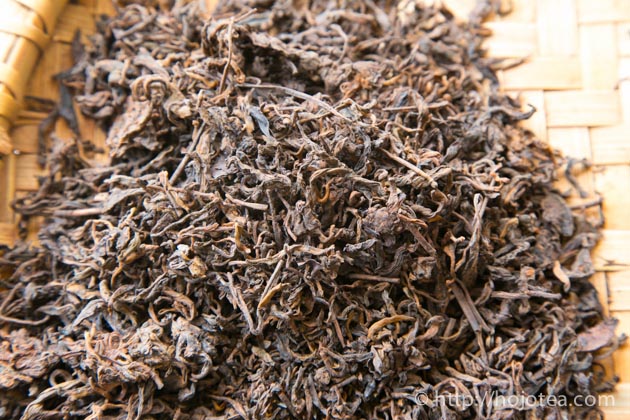
When it comes to blending raw materials, factories producing green, black, and oolong tea do much the same thing, not only pu-erh factories.
The big difference with pu-erh is this: because ripe pu-erh is made through microbial fermentation, the tannins that cause astringency are broken down, so even if cheap leaves are used, no astringency can be detected.
With green tea or black tea, by contrast, a product made from cheap plantation leaves is strongly bitter and astringent, and its low quality is obvious the moment you drink it. Raw pu-erh made from cheap leaves likewise becomes extremely astringent.
But ripe pu-erh never becomes astringent, no matter how cheap or low-grade the leaves, even if they were picked in midsummer.
Because ripe pu-erh lacks the astringency that is the telltale sign of cheap tea, the reality is that most people cannot judge its quality.
Unfortunately, the good-quality leaves in Yunnan go into making raw pu-erh.
That is because good raw pu-erh sells for far more than good ripe pu-erh. This raises the question, "Is there hardly any good ripe pu-erh on the market, then?" In fact, the position of ripe pu-erh in Yunnan is similar to that of bancha or genmaicha in Japanese tea,
and the reality is that genuinely good-quality ripe pu-erh is extremely limited.
At HOJO, we specifically buy only spring tea, before it is blended. We taste a great many teas, again and again, so that we can bring you only the best quality.
As mentioned above, hundreds of ripe pu-erhs are on display even at the airport, yet finding a truly good one is, in reality, harder than finding a good raw pu-erh.
So what sets a good ripe pu-erh apart? Ripe pu-erh may bring to mind a pungent, musty tea, but a good tea must move you to a certain degree when you drink it.
The characteristics of a delicious ripe pu-erh are listed below.
1. Even brewed lightly, the taste is rich and deep. The aroma, too, is not a thin fragrance that merely passes through the nose; it is felt deep in the throat and leaves a long, deep aftertaste.
2. A well-fermented tea has a sweet aroma like dried fruit. A poorly made tea, by contrast, smells of earth, natto, feet, or rotting furniture. This results from a failure to control the moisture level during fermentation, leaving the interior of the leaf pile starved of oxygen.
This tea was made at an elevation of 2000m. Even in Taiwan, 2000m would place it among the truly premium high-mountain teas. The high elevation brings a wide gap between day and night temperatures, producing a tea with a thick, full aftertaste.
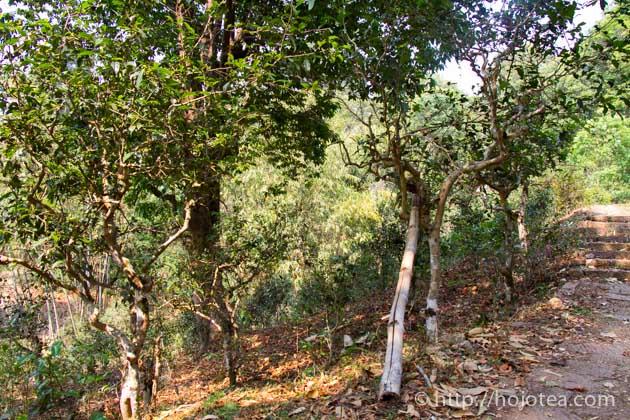
Tea trees grown by the cultivation method known as "qiaomu" (arbor-style)
The tea comes from Yunxian, in the Lincang region of western Yunnan Province. This area is also well known as a source of Yunnan black tea.
Because Lincang lies at a northerly latitude and its tea-growing areas sit at very high elevations, it generally produces good tea.
This tea has the sweet aroma of dried fruit, and combined with its deep finish in the throat, the aftertaste of its fragrance seems to linger forever when you drink it.
Given its affordable price, I would like to say "enjoy it as an everyday tea," but its depth of flavor and finish are far removed from a casual everyday tea. It is a tea of such high quality that it would not be out of place at two or three times the price.
Yunnan occasionally turns up bargains like this. With such outstanding value for money, I highly recommend it to anyone new to pu-erh.
Stock is limited, so if you find you like the quality of this tea, we suggest stocking up generously.
How to Brew
Water to Use
For convenience, we recommend tap water. If you use tap water, use a water purifier to remove the chlorine from the water. Even a simple faucet-mounted purifier costing two or three thousand yen will do. If chlorine remains, it oxidizes the tea's aroma compounds and you will not be able to enjoy its true fragrance. Chlorine is also added to kill microorganisms, and it kills not only harmful microbes but also the beneficial bacteria living in our gut. Various harms at the cellular level have been reported as well, and it can even cause allergies.
Distilled water and reverse-osmosis water contain no minerals at all, so the tea tends to taste flat. Please use mineral-containing water such as tap water whenever possible.
Also, never remove the limescale that builds up inside your kettle. Descaling with citric acid or the like will keep you from getting the tea flavor you are used to.
Once you have settled on a type of water, keep using that same type and do not switch. If the water changes, large amounts of minerals leach out of the scale, and after a while the tea will taste dramatically worse. Sticking to the same water is the secret to brewing delicious tea.
Choose options