
Wild Red 50g
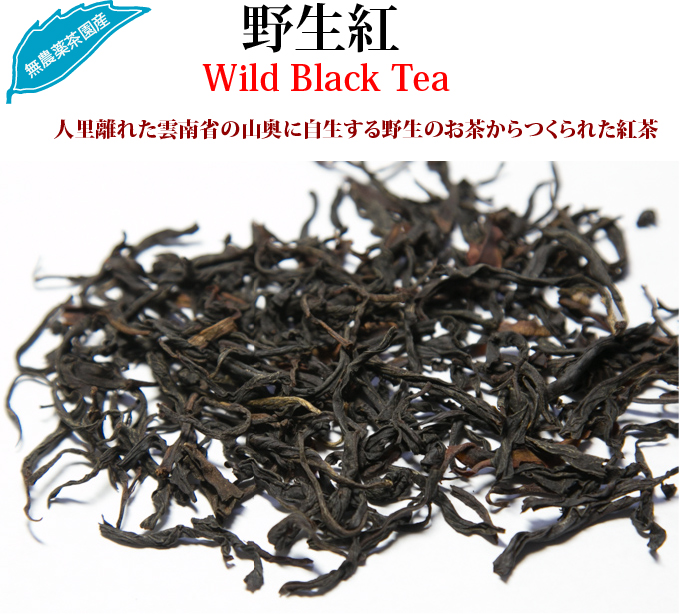
Black tea made from wild tea that grows in the remote mountains of Yunnan Province.
Wild Red is a powerful black tea made from wild tea that grows deep in the mountains of Yunnan Province. Wild tea is tea that grows in the mountains, untouched by human hands.
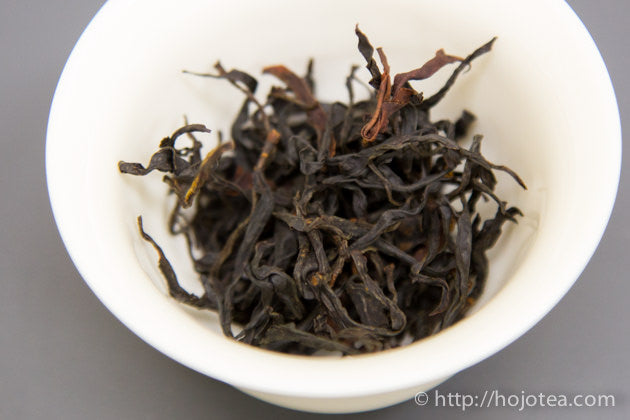
It has a distinctive, sweet, honey-like aroma and a very strong body, with the intense, deep flavor that only a wild tea can have.
It is rich in minerals and improves blood circulation, so the moment you drink it, your body will warm up and you will feel instantly relaxed.

For the 2016 harvest, we were able to procure raw materials mainly from very old wild tea trees, resulting in a clear, elegant fragrance.
Although it is a rare tea, it is a very popular product with a high repeat purchase rate.
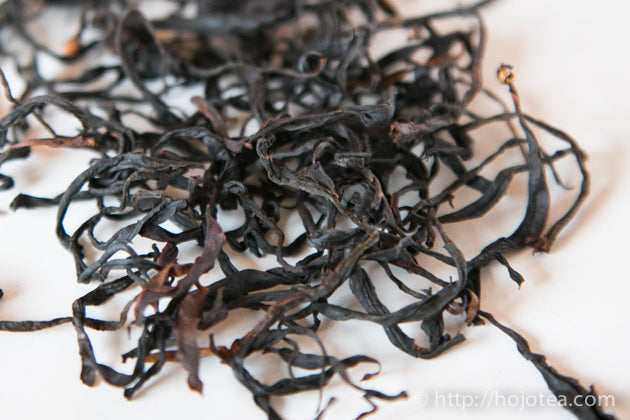
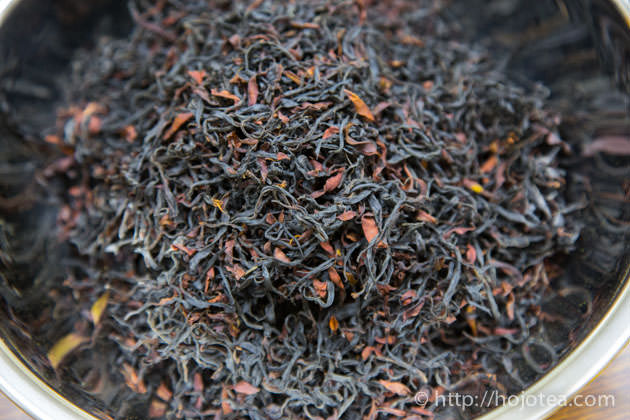
This black tea is made from leaves harvested from wild tea plants.

Wild tea trees do not refer to the old trees that are hundreds or even thousands of years old, which are common in Yunnan Province, but rather to natural tea trees that grow naturally in the mountains, far from civilization.
Up until now, the only tea made from wild tea was raw Pu-erh tea. To be honest, this was my first time seeing black tea made from wild tea.
The idea of making black tea from wild tea was intriguing, so I was determined to buy it before even trying it, so I went to try it.

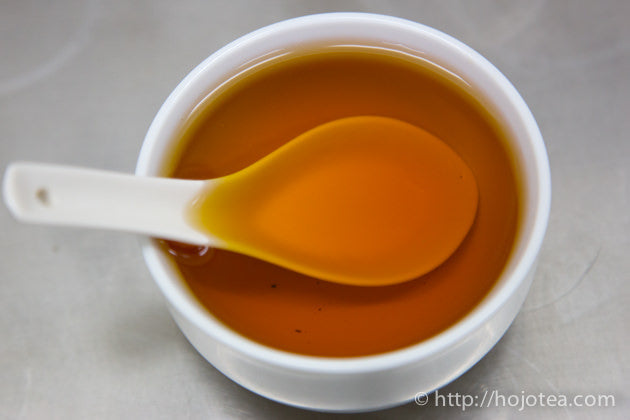
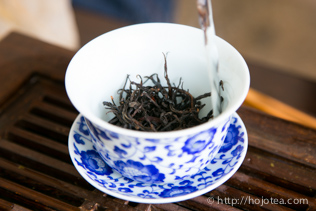
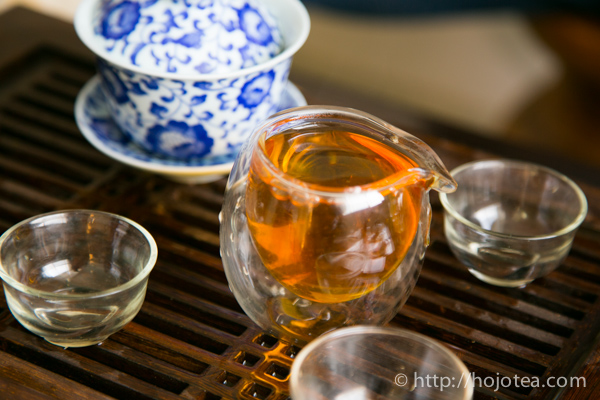
The aroma is very complex, the body is very strong, and it has a strong, deep flavor that only a wild tea can have. In the case of this tea, the aroma of the tea changes significantly depending on the water used to brew the tea, and if the water is well-suited, you can feel a honey aroma like that of Oriental Beauty.
I tasted water from my well at home, tap water, Malaysian water, and water from Yunnan province, and some of the water had a strong aroma reminiscent of bouquet, fruit, or tree bark.
Because it is rich in minerals and improves blood circulation, drinking the tea causes your face to turn red and you to sweat, and you may feel sleepy due to the tea-induced drunkenness.
For this reason, we recommend drinking it in the evening after work.

What is wild tea?
Wild red tea is a wild tea harvested in the mountains called Dasyueshan in Lincang, Yunnan, China. Wild tea is tea that grows naturally in the mountains, untouched by human hands.
In fact, almost all stores and websites that specialize in selling Chinese Pu'er tea have "wild tea" available.
However, 99.99% of that tea is not wild tea, but tea harvested from so-called old trees.
Old tree tea is tea that has been cultivated by ethnic minorities for hundreds to 1,000 years and is not "wild."
Wild tea is literally tea that grows in the mountains, untouched by human hands.

Tastes like wild vegetables
In spring, we eat wild vegetables such as taros and koshiabura, but don't you think they're delicious? Wild vegetables such as mitsuba, wasabi, and parsley can also be cultivated, but the taste is completely different between those that grow in the mountains and those that are cultivated.
What I would like to emphasize in particular is its sweetness. Wild tea is very sweet, like wild vegetables harvested in the mountains, and the sweet aftertaste lingers in your throat even after you have drunk it.
I have never had such a smooth, sweet tea in my life. Among all the teas sold at HOJO, Wild Red has a very strong throat feel and I get drunk immediately after drinking it.
The moment you drink it, your body will feel warm and relaxed.

Scented like wild grapes
When it comes to wild teas, many of them are bitter and generally considered to be for connoisseurs, but Wild Red Tea is an exception.
To use the example of wild vegetables again, just as some wild vegetables are bitter or have an astringent taste, the taste of wild tea also varies depending on the plant. The Ailao Mountain wild tea sold last year was slightly bitter.
In contrast, Yaen Beni has no bitterness at all. When you drink it, you can smell a strong woody aroma, and when you finish drinking it, you can smell a subtle fruity aroma like wild grapes or dried apricots.
This tea also has a smoky aroma, but strangely enough, the smoky aroma that you sense before drinking it doesn't hit you when you put it in your mouth.
This time, we carefully selected bitter-free teas from nearly 20 different types of wild tea from different regions.
Children's favorite tea
Even my kids love this tea.
Good quality tea contains a lot of iron, and it is said that the properties of tea are similar to those of human body water and breast milk.
The aroma doesn't seem suitable for children, but once they brew the wild tea, the children all say it has a strong, delicious flavor.
I keep having refills, and by the time I finish my face is red and my body is very warm.
This tea is very high in iron, so when modern people who are prone to iron deficiency drink it, they may naturally find it delicious because their bodies are craving iron.
Originally very expensive tea
Wild tea is usually very expensive, and even in the production areas we visited this time, most of the wild tea was about five times the price.
By chance, a producer in Daisetsuzan specializes in wild tea, and by being able to purchase directly from him, we were able to get the product at a very low price.
What is the difference between wild tea and regular tea?
Wild tea grows in fierce competition with other plants. In the dark forest, where sunlight is blocked, the tea leaves desperately stretch upwards in an attempt to catch sunlight.
As a result, tea plants only produce leaves at the tips of their leaves, which get the most sunlight. Despite the plant's large size, each small amount of tea leaves contains a large amount of minerals.
Furthermore, in the wild mountains, where there is no pruning or fertilizer, tea plants grow extremely slowly. This makes each cell small and dense, resulting in a rich flavor, just like freshly picked wild vegetables.
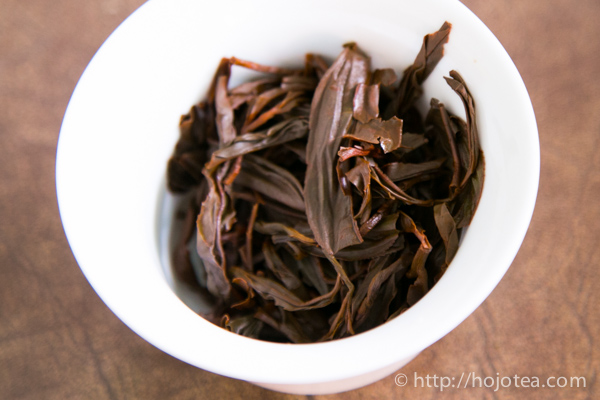
It is said to be good for people who need iron because it contains a lot of iron. Furthermore, a characteristic of wild tea is that even the new tea has a brownish color, like autumn leaves.
This is one of the characteristics of wild tea, and is thought to be related to the specific minerals contained in the tea leaves.

The photo above shows a tea tree that is several hundred years old. Generally, high-quality raw Pu-erh tea is made from such old trees.
However, these old trees are not wild tea. Although the trees are old and the quality of the tea leaves is very high, they are classified as "cultivated tea".

This is a wild tea tree that grows deep in the mountains, a few hours' walk from the nearest village.
Wild tea grows at an altitude of around 2000m, and the trees range in age from young ones to ones that are over 1000 years old. A characteristic of wild tea is that the buds grow ever upwards in search of sunlight.
Because of this, they look thin and spindly, like the buds of an elm or a Japanese koshiabura plant, but on the other hand, because there are only a few new shoots, they are very sturdy and have thick, resilient leaves.
A wide variety of wild teas
Most tea plants in Japan are grown by cuttings, or clones, and all the tea plants in a tea plantation are of the same variety.
In the case of wild tea, it grows naturally in the mountains, so seeds fall and sprouts grow from them. In other words, all tea varieties have various characteristics created through complex cross-breeding.
Even within the same mountain area, the size, shape, and color of the leaves, as well as the taste and aroma, vary greatly from one tea tree to another. When I actually picked buds from several trees and tasted them, I found a mixture of very refreshing tasting tea and extremely bitter tea.
When actually picking tea, the leaves are picked from multiple trees. However, because the leaves of different trees all have different flavors, the final tea will taste completely different depending on how the trees are combined.
Generally, all wild teas have a strong flavor and a very strong aroma, but depending on the accidental combination, the resulting tea may be weak in taste and light in aroma.
This makes it very difficult to select wild teas, as each batch only contains a few kilos, and each batch has a completely different taste and aroma.
Wild Tea Hunting Video
This is a video I made while searching for wild tea. Watching this will help you understand wild tea better.
Choose options