
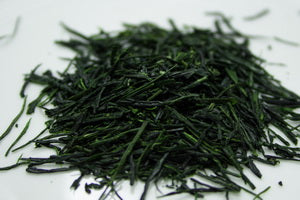
Asahina Gyokuro 100g
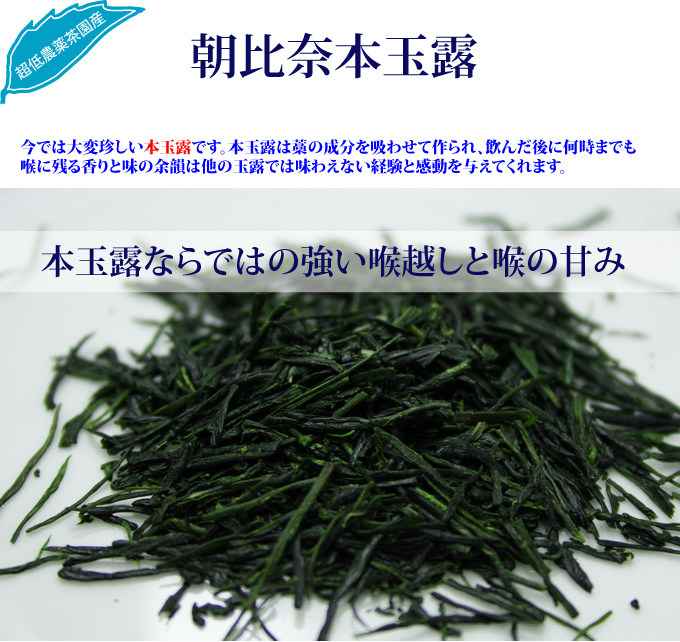
This is a very rare hon-gyokuro produced upstream of the Asahina River in Okabe-cho, Shida-gun, Shizuoka Prefecture.
Hon-gyokuro is made by covering it with straw, and by absorbing the components of the straw, it gives you a sense of excitement and satisfaction that you cannot get from other gyokuro.
This tea is characterized by its aroma and lingering flavor that lingers in your throat long after drinking.
Product Details

What is the difference between Hon Gyokuro and regular Gyokuro?
Gyokuro is made by covering the tea fields. Covering means covering the tea fields with black sheets or straw. Covering the tea fields blocks sunlight and dramatically changes the environment of the tea fields, which gives the tea its unique aroma and flavor.
However, different types of tea can be made depending on the covering method.
Various coating methods
- Tea that is simply covered directly on the tea plant is called "Kasedcha" and does not fall under the definition of Gyokuro. Generally, cheesecloth is used, and the resulting tea is rich in the umami flavor of amino acids. Note: Umami does not mean delicious.
- Next, there is the type where the tea garden is covered with frames and cheesecloth. This type has plenty of head space between the tea plants and the cheesecloth, and because the sheets are black, the temperature in the tea garden tends to be high.
- Finally, the tea garden for Hon-Gyokuro is surrounded by straw from all sides. In the case of Hon-Gyokuro, the gap between the tea plant and the straw is narrowed as much as possible. The temperature inside is lower than in the cheesecloth type, and the harvest time is delayed.
Covering the fields with straw requires a lot of work to make the straw sheets, so most farmers have now given up on it.
When comparing Hon Gyokuro with regular Gyokuro, there is a huge difference in both taste and satisfaction when drinking, and the decisive difference lies in the taste and aroma.
There is not much difference between gyokuro covered in cheesecloth and gyokuro covered in straw in terms of the umami flavor derived from amino acids.
In terms of the distinctive seaweed-like aroma of gyokuro, both types of gyokuro meet the criteria.
The defining difference is the depth of flavor and aroma of Hon Gyokuro, which has a long aftertaste and a rich, deep flavor.
To borrow a Chinese word, 'huigan', or the sweetness and aroma that lingers in the throat for a long time, is what makes Hon Gyokuro so special.
Why does this difference occur?
The secret to the superior quality of Hon Gyokuro lies in the "straw"
The secret to the superior quality of Hon Gyokuro lies in the "straw" that covers it.
If the rice is covered with straw, when it rains, the water drips off the straw and onto the ground. The straw contains a large amount of minerals that can be sent to the rice, so the water that drips off the straw contains a large amount of minerals.
The reason why freshly made straw tastes sweet when you chew it is because the straw contains a lot of nutrients.
According to this logic, recycled straw cannot fully serve its purpose: first-year straw is the most effective, with the second and third years being less effective.
It is well known locally that Hon Gyokuro is delicious, but weaving the straw into the "komo" is not an easy task.
Unlike black cheesecloth, the straw covering does not increase the temperature inside the covering room, allowing the tea leaves to mature slowly over time, resulting in a sweeter, more aromatic gyokuro.
By the way, real Gyokuro is overwhelmingly more delicious, but surprisingly, the one covered in cheesecloth can sell for a higher price.
This is a paradox in the Japanese tea industry, because the earlier the tea is harvested, the better the price. In China and Taiwan, prices tend to be based on quality, and this is also a challenge for the Japanese tea industry.
Gyokuro is composed of the Chinese characters meaning "drop of jade." (Gyoku refers to jade.)
Until now, I thought that the tea was called Gyokuro because it is so precious, but I can't help but feel that this "dew" refers to the drops that drip from the straw.

This is a tea plantation covered with cheesecloth.

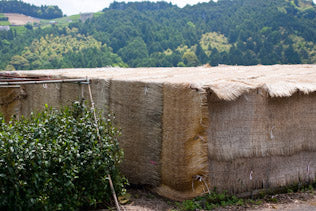
Traditional gyokuro tea plantation covered with straw
Historical background
Okabe Town, Fujieda City, Shizuoka Prefecture, is located northwest of Shizuoka City, with the clear Asahina River flowing north and south through the town and surrounded by mountains on both sides.
The Asahina district, located in the northern part of Okabe Town, has many sloping areas and the weather conditions unique to mountainous areas make it ideal for producing high-quality tea, and tea has been produced there since the Muromachi period.
Gyokuro production in Asahina began in the middle of the Meiji period, when tea fields were covered with straw at first. Gyokuro was invented by Kahei Yamamoto of Uji in 1835, so the history of Asahina Gyokuro can be said to be relatively new.
However, thanks to the tireless efforts of its farmers, it is now counted as one of Japan's three major gyokuro producing areas, alongside Uji in Kyoto and Yame in Fukuoka, and is known for its intense fragrance.
Origin and cultivation
The defining feature of Hon Gyokuro cultivation is undoubtedly the use of straw.
At first glance, the straw-covered tea plantations resemble the houses of Southeast Asia or those from the Jomon period. As explained in the introduction, when straw is used for covering, when it rains, the water drips down to the ground.
Straw refers to rice stalks, which contain a lot of minerals needed to grow rice.
The water that drips from the straw contains large amounts of ideal minerals, mainly iron, which gives the tea a very deep flavor and a strong lingering aftertaste.
HOJO also purchases Gyokuro from the same region that is covered in cheesecloth. Cheesecloth is a black plastic sheet.
That's why I was so surprised when I tried the straw-covered gyokuro.
When you drink the tea, you get the feeling that it is drawn smoothly down your throat, and that the aroma and sweetness lingers in your throat for a long time, which I think is something that only real Gyokuro can give you.

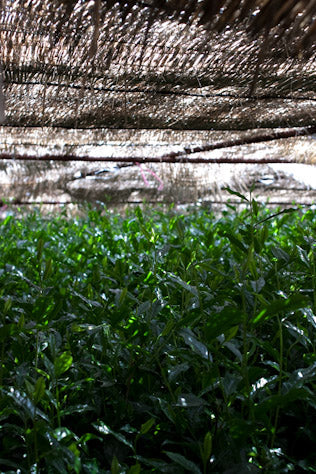
Gyokuro garden covered with straw

Cultivation of Gyokuro
In the cultivation of Gyokuro, the tea fields are covered with straw several dozen days before harvesting. The shading rate is 65-70% for the first 7-10 days, and 97-98% thereafter.
Theanine, a type of amino acid, is synthesized in the roots and transported to the stems and leaves.
In fact, when leaves absorb sunlight, some of the theanine is broken down and converted into catechin. Therefore, shading the leaves partially inhibits the synthesis of catechin, and the theanine content increases relatively.
In other words, the mellow flavor that is characteristic of Gyokuro is formed by shading the light.
In addition, the main component of Gyokuro's distinctive green seaweed-like aroma is a substance called dimethyl sulfide, and the precursor to this dimethyl sulfide, methylmethionine sulfonium, also accumulates in the tea leaves when they are shaded.
Then, due to the heat applied during the subsequent gyokuro manufacturing process, it decomposes and produces dimethyl sulfide.
And, as for the deep green color characteristic of Gyokuro, when the tea fields are covered, the tea leaves are unable to absorb enough light.
As a result, the tea leaves expand their surface area and produce more chlorophyll than usual for photosynthesis, which causes the gyokuro leaves to turn a deep green color.
Variety and Harvesting
Tea plantations that are covered with straw have a later harvest time, and the tea is usually picked in mid-May.
When tea fields are covered with cheesecloth (black sheets), the temperature of the field rises, which causes the tea to grow faster and the harvest time to come sooner.
In the Japanese tea market, the earlier the tea is harvested, the higher the price. This is an indirect cause of the decline in the production of hon-gyokuro tea and tea plantations located in high mountains, which are supposed to be delicious.
Tea fields covered with straw have a slightly later harvest time, and because it is more labor-intensive, the tea is carefully picked by hand.
When picking tea, it is common to pick one bud and two young buds, called one bud and two leaves, but this method of picking weakens the tea's aroma. In the case of Gyokuro, the tea is picked at one bud and three leaves. The third leaf has been on the tree for a long time, so it contains more concentrated ingredients.
This picking method is the same as for oolong tea and pu-erh tea. Basically, to make delicious tea, you need not only the young buds but also the third leaf.

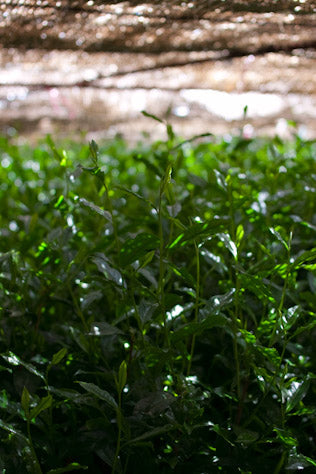
Gyokuro farm just before harvest

It is commonly believed that being covered makes the tea leaves darker in color, but in the case of Hon Gyokuro, there is not enough light, so the tea leaves turn a slightly yellow-green color.
Gyokuro manufacturing method (processing)
The manufacturing process for gyokuro is basically the same as for sencha, but compared to sencha, gyokuro tea leaves have a higher moisture content and a softer texture, so they must be handled with great care.
Raw materials
-Raw materials arrival-
The collected tea leaves are transported by each farmer to the tea processing factory. Clear traceability is established by managing each production unit by lot.
Steamed
Gyokuro leaves contain a lot of moisture and are very delicate, so they are steamed for a shorter time (about 20 seconds) than Sencha. By applying high-temperature steam evenly in a short time, the tea leaves have a smooth finish and do not get wet with condensation.
cooling
The tea leaves, which have become hot through steaming, are cooled and the moisture contained in the tea leaves is removed at the same time. By quickly removing the moist heat, secondary thermal deterioration is prevented.
Rough kneading
The tea leaves are dried efficiently by stirring them in hot air, and are then shaped by rolling them. After the rough rolling process, the rolling process (pressure application) continues until the fine rolling process, but because the tea leaves are fragile, less pressure is applied than when making Sencha.
Kneading
This is the only process that does not use heat. A circular motion is performed while applying pressure to the tea leaves, dispersing the moisture evenly. Frictional heat is generated by rolling the tea leaves, so the leaves are periodically kneaded to dissipate the heat.
Medium kneading
Using a rotary dryer, the tea leaves are gently kneaded while drying, uniformly distributing the moisture and twisting the leaves into smaller pieces.
Seiju (sperm massage)
The linear back and forth movements and circular sideways movements create needle-like strands. This process gives Gyokuro its unique luster and enhances its aroma and flavor. It is important that each strand is shiny black and firm.
Drying
After the rolling process, the tea leaves still contain moisture, so they are dried to reduce the moisture content to about 5%. Tea that has been dried in this way is called "aracha".
Pasteurization (only some Gyokuro)
After the rolling process, the tea leaves still contain moisture, so they are dried to reduce the moisture content to about 5%. Tea that has been dried in this way is called "aracha".
The purpose of the fire is twofold:
- The rough tea is dried to reduce its moisture content so that it can be stored.
- Heating the tea enhances its aroma and flavor.
Each tea company usually purchases rough tea leaves as raw material, and then roasts this tea in their own unique way to create their own original aroma and flavor.
By blending multiple original pasteurized teas created in this way, the tea company's original "finished tea" is completed.
However, gyokuro is rarely pasteurized in order to preserve its aroma.
Choose options