
Shifeng Longjing Tea 2024 50g
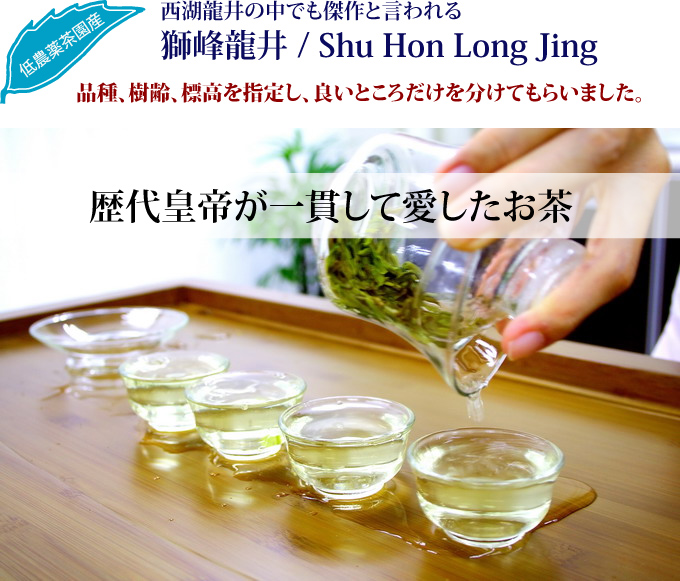
Shifeng Longjing tea is said to be a masterpiece among West Lake Longjing teas.
We specified the variety, age of the vine, and altitude, and were given only the best pieces to pick.
Would you like to experience the tea that has been loved by successive emperors?

This is the first harvest of tea from seedlings grown in Tatsui Village, which boasts an extremely high reputation both historically and for its quality.
Product Details
When it comes to Chinese green tea, the most famous is Longjing tea, characterized by its refreshing aroma and rich flavor.
The reason why Longjing tea became famous for its aroma is because its production area is close to the consumption area. Longjing tea is produced in Hangzhou city, Zhejiang province.
In addition to the city of Hangzhou, there are other major consumption areas nearby, such as Shanghai and, formerly, Nanjing, so Longjing tea has become so famous that there is no Chinese person who does not know about it.
There are many lesser known but very delicious teas in China, but in areas far from big cities, the tea doesn't become very well known.
For these reasons, Longjing tea, along with Biluochun tea from Suzhou, is one of the most famous teas in China.
Because it has become so famous, Longjing tea is now grown in areas other than the area around Longjing Village (Shifeng), and even outside of Hangzhou.
Recently, tea called Longjing tea has been produced outside of China, and Longjing tea from India as well as Taiwan is now in circulation.
In order to differentiate from these overseas Longjing teas, authentic Longjing teas are now called by the name of their place of origin. The most common Longjing tea is West Lake Longjing (Seikoronjin/Shifuronjin).
It is so named because its production areas are scattered around Lake Saiko.

The highest point of Shiho is about 300m above sea level. This is not a particularly high altitude, so the age of the tea trees is an important factor in determining the quality of the tea.

As you can see, even though it is simply called Longjing tea, there are actually many different types.
The most famous of the West Lake Longjing teas is Shifeng Longjing (Shiho tea), which we handle. If you actually go to the site and do some research, you will understand why Shifeng tea is so delicious.
The reasons for this are explained below.
Shifeng Mountain is the highest elevation among the West Lake Longjing tea producing areas.
Altitude is an important factor in producing high-quality tea. In tea plantations located at high altitudes, the temperature difference is so extreme that the ingredients in the tea leaves are not consumed but are concentrated within the tea leaves.
However, in terms of altitude, there are countless areas higher than Shifeng Mountain. It is possible that the Longjing tea made in lesser known, higher altitude mountains is more delicious than the original Shifeng Mountain.
Tea made from a mixture of varieties
On Shiho Mountain in Longjing Village, there are still mixed varieties that have been cultivated since the Qing Dynasty. Mixed varieties are equivalent to what we call "native varieties" in Japan.
It refers to the variety with the longest history, which is the tea planted by our ancestors and has remained to this day. On the other hand, the variety that is currently becoming the mainstream of Longjing tea is Longjing No. 43.
Just like in Japan, the earlier the tea is harvested, the higher the price. The great thing about Longjing No. 43 is that it can be harvested about 10 days earlier than traditional hybrids.
Farmers are naturally happy about this because they can sell it at a higher price. For this reason, Longjing 43 is now grown in many areas, and only a few tea plantations in Shifeng Mountain still have the mixed variety.
The fact that Longjing No. 43 tea leaves can be harvested early means that they grow quickly. This is not limited to tea, but for fruits and vegetables, the faster they grow, the lighter their flavor will be.
It's the same principle behind greenhouse-grown vegetables and fruits having a bland flavor.
The same can be said about Japanese tea, but the first teas that come onto the market are honestly not tasty. Furthermore, hybrid teas have extremely long roots and an overwhelmingly large surface area compared to new varieties such as Longjing No. 43.
The long, spreading roots are able to absorb more of the minerals that are most important for the quality of tea, which inevitably results in tea leaves that are superior in quality, especially in terms of depth of flavor and richness of aftertaste.

Mr. and Mrs. Kim, the tea farmers who produce HOJO's Longjing tea

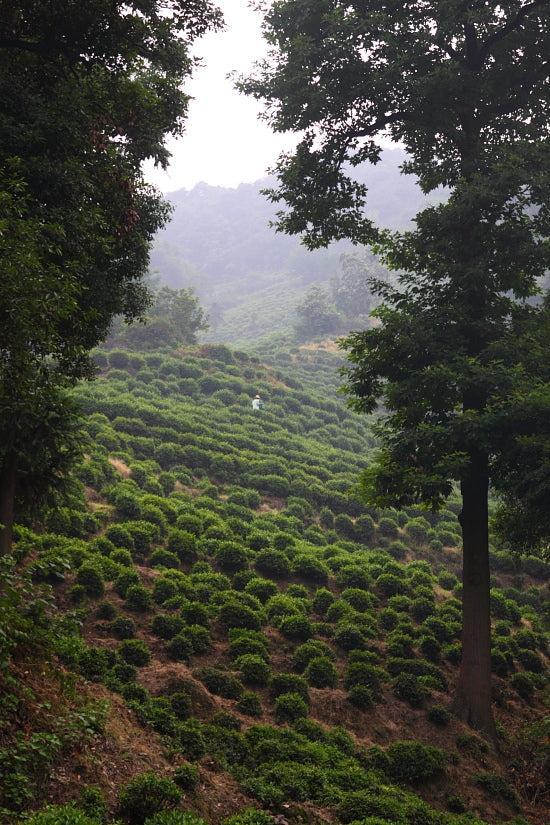
The tea plantations in Shiho are very rocky, and most of the tea plantations are built on stone walls.
Old trees that still remain
Lion Peak Mountain is the oldest place where Longjing tea has been grown, and there are trees that are over 100 years old. Old trees have different root systems compared to younger trees.
Let me explain using the analogy of a plant.
One-year-old trees can be easily pulled out by hand, but 50-year-old trees cannot be uprooted without heavy machinery.
This is because the older the tree, the more deeply rooted it is, which means that it has a greater ability to absorb minerals.
The above three conditions are the important factors for us when choosing Shifeng Longjing.
Not all tea plantations in Shifengshan meet the above criteria. The tea plantations we deal with also have tea plantations at lower altitudes, including the Longjing No. 43 tea plantation.
By communicating our requests in detail to producers, we are able to allow them to select the products based on the quality we desire.
At HOJO, we don't care about the name, but rather pursue the essential quality, and as a result, we choose the first-picked teas of Shifeng Longjing and mixed varieties.
This tea is very expensive, but it is unavoidable due to the above mentioned conditions.
In fact, because the name Shifeng Longjing is more well-known in Chinese cities, it is sold at a higher price, and we feel that our prices are actually lower than the selling prices in China and Hong Kong.
Furthermore, even if it is the same Shihoshan tea, the second and third grade teas are very cheap. The difference is obvious when you compare the size and shape of the tea leaves.
From the second tea onwards, the depth of the taste and aroma becomes noticeably shallower. As for the third tea, although the aroma is strong, the taste is flat and lacks depth.

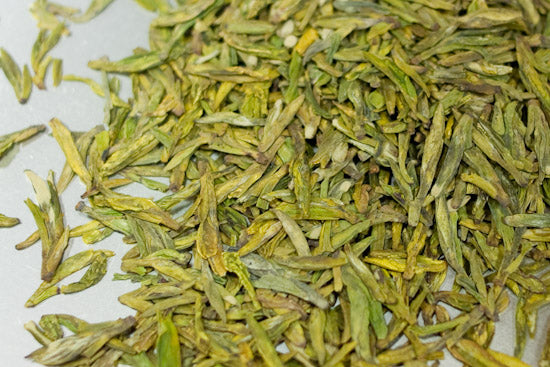
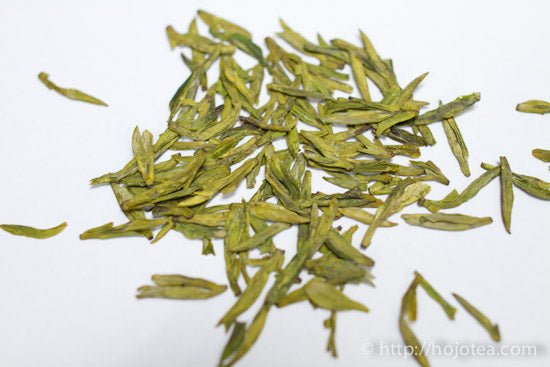
Before packing into bags, we manually select small quantities of tea to ensure there are no foreign objects. The tea leaves of Shifeng Longjing Tea are characterized by their slightly yellowish color.
Tea leaves that are a very vivid green color are either produced in other regions or are second or third harvest tea.

You can see that the size of the tea leaves is very small when you compare it to the size of my hand. I bought tea without worrying about the price, and as a result, I was able to get a product of very satisfactory quality. I really wish the price was a little cheaper.

High quality Longjing tea contains white lumps that look like fluffy balls. Customers who see these may mistake them for spider webs, mold, or other foreign objects. These fluffy white objects are the "fuzz" that grows on the young buds and turn into fluffy balls when rolled. Please rest assured that these fluffy balls are a sign of quality in a way.
Below we will introduce Longjing tea.
Historical and cultural background
Longjing tea is a well-known tea in China throughout history. Its production records date back as far as 1500 years ago, and its name appears in the Tea Classic, written by Lu Yu during the Song Dynasty.
Long ago, before it was called Longjing tea, the names derived from the mountains were commonly used, such as Xiang-lin-cha, Bai-yun-cha, and Bao-yun-cha.
During the Yuan and Ming dynasties, Longjing tea became extremely popular, and was eventually given the name "Longjing" during the Song dynasty.
When Emperor Qianlong visited Shifeng Mountain during the Qing Dynasty, he was served Longjing tea and was impressed by its beautiful appearance, elegant aroma and mellow taste.
When Qianlong was accompanied by a monk to a tea field, he found 18 Longjing tea trees planted there. While Qianlong was enjoying picking tea, he received a message that his mother had fallen ill and that he should return to the capital immediately.
When Qianlong returned to the palace, he noticed an indescribable fragrance in the tea leaves in his pocket, so he brewed tea with the leaves and gave it to his mother, who then completely recovered from her illness.
Qianlong was so pleased that he designated 18 tea trees as imperial teas, and from then on, Longjing was firmly established as the tea presented to the emperor.
Today, those 18 tea trees remain on Shifeng Mountain. To date, Longjing has dominated the top ten Chinese teas.
It is also known as the "national tea" of China and is always used as the tea to entertain important people from abroad. Today, it has established itself as the queen of green teas.
Production area
The original Longjing tea comes from Longjing Village on the shores of West Lake. Historically, Longjing tea was produced in Shi-feng Mountain, Mei-jia-Wu, Weng-jia Mountain, Yun-qi and Hu-pao.
Today, the production areas are classified into Shi, Mei, Xihu and Zhejiang Longjing teas from other areas.

A traditional mixed tea plantation

Cultivars and Harvesting
Longjing tea varieties are broadly divided into two types: "Longjing No. 43" and "mixed varieties," which are what we call indigenous varieties in Japan, in other words, varieties that have been growing in the fields for a long time.
The germination season of Longjing No. 43 occurs 7 to 10 days earlier than other teas. In China, the earlier Longjing tea is shipped, the higher the price it commands, so Longjing No. 43, which germinates earlier than other tea leaves, is highly valued by tea farmers.
I'm embarrassed to admit it, but when our company was first founded, we also chased Longjing No. 43.
Later, as we gained more knowledge about tea, we realized our mistake. No. 43 is a variety that was developed through recent selective breeding.
For this reason, the tea plants are young and have short roots. Furthermore, because the period until they grow is shorter than that of mixed varieties, the ingredients in the tea leaves are weaker, resulting in an inferior taste and aftertaste.
Many of the mixed species were planted during the Qing Dynasty and remain in the tea plantations. These trees are very old and have very deep roots, so there is a huge difference in quality when comparing the different varieties.

Grade and bud length
In spring, tea leaves are hand-picked, one bud and one leaf or one bud and two leaves. The best grade is when the buds are 2.5 to 3.0 cm long.
Tea made from buds harvested before Qingming (April 4th-5th) is called Ming-qian Cha, and is said to produce the highest quality Longjing tea.
Later, the Longjing tea harvested before the Guyui rain was called Yu-qian Cha, and its quality was second only to that before the Ming rain.
Even an experienced farmer can only harvest 1.0-1.5 kg of buds per day. 1 kg contains 120,000 young buds.
Processing: The craftsmen's hands become red and swollen
The manufacturing process of Shifeng Longjing tea involves the following steps:
Withering
After plucking, the tea leaves are moved to a cool room indoors. On a sunny spring day, the leaves are spread out in a thin layer of 3-5cm and left to sit for 6-12 hours without stirring or turning.
This withering process gradually evaporates the water and reduces the moisture content of the tea leaves by 70%, removing the grassy aroma of the tea leaves, reducing the bitterness and astringency, and increasing the proportion of sweetness (amino acids) per weight.
Sasao (heat deactivates enzymes and shapes tea leaves)
The first purpose of roasting the tea leaves in a pot is to inactivate the oxidizing enzymes through heat and to shape the tea leaves into the characteristic shape of Longjing tea. At high temperatures, the tea leaves are heated in a very short time and the enzymes are inactivated.
When the temperature of the kettle reaches 80-100℃, 100g of tea leaves are placed in the kettle and roasted by hand. At first, the leaves are picked up and slowly dropped from a height of about 10cm while shaking.
This process is done to efficiently remove moisture from the tea leaves. The tea leaves are roasted for 3 to 4 minutes to soften them. The next step is to press the tea leaves into the pot with your hands, occasionally lifting them up and letting them fall apart. After that, the pressure is gradually increased.
These steps play an important role in shaping the tea leaves. The leaves are molded into a long, thin, flat shape. A skilled craftsman has a good understanding of the timing and pressure of each step.
Improper movements or applying pressure too early can cause the tea leaves to turn black. If the pressure is insufficient or the pressure is applied too late, the tea leaves will dry out before they can form their shape, and they will not achieve the characteristic Longjing shape.
After roasting the tea leaves for 12 to 15 minutes, when the moisture content is 20 to 30%, the leaves are removed from the kettle.
cooling
The dried tea leaves are spread out in a 15-20cm layer and cooled for 40-60 minutes. During this time, the tea leaves absorb moisture again and become soft. This phenomenon is called "re-chio".
After cooling is complete, the softened tea leaves are sorted to remove all broken leaves, irregular leaves and non-standard leaves.
After sorting, the tea leaves are passed through a 0.7cm x 0.7cm sieve to be sorted based on size.
Second heating
The second roasting process is to shape the tea leaves and dry them. After the first sorting, 250g of tea leaves (4-5 times) are collected and put into the pot.
The initial temperature is 60-80°C, and the tea leaves are heated until the heat is transferred to the tea leaves and the hairs become visible.The temperature is then increased to 80-90°C and the tea is roasted continuously.When the hairs stick to the leaves and the leaves become flat and smooth, the temperature is reduced to 50°C.
The roasting process is carried out in the same manner as the initial drying step, with various movements and gradually increasing pressure. The roasting process is completed in a total of 25 minutes, when the beans become crispy and give off a pleasant aroma.
Chinese green tea is the favorite of 1.3 billion Chinese people. Why not experience the best of it?
Choose options