
Tsukigase Native-Seed Sencha 100g
Umami does not equal delicious
The mainstream of Japanese tea today is tea rich in umami compounds. The substance behind umami is an amino acid called theanine, but umami is not the same thing as deliciousness. Umami refers to the taste typified by monosodium glutamate, the stuff of instant dashi stock.
To increase the amino acid content of tea leaves, nitrogen fertilizer must be applied. In a fertilized garden the tea bushes grow vigorously, but in exchange the amounts of catechins and other polyphenols, as well as minerals, decrease.
Tea high in theanine also has less depth of flavor (body and finish), so as a taste it comes across as light and plain.
Strong body is the hallmark of HOJO's Japanese teas
At HOJO we select tea with an emphasis on body, choosing teas rich not in theanine but in catechins and minerals.
Mineral-rich tea means tea grown with no fertilizer or only limited fertilizer, such as natural-farming tea. Enjoy the sweet aftertaste that lingers in the throat after each sip.
Do you know the sensation of tea being drawn down into your chest?
Tsukigase Native-Seed Sencha is a naturally farmed tea harvested in Tsukigase, Nara Prefecture. HOJO reserves a tea garden exclusively for its own tea and purchases a custom-made, original Sencha.
Although a Japanese tea, it has a deep throat feel, with a depth of flavor reminiscent of a fine Chinese tea.
It slips smoothly down as if drawn into the throat, with a sensation almost of settling into the chest. The moment you swallow this tea, you will be surprised at how completely different it is from ordinary tea.
This is precisely the sensation characteristic of the premium teas that win prizes at competitions in China.
Because it is rich in minerals, drinking it warms the body and relaxes you from the inside.
A depth of flavor to rival prize-winning teas at Chinese tea competitions

This is a Japanese tea with an astonishingly deep throat feel on the level of Phoenix Dancong Oolong, something unthinkable by the usual standards of Japanese tea.

A Phoenix Dancong Oolong garden: for Tsukigase Native-Seed Sencha to hold its own against tea from old trees like these is remarkable
The moment you swallow, you will be surprised by a sensation completely unlike ordinary tea.
This is a tea that lets you feel it slide smoothly down as if drawn into the throat, almost as if settling into the chest.
This sensation is precisely the mark of high-quality raw leaf. High-quality teas in China share the same characteristic.
Put simply, the definition of a good tea is that it tastes "concentrated." Concentrated means having body, a flavor you can clearly feel at the back of the throat.
Brew a cheap tea strong with a large amount of leaf and the astringency and bitterness increase, but it does not become "concentrated."
Tsukigase Native-Seed Sencha has concentration in this sense. Even brewed with a tiny amount of leaf, the water itself takes on a concentrated taste, giving a deep sense of satisfaction.
Tsukigase Native-Seed Sencha also has none of the amino-acid aroma so common in recent Japanese teas; its fragrance is so clean and refreshing you might mistake it for an Oolong.
It is an ideal tea for Oolong lovers, too.
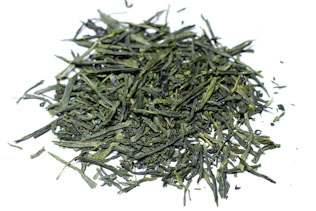
In appearance, Tsukigase Native-Seed Sencha has rather large leaves and cannot honestly be called beautiful.
But tea is something to be enjoyed by drinking; try it even once and I suspect you will become a devoted fan. I certainly did.
Worried that tea will keep you awake at night?
With Tsukigase Native-Seed Sencha that is not a concern. Quite the opposite: it is the perfect tea for anyone seeking deep sleep.
Drink a mineral-rich tea, that is, what the overseas tea market calls a "premium tea," and your body grows warm and you actually become drowsy.
It is common knowledge that tea contains caffeine and that drinking too much can keep you awake.
As quality rises, however, the mineral content increases, and the resulting improvement in circulation makes you sleepy instead.
Because Tsukigase Native-Seed Sencha is so rich in minerals, it can even bring on a mild "tea tipsiness," relaxing you from within much like a fine brandy, whisky, or wine.
This is not a matter of mind over matter: keep drinking and your face flushes and a soft, mellow feeling comes over you.
Tea grown on the ancient bed of Lake Biwa
Tsukigase Native-Seed Sencha is made in a place called Tsukigase, in Nara City, Nara Prefecture.
Tsukigase has been known as a tea-producing area since ancient times, shipping its tea to Kyoto via the Nabari River (the Yodo River downstream).
For this reason, until origin labeling became mandatory quite recently, it was distributed as Uji tea. Tsukigase lies right on the border of Nara Prefecture, with Mie, Shiga, and Kyoto Prefectures immediately adjacent.
Land that was originally the bed of Lake Biwa was uplifted, and subsequent erosion by the Nabari River formed the river terraces characteristic of Tsukigase.
Perhaps because it was once the lakebed, Tsukigase has fine-grained red clay of exceptionally high quality.
This red clay is not found everywhere in Tsukigase, however; only gardens near the tops of the hills, where erosion has not reached, have this soil.
Naturally, HOJO's Tsukigase Sencha is grown in a spot where this red clay is abundant. Conversely, land formed by river erosion contains a lot of sand and produces an ordinary Japanese tea with no throat feel.
The diagram below illustrates why the red clay layer exists only at higher elevations. River erosion washes soil down from the hills, leaving the red clay layer in only a limited number of places.

Tsukigase Native-Seed Sencha, an exceptionally rare "Yamato tea"
As the name suggests, Tsukigase Native-Seed Sencha is made from so-called zairai, or "native," tea. The term is often taken to mean an indigenous or original species that has existed in Japan since ancient times, but strictly it means tea grown from seed (seedling tea).
Seed-grown tea has roots that extend straight down, so the total root length is greater than that of cultivar tea.
For this reason it absorbs minerals more effectively than typical cultivars, producing a tea with more thickness in its taste and aroma. (Thickness of taste does not mean bitterness or astringency, but richness of flavor, that is, depth of finish.)
Because so-called native tea is grown from seed, complex cross-pollination means that even within a single garden you find every possible leaf shape, size, color, aroma, and taste from A to Z.
In China, too, most high-quality teas are made from seed-grown bushes, sometimes referred to as mixed-variety tea. Even the famous Longjing, at its highest grades, is made from mixed-variety plants.
Tea grown by natural farming
Furthermore, the farm I buy from practices natural farming.
The virtue of natural farming is that no artificial fertilizer is applied; cultivation relies on recycling undergrowth and grasses gathered from the surrounding hills, so minerals are replenished but no nitrogen fertilizer is given.
As a result the tea grows in a state close to a wild plant, slowly and over time, producing dense cells and a deeply flavored tea.

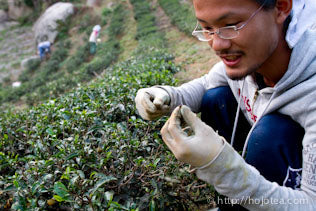
Even pest removal is done by hand: picking bagworms off the tea leaves

Natural fertilizer, too: pampas grass and reeds piled up to be used as fertilizer
Moreover, thanks to the extraordinary dedication of the farmer, the garden HOJO selected is cultivated in a highly unusual way.
Normally, a typical tea farmer prunes the bushes hard in the off-season.
Hard-pruned branches become thick like straws and, to draw up fertilizer vigorously, they grow with great force when spring comes.
In a sense, though, this is an unnatural way of growing: because the leaves shoot up so fast, yields increase, but the finished tea is thin in taste and light in aroma.
HOJO's supplier farm uses a cultivation method with only the lightest pruning, keeping the garden in an optimal state with just the right amount of human intervention.
Because of this method, the tea leaves are very small, and their cells are so dense that when you handle them you can feel the firm, strong core of the leaf.
Yields, however, drop dramatically, so only farmers with a real conviction adopt this approach.

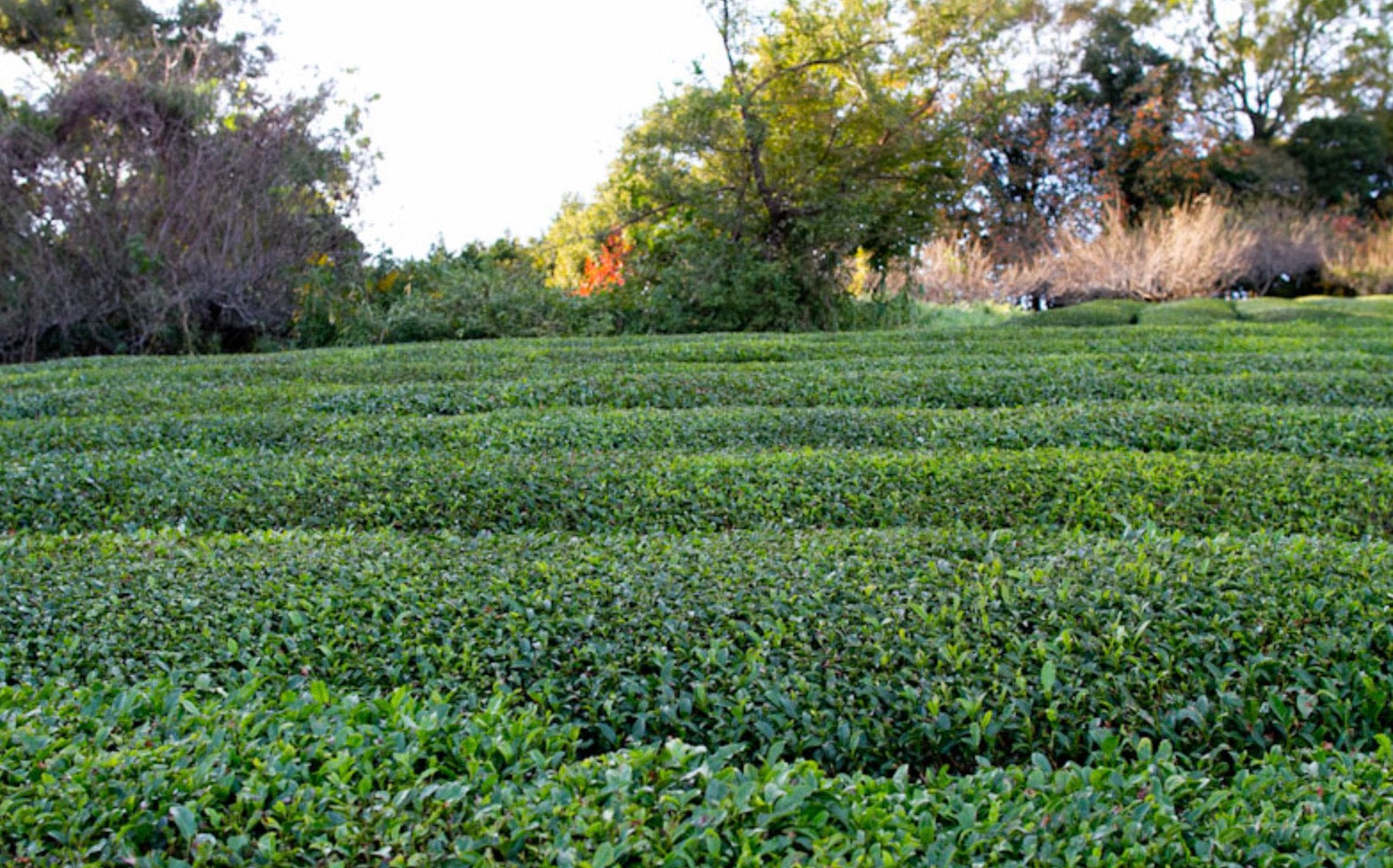
Semi-natural cultivation: even in autumn, the leaves are uniform in size and full of vigor

Conventional cultivation: leaf sizes vary and the leaves lack vigor
Watch the video below to learn in detail about the soil that produces Tsukigase's finest tea and how the tea is made.
A tea garden reserved exclusively for HOJO
To secure tea that meets all of the conditions above, HOJO takes the rather extravagant approach of evaluating the farmer's tea garden by garden and taking only the tea from specific hillside gardens.
In a sense it is like being served only the fattiest cut of the tuna, and we are humbled by it. We are deeply grateful to the farmer for granting us this privilege.
Choose options