
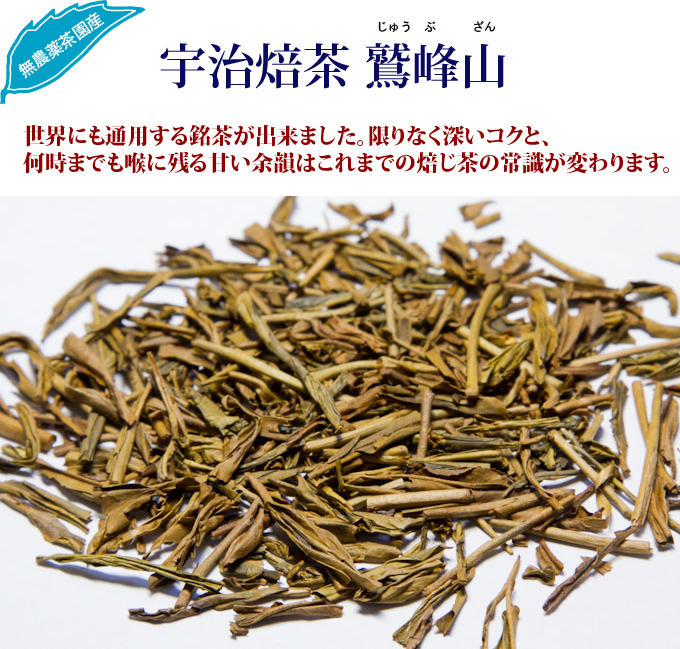
Uji roasted tea, Mount Juho 100g
Umami does not mean delicious
The mainstream of Japanese tea today is tea that contains a lot of umami ingredients. The main component of umami is an amino acid called theanine, but umami does not necessarily mean delicious. Umami refers to the taste represented by monosodium glutamate, which is used in soup stock.
Nitrogen fertilizer is necessary to increase the amount of amino acids contained in tea leaves. In tea fields where nitrogen fertilizer is applied, tea plants grow vigorously, but on the other hand, the amount of polyphenols and minerals, including catechins, decreases.
In addition, tea that contains a lot of theanine has a weaker depth of flavor (richness and aftertaste), making the tea taste lighter.
The strong flavor of HOJO Japanese tea is its defining feature.
At HOJO, we select teas that emphasize the richness of the tea, and we choose teas that are rich in catechins and minerals, rather than theanine. Teas that are rich in minerals are teas that are grown naturally without fertilizer or with limited fertilizer.
Enjoy the sweet aftertaste that lingers in your throat when you drink the tea.
Producing roasted tea with a deep, lingering aftertaste that rivals the world's finest teas
Uji Hocha Juhozan is a roasted tea made from naturally grown first-pickle tea grown on Mount Juho in Wazuka Town, Kyoto Prefecture.
Wazuka Town, along with Ujitawara Town, Minamiyamashiro Village, Kasagi Town, Tsukigase, and Asamiya, has long been known as a producer of high-quality Uji tea.
The infinitely deep flavor and lingering sweet aftertaste will change the perception of roasted green tea. Enjoy HOJO roasted green tea that rivals the world's finest teas.
Product Details
We have produced a roasted tea with a rich flavor and a very long lingering aroma. This roasted tea is made to order using naturally grown first-pickle tea leaves.
If you drink it, you'll definitely become addicted.
We have created a roasted tea of a level that will satisfy even those who drink high-quality Chinese tea. The infinitely deep flavor and the sweet aftertaste that lingers in your throat will change the perception of roasted tea up to now.
It's a quality that makes you want to brag about yourself.
I wanted to create an ultra-high quality roasted green tea like no other I had ever tasted before, one that would win a gold medal at a tea competition in China.
High quality tea has a deep flavor. This depth makes the tea feel soft and leaves a sweet aftertaste that lasts forever.
The most important thing to achieve this flavor is the selection of ingredients. The one we chose this time is Uji Sencha called Jubozan, sold by HOJO.
This tea has a particularly deep taste out of the HOJO lineup, and the quality of the ingredients is outstanding, so we decided to use this sencha as is as an ingredient in roasted green tea.
When tea leaves are grown slowly over time without any fertilizer, they contain a lot of polyphenols and iron. The difference is obvious just by smelling the raw tea leaves. Even people who are not familiar with tea can tell at a glance that the depth of the aroma and the strength of the flavor are completely different.
We also paid special attention to the roasting method.
The raw material, sencha, is roasted using a traditional roasting method called sand roasting. Sand has a large surface area, and the heat is transmitted to every corner of the tea leaves, allowing the tea to be roasted evenly.
A fragrant, sweet aroma like high-quality oolong tea.
I've had close to 10 people try it so far, and the majority of them have said, "This isn't roasted green tea."
It doesn't taste like roasted green tea at all. It has a sweet aroma like high-quality oolong tea, an unimaginable smoothness, a deep throat feel, and a long-lasting sweet aftertaste.
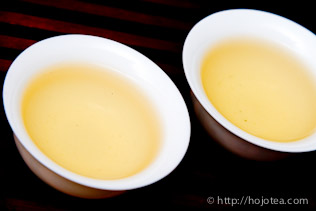
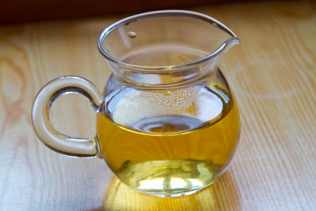
The brewed tea is golden brown and has the taste and aroma of high quality oolong tea rather than roasted green tea.

It has a glossy amber color, and the moment you smell it you can imagine the quality of this tea.

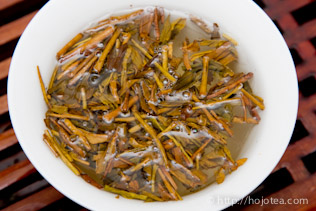
Try touching the used tea leaves after brewing. They are soft and elastic, which is beyond imagination from their appearance.
Feel the difference in quality with the water.
The higher the quality of tea, the more iron it contains, so high quality tea changes the very properties of the water.
This iron dissolves in the tea, making the water very soft and viscous. The properties of this water are similar to that of biological water, which also contains iron, and the water consumed as high-quality tea is easier for the body to use than regular water.
Uji Hocha Jufusan dramatically changes the properties of the water. Just a little sip will give you a pleasant tea intoxication.

It has a color more similar to oolong tea than roasted green tea.

Because it is high quality roasted green tea, it is best enjoyed in a small teacup.
This product uses Uji Sencha itself as the raw material. Unlike Hojicha, which is made using stems and bancha tea, the raw material itself is expensive.
Furthermore, when making Hojicha, some weight loss is unavoidable due to the additional roasting required during processing. Therefore, the weight loss is reflected in the cost, making it a little more expensive than Sencha.
Below is a description of the Uji Sencha Juhozan used as an ingredient.
To achieve a deep, intense taste and a sweet aftertaste, we are committed to natural cultivation without fertilizer.
Mount Juho is a 682m high mountain located between Ujitawara Town and Wazuka Town. This area was once the bottom of Lake Biwa long ago, so the area is rich in red clay soil.
In sourcing this tea, in addition to the ideal environment of Mount Juho, we chose to use naturally grown tea leaves. Natural cultivation means that the tea is grown without fertilizer or pesticides, and is grown slowly and carefully, like the wild vegetables that bloom in the mountains, to grow hardy and wild.
In modern agriculture, fertilizer is essential for tea production.
However, tea that is soaked in fertilizer will continue to grow excessively and accumulate large amounts of amino acids, but the polyphenols and minerals that are biological regulators and elements of deliciousness and quality will be very diluted, resulting in a bland tea.
Most Japanese teas on the market have an extremely weak flavor due to an excess of amino acids, so they are roasted excessively to bring out the aroma and enhance the tea's individuality. However, good tea is something that you can be impressed with just by eating the raw tea leaves.
"Tea rich in theanine," which is often cited in books as a synonym for good tea, is, in other words, tea that has been soaked in nitrogen fertilizer, which, in my definition, is the opposite of tasty tea.
The words alone are not very persuasive, but if you actually taste the raw leaves at the tea farm, the difference is obvious. When we were considering new products for this year, we were extremely particular about the selection of raw materials, even before discussing how to process them.
By obtaining high-quality ingredients, we have been able to produce delicious tea with little to no pasteurization, which is the norm in the Japanese tea industry.
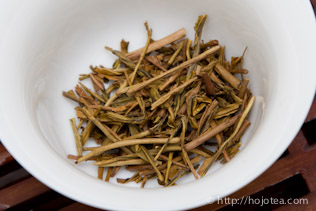
The stems are intentionally not removed to preserve the tea's natural aroma.
In the case of Japanese tea, the stems are yellow in color, making them stand out.
In modern tea manufacturing, the common sense is to always remove the stems. By removing the stems, the tea leaves become beautiful green, so in the Japanese tea industry, where appearance is important, removing the stems is the most basic of basics.
However, at HOJO, we do not remove the stems. Through numerous experiments, we have realized that the presence of the stems is very important. The stems are rich in minerals and have a very sweet aroma.
As anyone who has tried Kanegone kukicha knows, kukicha is very sweet!
However, one cup (3-5g) contains about 10 stems. Will this amount of stems really affect the way the tea tastes?
To determine whether or not the stems were present, we compared the taste of tea whose stems had been removed by hand (with tweezers) with tea whose stems had not been removed at all.
The result was that the aroma was so different that even I was surprised. Everyone who tried it said the one with the stems was tastier.
The tea that had the stems removed had a sharper aroma and the sweet, soft floral scent was dramatically weakened. As an aside, in the old days, it was said that tea leaves standing up were auspicious.
However, modern tea does not contain the stems that form the tea sticks. In other words, no matter what you do, the tea sticks will not stand up. In the past, people knew how delicious the stems were, and it was customary to drink tea with the stems in it.
Nowadays, the world is so focused on appearance that people are removing the stems even at the expense of aroma and flavor.
This tea is grown at an altitude of 600m, which is extremely rare for Uji tea.
The tea plantations are located at high altitudes where snow accumulates in winter. This area was originally the bottom of Lake Biwa, so high-quality red soil has accumulated at higher altitudes, producing tea with a rich iron content and a deep, smooth finish. On the other hand, at the foot of the mountain, the terrain was eroded by rivers, so it contains a lot of sand and produces tea with a weaker flavor.
At higher altitudes, the tea cells receive stronger sunlight during the day and photosynthesize more actively. On the other hand, at night, the temperature drops so low that the tea does not grow and instead stores plenty of polyphenols and minerals.
Highland vegetables have a strong flavor and are delicious. The same goes for tea. Tea made at high altitudes has a strong flavor and a deep throat feel.
We source tea from completely natural farms to provide tea with a sweet aftertaste.
The moment you sip the tea, you will be surprised at how different it feels from regular tea.
The tea flows deep into your throat, as if it is being sucked into your chest, and then you feel a very pleasant sweetness from the base of your throat to the back of your throat.
This is the feeling that is unique to high-quality tea that has won awards at tea tastings in China. Normally, this product would be priced extremely high overseas, but thanks to Japan's quality standards being isolated from the rest of the world, I was able to get it at a very reasonable price.
The simple definition of good tea is that it has a strong flavor. Strong means that it has a full-bodied flavor and you can taste it deep in your throat.
Even if you brew cheap tea using a lot of tea leaves to make it strong, it will have a strong astringent and bitter taste, but it will not be "strong." Uji Sencha Juhozan is a tea that is strong by this definition. Even if you brew tea with a small amount of tea leaves, the taste of the water itself will be strong, so you will feel a deep sense of satisfaction. It's the same as saying that high-quality kelp only needs to be soaked in water.
Of course, if you put a single leaf of this tea in miso soup, you can make a miso soup with a deep flavor just like clam miso soup. Of course, it won't have the scent of clams.
High-quality tea is delicious even when you hold your nose. Good tea has a soft, deep flavor, so it tastes good even without any aroma.
Try putting just one tea leaf into orange juice, beer, yogurt, Coca-Cola, or coffee. Just give it a try, even if you think you might be tricked! You will experience a dramatic change in taste that is beyond common sense.
These mysterious properties are due to the fact that the tea leaf cells are very fine and release a large amount of minerals, especially iron ions.
This tea does not have the amino acid aroma that is common in recent Japanese teas, and has such a clean, refreshing aroma that you would think it was oolong tea. This tea is perfect for those who like oolong tea.
In search of golden tea gardens
Blind spots of organic farming
The idea that organic food is healthy and delicious is widespread in society.
It is true that organic farming is safer in terms of pesticides, but that does not mean that food is "delicious" or "good for your health."
If you want to produce delicious vegetables, fruits, and teas, it is important to allow the plants to grow slowly and produce leaves with a high cell density, which will be rich in polyphenols and minerals and give them a deep, full-bodied sweetness.
I have tried many organic teas, and most of them are of similar quality to regular tea, so much so that you wouldn't know they were organic unless you were told.
This is largely related to the fertilizer used and the way tea is grown. Even if it is organic fertilizer, if you use nitrogen fertilizer such as compost, the effect on the plants will be the same as if you use chemical fertilizer such as nitrate.
When nitrogen is applied, plants grow vigorously because the nitrogen input switches on growth.
It is a vigorously growing plant, but in fact, the cells themselves are growing larger. Tea leaves in the growing process do not produce polyphenols, and therefore the tea has less minerals.
They are so busy synthesizing cell walls necessary for their own growth that they don't have time to synthesize polyphenols.
Tea leaves made up of large cells are prone to breaking and powdering.
My parents are apple farmers, and when they use nitrogen fertilizer, the apple leaves turn a deep green, increase in size, and the apples grow larger.
However, when you eat the apples, it's obvious. They have no rich flavor, are watery, and not tasty. Regardless of whether they are organic or inorganic, I believe it is important to grow tea slowly, taking the time to grow it in a way that is close to natural mountain plants.
When tea is grown over a long period of time in harsh environments, the hardships it endures can be felt in its quality.

A tea tree next to an animal manure pile. It has huge, dark green leaves that make it hard to believe it is a tea tree. The tea made from such a tea tree has a weak flavor and is almost dull.
Deep Cut
The deeper the tea plant is pruned, the more vigorously it will produce tea leaves the following year.
"Vigorously" basically means that the cells that make up the tea leaves get larger, resulting in tea with a weak mineral content.
This is not just true for Japanese tea, but for all types of tea, pruned tea is suited to mass production, while tea that requires quality is generally left largely untouched and allowed to grow slowly over time.
The above two are very common practices in famous tea producing areas such as Shizuoka and Kagoshima. Applying nitrogen and deep pruning accelerates growth, increases the size of the tea leaves, and increases production.
Don't you think that high quality means low production and rarity? It's too convenient to say that there is a large production volume and the quality is high.
To reiterate, whether it's highland vegetables, delicious apples, or high-quality melons, if you want great taste, you need to grow them slowly over time.This will reduce production, but it will increase the density of cells that make up the vegetables and fruits, resulting in foods with a strong flavor.
This is not limited to vegetables; the same can be said when comparing farmed fish, which grow in a short period of time, with wild fish, which grow slowly over a long period of time.

Pruned tea leaves will produce young shoots vigorously, producing large, green tea leaves in large quantities.
The more you drink this tea the more sleepy you become
This is not an issue with Uji Sencha Jufusan. Quite the opposite: it's the perfect tea for those looking for a deep sleep.
When you drink tea that is high in minerals, in other words what is called "high-quality tea" in the overseas tea market, your body will feel warm and, in turn, you will feel sleepy.
It is commonly known that drinking too much tea will keep you awake because it contains caffeine. However, as the quality of the tea improves, the amount of minerals increases, which in turn improves blood circulation, making you feel sleepy.
In the case of Uji Sencha Juhozan, the tea is rich in minerals, so it can cause a slight tea intoxication, relaxing you from the inside out, just like drinking high-quality brandy, whiskey, or wine.
This is not a spiritual thing; if you continue to drink it, your face will turn red and you will feel light and warm.
Japanese law does not permit the specification of efficacy, so I cannot go into detail, but foods that improve blood circulation not only have a relaxing effect, but also contribute to good digestion and better sleep.
Try it out and experience it for yourself.
About Mount Juho
Uji tea Juhosan is made from Mt. Juho in Wazuka Town, Kyoto Prefecture.
Wazuka Town, along with Ujitawara Town, Minamiyamashiro Village, Kasagi Town, Tsukigase, and Asamiya, has long been known as a producer of high-quality Uji tea.
Originally, the land that was the bottom of Lake Biwa rose up, and then the river terraces unique to Tsukigase were formed by erosion by the Nabari River.
Perhaps because these areas were once the bottom of Lake Biwa, they have fine-grained, extremely high-quality red soil.
However, red soil is not found everywhere in the Nabari River basin; it is only found in tea plantations located near the tops of mountains that have not been eroded.
On the other hand, land that has been eroded by rivers contains a lot of sand, which results in typical Japanese tea that has a dull taste.

Around Mount Juho: This area is covered with red clay soil that is very rich in iron.

Uji Tea Village: The unique environment of the mountains and valleys creates a large difference in temperature between day and night, which helps to grow high-quality tea.

This tea is made from a precious native variety of sencha.
Uji Sencha Jufusan is made from a native species of tea.
The term "native species" is often taken to mean endemic or original species that have existed in Japan since ancient times, but more accurately it refers to tea that has the characteristics of traditional tea handed down from China.
Native species are closer to the wild species, so their roots are stronger than varieties such as Yabukita, and their total root length is longer than other varieties of the same age.
For this reason, compared to other varieties, it produces tea with a higher mineral absorption capacity and a fuller flavor and aroma. (Flesh does not mean bitterness or astringency, but rather richness of flavor, that is, a deep aftertaste.)
Landrace varieties are teas made from seeds, and through complex hybridization, a variety of leaf shapes, sizes, colors, aromas, and flavors from A to Z can be seen even on the same tea plantation.
In China, high-quality tea is often made from indigenous species and is generally called a mixed species. The famous Longjing tea, for example, is made from a mixed species when it becomes a high-quality product.
The video below introduces tea making in Tsukigase.
Like Wazuka Town, Tsukigase was originally the bottom of Lake Biwa, and the soil quality and growing environment are exactly the same.
This tea is made by lightly pruning only the tips of the tea stalks, making each branch as thin as a toothpick, and managing the tea so that it does not absorb fertilizer. By making tea in this way, yellow tea leaves are produced.
Choose options